
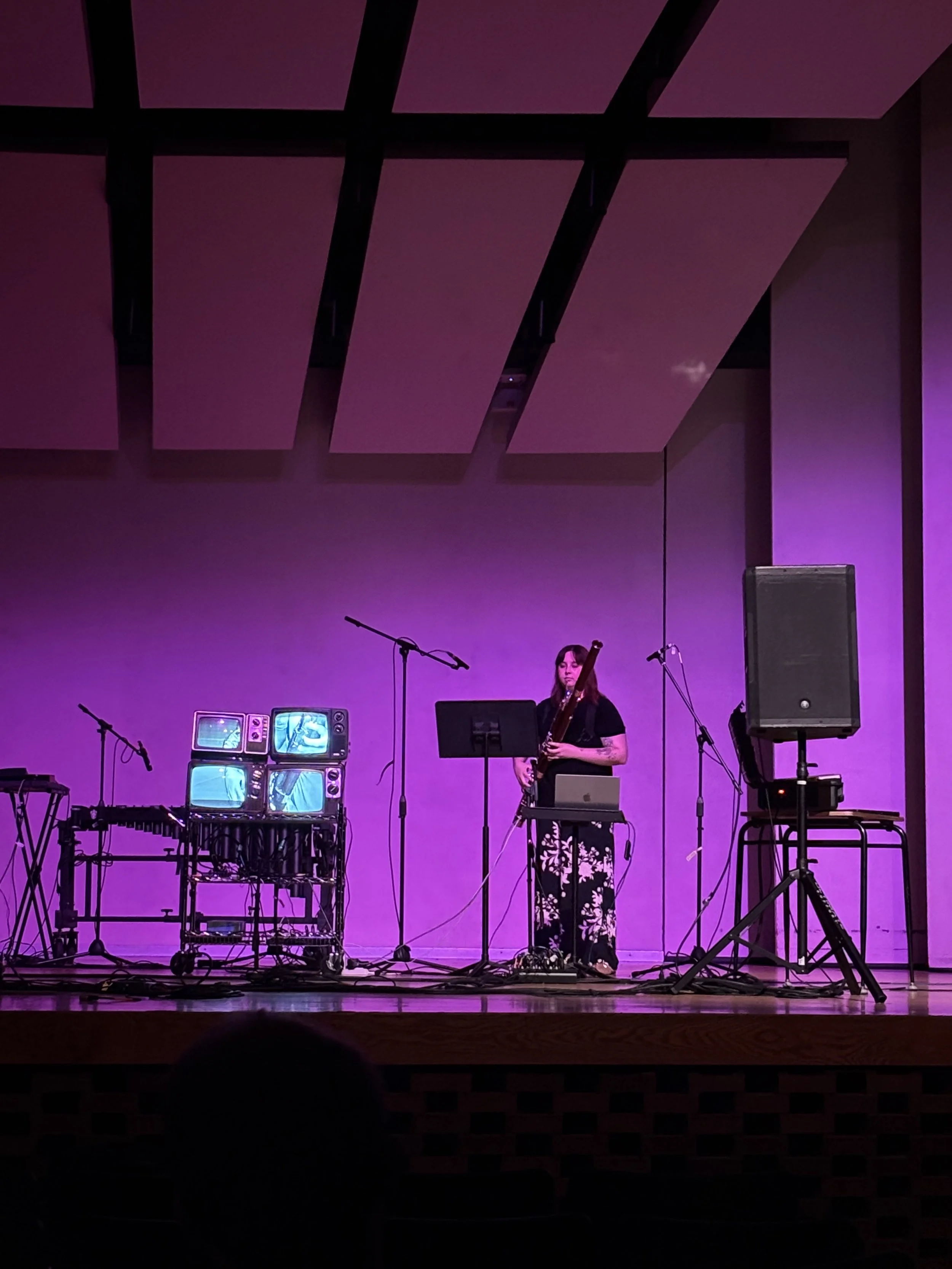
SPLICE Institute 2026 Participant Concert 4 Program
Saturday June 27, 2026
7:30pm EDT
Dalton Recital Hall, Western Michigan University
Livestream simulcast on SPLICE YouTube (unique link)
Ashkan Tabatabaie : Conduit
Ashkan Tabatabaie, electric guitar
Richie Arndorfer : Figment (of Noise)
Richie Arndorfer, oboe
Ayla Cosnett : Splinters of Messianic Time
Jack Synoski, double bass
Feihong Yu : Relit
Anne Pinkerton-Dion, oboe or English horn
Sarah Parker : light bled, catasterized
Makayla Rasmussen, bassoon
Indigo Knecht : born//didn't ask
Nick Zoulek, saxophone
Joey Miller : Shared Spaces
Nick Zoulek, saxophone
Notes
Richie Arndorfer : Figment (of Noise)
Figment (of Noise) started as an attempt to write a piece using only noise sounds but quickly came to be about ghosts instead. The piece starts with the use of a Spirit Box, a ghost hunting tool that generates white noise by sweeping through radio frequencies. Most of the electronics in the piece are taken from clips of electronic voice phenomena as well as from recordings I made using the Spirit Box at Central State Hospital, a derelict mental asylum in Milledgeville, Georgia.
Feihong Yu : Relit
Relit is a work for oboe, English horn, and fixed and live electronics that explores the relationship between a human presence and an ever-changing sonic environment. The electronics create a world shaped by shifting textures, sometimes suggesting rain, wind, and storms, and at other times becoming more abstract and atmospheric. Within this landscape, the oboe serves as a human voice, while the English horn acts as a guide through the darkness—a distant light. Rather than telling a specific story, Relit unfolds as a journey. Through the interaction of acoustic and electronic sound, the work reflects on renewal, transformation, and the light that can emerge through change.
Sarah Parker : light bled, catasterized
To catasterize is to immortalize a being as a constellation, as in Greek mythology. Video projections for this piece were made by digitizing and animating found vintage slide films published by different observatories in the 50’s and 60’s.
Ashkan Tabatabaie : Conduit
Conduit is an interactive multimedia work for electric guitar and real-time projection mapping that maps a sonic and visual timeline of coastal runoff systems. The composition relies on an audio-driven tug-of-war engine where specific instrumental performance techniques trigger corresponding generative video states. Sustained, melodic playing stabilizes the visual baseline, rendering a pristine, high-contrast aquatic environment across the guitar body. In contrast, high-transient sounds down the neck route raw amplitude and frequency data directly into an accumulator engine. This configuration acts as a structural conduit that forces visual assets of urban stormwater, industrial runoff, and wastewater into the projection map. Over a fixed-media backdrop of municipal infrastructure soundscapes, the accumulation of performance friction drives the generative system into an accelerated, oversaturated algal bloom state, ending in anoxia. The piece transforms a solo instrumental performance into a physical study of cause, latency, and material feedback within an interactive ecosystem.
Ayla Cosnett : Splinters of Messianic Time
“Historicism contents itself with establishing a causal nexus of various moments of history. But no state of affairs is, as a cause, already a historical one. It becomes this, posthumously, through eventualities which may be separated from it by millennia. The historian who starts from this, ceases to permit the consequences of eventualities to run through the fingers like the beads of a rosary. He records the constellation in which his own epoch comes into contact with that of an earlier one. He thereby establishes a concept of the present as that of the here-and-now, in which splinters of messianic time are shot through.”
—Walter Benjamin (trans. Dennis Redmond), “Theses on the Philosophy of History” (1940)
Splinters of Messianic Time was written in the spring of 2026 for bassist Jack Synoski to premiere at the 2026 SPLICE Institute. It represents an attempt to reconcile (with) and in some sense redeem an overwhelming accretion of strange shadows and knots of myth which had come to dominate my psyche since my participation in the 2025 iteration of SPLICE, an experience which profoundly affected all aspects of my life and art. While this may have been doomed from the beginning as an act of spiritual alchemy, coming after several other attempts at as much which ultimately engendered no real transfiguration of the referent, the ineffable specular presence of this reservoir of ideas and memories had retained such a monopoly on my personal sense of meaning that it seemed the only alternative to consciously rising to fail at this task again would be to have a work conceived as something else gradually and far less artfully slip into that same role. This piece can nonetheless unequivocally lay claim to having granted redemptive rest to a (far inferior) piece for the same instrumentation from my undergraduate years, which was never performed for a variety of tangled reasons and has subsequently been scrubbed from history.
Ostensibly, this all has something to do with abusing recordings of the double bass to generate wavetables and as transfer functions for nonlinear waveshaping, and with controlling those mechanisms with parameter values derived from the logistic equation as seeded by analyzing the amplitude of the instrument itself before being left to run autonomously. There may be something in there about the insistence of a symbol in all degrees of perception (both right around any given corner in the broader world and as a master signifier defining the entire space in which anything is staged), and the apparently random dance of the logistic map around itself which is nonetheless strictly determined by a simple self-contingent process of history accumulating in response to itself but never resolving. As Benjamin writes, the redemption of the past and the creation of a future is not an inevitable result of this so-called progress but something radically outside of it that must be envisioned and fought for; here, the bass would perhaps present its means of shaping, serving as a Greek chorus to, and interfering with these software processes according to materials defined by a radically different logic (that of what one might consider musical language) as serving this purpose, but it, too, is weighed down by a stunted march of irregularly-metered time that strings together mangled, decontextualized quotations of a musical memory bound up in loss, and by delay buffers that force it into counterpoint with funhouse-mirror recapitulations of its past. Whether this dialectic amounts to anything greater is probably not my own judgment to make when the world of meaning from which it springs forth is wont to shrivel and shatter where it tries to assert an external existence-in-itself and the concomitant right to shape in turn the external world which has shaped it.
This piece owes a considerable debt to Sarah Hennies and Liza Lim, both visitors to the University of Louisville School of Music during my final semester there, in terms of both the musical and philosophical ideas they expounded upon and the generous creative and moral support they provided.
Indigo Knecht : born//didn't ask
Written for Nick Zoulek.
born//didn’t ask explores themes of biological and ecological existentialism. It is also a reference to Laurie Anderson’s Big Science, which has had a profound influence on me as a composer. The pitch material is derived from spectral analysis data in Max/MSP of prerecorded bass saxophone, tuba, and piano samples. Inspired by Anderson’s use of her voice in her music, my own voice joins the musical texture in conversation with the bass saxophonist before becoming one entity. Together, they plead: Why do I feel this immense guilt? I didn’t ask to be born. Why is it always my fault?
Joey Miller : Shared Spaces
The term "multinaturalism" is a term which runs counter to multiculturalism. Where multiculturalism smooths over differences to highlight similarities, multinaturalism celebrates the differences and acknowledges that we all experience the world in different "natures." Shared Spaces explores multinaturalism through the physics of the saxophone by manipulating how the sounds are produced, often separating the two "natures" inherent to the saxophone— the keys and the mouth. The resulting sounds are the two natures interacting, and while they may be unstable at times, the sounds cannot be produced without aid from the other nature. Just because two natures may be different, this does not mean one is any more invalid than another.
Bios
Richie Arndorfer is a composer pursuing a DMA in Composition at the University of Georgia. He has a background as a concert oboist, jazz saxophonist, and singer-songwriter and this diversity of experience is reflected in his music which incorporates different styles and often blends text, technology, and theater.
Born in Easton, Maryland, and raised in Greater Baltimore, Ayla Cosnett’s compositional practice first grew from the desire for her electric guitar playing to be supplanted by the electronics emerging from the instrument, transcending its heteropatriarchal trappings. She has subsequently sought to destroy the tensions witnessed in her liminal position between academic electroacoustics and DIY "noise”, variously engaging with these ideological inheritances, the psychogeography of the Upper South, the perpetual flux of queer and female identity, [post-]internet culture and aesthetics, and the history and (her) practice of so-called Western esotericism. Her work has been presented at the 2021 SEAMUS conference and the 2025 SPLICE Institute, alongside locales of less institutional prestige and/or baggage. Cosnett's teachers have included Dan Ryan, Benjamin Buchanan, McGregor Boyle, Sam Pluta, and Krzysztof Wołek; she is currently preparing to begin doctoral study at the University of Cincinnati College-Conservatory of Music under Carl Jacobson and Mara Helmuth.
Indigo Knecht is a composer, tubist, and educator fascinated with the challenges people face as they navigate this world. Through a synthesis of contemporary classical music and rock & roll, Indigo explores themes such as environmentalism, mental illness, and self-realization.
Indigo has a BM in Composition from Bowling Green State University and a MM in Composition from University of Michigan. They are currently in their fourth year at University of Miami pursuing a DMA in Composition under the guidance of Dr. Juan Chattah. Their multimedia installation, “The Chanting of Coral Reefs: Bringing Awareness to the Endangerment of Coral Reefs Through the Sonification of Settling Larvae,” received the 2024 Presser Foundation Graduate Award. Indigo currently teaches music theory and composition at Tennessee Technological University while they continue to develop expansive compositions that bring awareness to issues in our world with groundbreaking technology.
Joey Miller is a manipulator of wiggly air working toward his MM in music composition at the University of Georgia. Often focusing on augmenting the performer with electronics, Joey has found great satisfaction in making both beeps and bloops. His compositions often focus on the human condition, from human connection, to the fragility of memory. He has had works read by various ensembles such as Hub New Music, the Toledo Symphony Orchestra, and his work The Snow Like Butterflies enjoyed several performances by members of the UGA cello ensemble. Outside of music, Joey enjoys hiking, camping, baking, table-top roleplaying games, board games, MarioKart Wii, and traveling. His favorite color is blue, and his favorite musical is Hadestown.
Sarah Parker According to a plethora of Facebook hate comments, Sarah’s practice centers around “devolving the saxophone with attention-seeking gimmicks,” some of which include: modifying instruments with tubes, animal calls, and live electronics; turning a preserved heart specimen into an electronic instrument; and performing fake dental surgery on unsuspecting audience members. Through her “attention-seekings,” Sarah aims to redefine the performer-instrumental relationship by inventing scenarios which dismantle tradition and expand music-making into a curiosity-centered, interdisciplinary process. As a composer, performer, and educator, she believes that exploration challenges us to listen, and to live, in radically new and healthy ways. Sarah is a Baltimore-based composer and saxophonist and performs regularly with her trio Sophie Rollover and as a member of Wieldflower Arts.
Anne Pinkerton-Dion is an oboist originally from the Chicago area. Especially interested in new music, she has performed with One Found Sound (San Francisco), Bang On A Can Festival (North Adams, MA), Lucerne Festival (Switzerland), and the Blackhouse Collective Workshop (Los Angeles/Dallas). With a background in dance, she enjoys curating and performing interdisciplinary works and collaborating with other artists. She has worked with Root River Photography, Ballet Oberlin, Rice Dance Theatre, and other visual artists and dancers. Anne is the oboist in Reeds and Keys organ and oboe duo, performing with her husband, organist Matthew Dion. Anne is currently acting assistant principal/second oboe with the San Antonio Philharmonic, oboist with Opera in the Heights, and plays as a substitute with the Houston Symphony, Houston Ballet Orchestra, and Louisiana Philharmonic. As a private teacher, Anne maintains a teaching studio among several schools in the greater Houston area, and is the adjunct oboe instructor at Houston Christian University. She studied at Oberlin Conservatory and Colburn Conservatory, and recently graduated from Rice University.
Makayla Rasmussen is a devoted performer and educator with a passion for new music and commissioning new chamber works for bassoon. She has frequently performed with orchestras around the midwest including the Champaign-Urbana Symphony, Illinois Symphony, Waterloo-Cedar Falls Symphony, and the LaCrosse Symphony. A strong advocate for expanding the bassoon’s repertoire, Makayla focuses on collaborating with student composers and historically underrepresented living composers. She holds a Bachelor of Music from the University of Northern Iowa and a Master of Music from the University of Illinois Urbana-Champaign. Makayla is currently pursuing a Doctor of Musical Arts at Louisiana State University where she studies with Nanci Belmont. Her former teachers include Ben Roidl-Ward, Marcia Martin, Cayla Bellamy, and Josh Carlo.
Jack Synoski Jack is a bass player and audio engineer based in Bloomington, Indiana. He received his Bachelor of Music degree in jazz performance and Master of Science degree in music technology from Temple University. Besides playing bass, he enjoys baking, woodworking, and playing Dungeons and Dragons.
Ashkan Tabatabaie is an interdisciplinary composer, performer, and media entrepreneur serving as an Assistant Professor of Music and Digital Media at the New College of Florida. His creative practice encompasses instrumental, vocal, electronic, and multimedia works exploring the boundaries of perception. His compositions have been featured at festivals, including the NYCEMF, SEAMUS, MOXsonic, JemFEST, and ATMI, and Oregon Bach Festival. As a scholar, Tabatabaie’s cross-disciplinary research investigates music cognition, technology, and music theory. His findings have been presented and published through events such as Future Directions of Music Cognition, Basic and Clinical Neuroscience, and the College Music Society. He holds a PhD in composition and completed a postdoctoral research assistantship in auditory perception and physiology, positioning him at the intersection of creative expression and scientific inquiry to transform perceptual spaces into compelling music and digital art.
Feihong Yu is pursuing her Master’s degree in Classical Voice and Computer Music Composition at the Indiana University Jacobs School of Music, where she is expanding her artistic practice of opera performance and technology-based composition. Her work will be presented at the EMM Festival (March 2026), MOXsonic Festival (March 2026), and the SEAMUS Conference (May 2026).
Feihong previously earned her Bachelor’s degree in classical voice from the Manhattan School of Music. As a performer, she has sung leading roles in operas throughout Italy and Germany and appeared in concerts across New York City and her hometown of Dalian, China. In addition to her performance and compositional pursuits, she has extensive experience in music production, having worked as an audio technician specializing in recording, mixing, and mastering.
Nick Zoulek builds worlds out of brass, breath, and reeds. Based in Chicago, Zoulek is a saxophonist whose music feels physical, visceral, and urgent. Tender one moment, tectonic the next, his sounds are simultaneously alive and mechanized. Allan Kozinn wrote in The Wall Street Journal, “Zoulek’s performance, on saxophones in every range, is stunningly virtuosic, whatever the genre.” A musician of “pure mindfulness and talent” (PopMatters), his intuitive playing results in a “no-holds barred engine of avant-garde exploration.” (Portland Press Herald)
Zoulek’s new album, Enter Branch, unfolds as a narrative of growth. The album bridges his vivid approach to the saxophone with a cast of collaborators from across the musical spectrum, including Sean Carey (S. Carey, Bon Iver), spoken-word legend J. Ivy, Nathalie Joachim, Nick Photinos, Chris Porterfield (Field Report), ~Nois, and the Tontine Ensemble. These artistic voices merge with Zoulek’s prismatic performance style. His solo saxophone sound is raw, almost impossibly layered. This is not achieved through digital effects like looping or delay, but rather through a tapestry of circular breathing, extended overtones, vocalizations, and unrelenting arpeggios. Every tone of the saxophone is live, recorded in full, uninterrupted takes, and shaped with experimental microphone arrangements. Even the cracks of the saxophone’s sound create a root system of expression, woven with strands of vocals, bowed strings, ambient drones, seismic depth, and unfiltered warmth from his collaborators.
Enter Branch follows Zoulek’s debut album, Rushing Past Willow (Innova, 2016). Of that record, Allan Kozinn wrote, “Circular breathing yields rapidly undulating, swirling figures that seem unstoppable…fascinating chordal figures…evocations of electronic timbres and feedback. None of that would matter much…if he were a less imaginative composer.” Zoulek’s projects have been interdisciplinary from the start, and Rushing Past Willow exemplified this. Collaborators on the project included installation artist Erwin Redl, Wild Space Dance Company, and filmmaker Cody LaPlant. Rushing Past Willow yielded long-form dance works, art installations, and a series of landscape-based performance videos.
Though known for his original music, Zoulek is grounded in classical solo and chamber performance. He has commissioned and premiered over 100 works for the saxophone, including pieces by Martin Bresnick, Shelley Washington, Emma O’Halloran, and Aaron Kernis. His collaborative spirit has led to performances with champions of the contemporary music world, including Eighth Blackbird, Third Coast Percussion, Present Music, and ~Nois, with features by the Shockingly Modern Saxophone Festival, New Music Detroit, the Encore Chamber Music Festival, and the Sensoria series. He is the tenor saxophonist of the Coalescent Quartet and half of the experimental ensemble, Duo d’Entre-Deux. Every now and then, he plays covers of sad pop songs in the tenor saxophone trio, Dial-Up Stepmom.
Zoulek grew up in southeastern Wisconsin. He took up the saxophone in fifth grade, and in middle school, discovered Anthony Braxton’s For Alto at a particularly eclectic local record store. That experience soon expanded, listening to John Zorn, Ned Rothenberg, Joshua Redman, Brian Eno, modernist composers like Stockhausen, Berio, and Takemitsu, along with recordings of saxophone with electronic manipulation. Solo saxophone became a fascination. At the same time, skate videos and their soundtracks left a lasting mark, with everything from DJ Shadow to Slayer blending into his musical identity.
After earning a degree from the University of Wisconsin-Whitewater, Zoulek moved to Paris, studying avant-garde repertoire with Jean-Michel Goury and improvisation with bassist Joëlle Léandre. He later completed a Doctor of Musical Arts in Contemporary Music at Bowling Green State University studying with Dr. John Sampen, one of the foremost innovators of contemporary classical saxophone. Alongside his musical practice, he developed a deep craft in audio engineering, videography, and photography—skills that naturally folded into his interdisciplinary projects.
As a composer, Zoulek’s work lives in a diverse array of settings, writing for Third Coast Percussion, the Madison Ballet, Wild Space Dance Company, Rockstar Games, Legs of Steel ski films, and Found Format films. He is an accomplished video artist, with films screening at festivals and galleries worldwide. His visual work under the rubric NZMEDIA has led to collaborations with the Oregon Shakespeare Festival, the Chicago International Puppet Theater Festival, screenings with the Library of Congress, and numerous projects that translate music to the visual medium. No matter how far his practice branches outward, it remains rooted in the saxophone, built from breath and bones, but wired to become something more.