
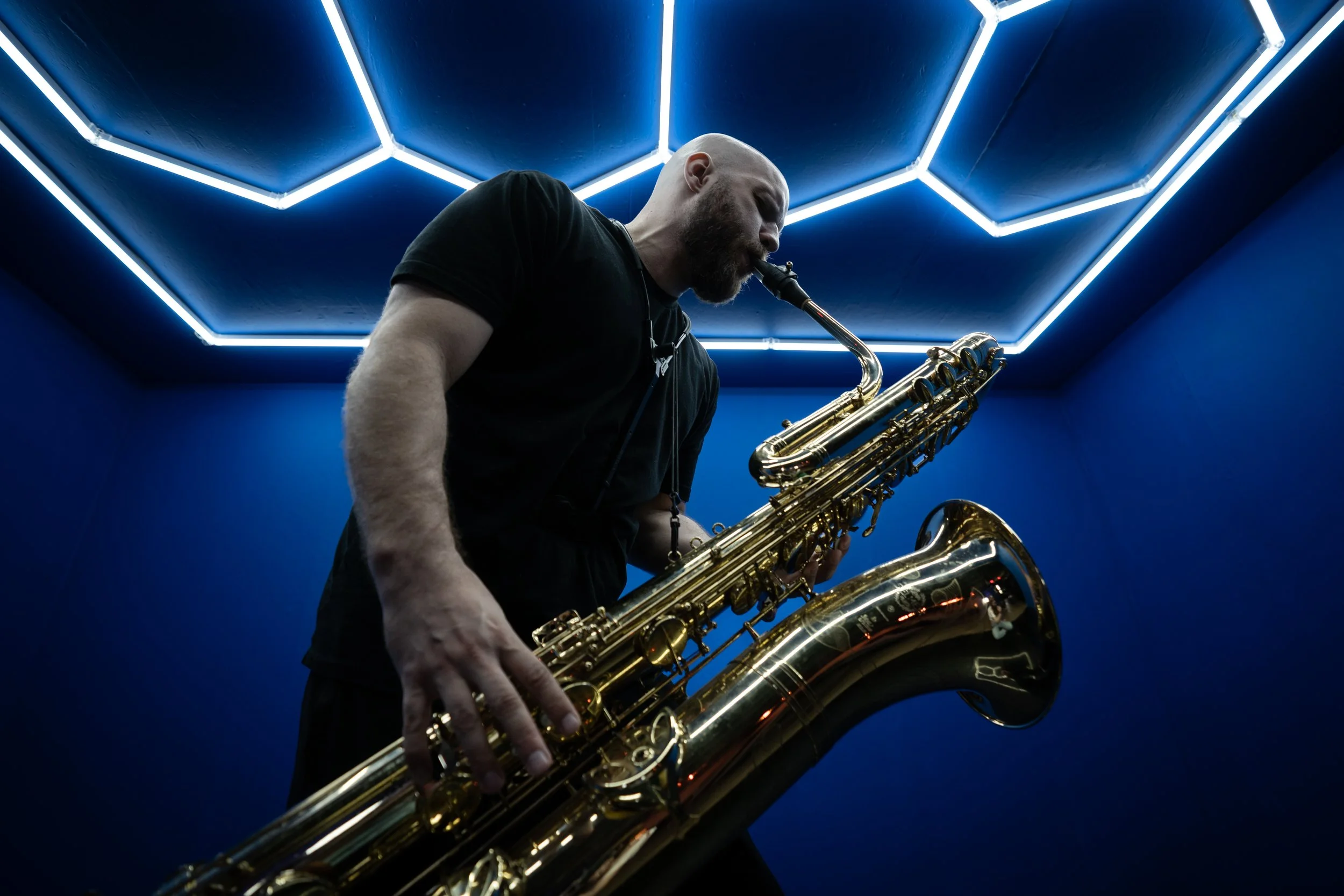
SPLICE Institute 2026 Concert 2 Program
featuring
Nick Zoulek
Tuesday June 23, 2026
7:30pm EDT
Dalton Recital Hall, Western Michigan University
Livestream simulcast on SPLICE YouTube (unique link)
Program:
All compositions by Nick Zoulek.
Enter Branch (2025)
tenor saxophone
Torn (2026)
bass saxophone
Reach (2025)
bass saxophone and video
Rushing Past Willow (2016)
alto saxophone and video
video featuring Mauriah Donegan Kraker, additional videography by Cody LaPlant
Amplituhedron (2016)
alto saxophone and video
Video by Simsies
-pause-
Full Vision (2026)
extended bass saxophone
The Life and Death of 9413: a Hollywood Extra (1928)
Original score by the Overture Center’s Duck Soup Cinema, premiered June 2026
A silent experimental film co-written and co-directed by Robert Florey and Slavko Vorkapić.
Notes
Hey everyone,
First off, I’m honored to be here at Splice, sharing music and artistry with so many inspiring people. I’m here at Splice focusing on the performer/composer dynamic along with collaboration and multimedia work. I tried writing formal program notes for this performance, but that didn’t quite feel right. Instead, I want to focus on aspects of these pieces that have been on my mind in relation to the performer/composer journey, and I wanted to write it while I’m in a reflective place. So, I’m writing this message while walking along Lake Michigan in my home city of Chicago.
Enter Branch is the lynchpin of the album that I released last year, Enter Branch, on Better Company Records. This was the first piece that came together for the project, but in reality, it wasn’t finished until the very end. When I introduce it live, I usually say that performing it is a journey every time. It came to represent something more: growth, grit, and adversity. I don’t always share this part, but there was a great deal of physical hardship in the performance itself. There was a time when it felt like performing this piece was physically impossible. It sort of backslid, and my body would betray me during the performance. It’s interesting to reflect on that. The harder I tried to avoid it or mask it, the more present those difficulties became. It led me on a journey that included coachings with the Musician’s Wellness Institute, reevaluating my pedagogical background, and completely changing my perspective on what it means to play saxophone. But once I allowed the piece to be what it is, allowed the sounds to exist as they are, and accepted the possibility that I might not be able to perform it, it came together. It’s part of me, and sharing it with you all is a privilege.
For years, Torn was meant to be part of Enter Branch. The album had a dual narrative: one side representing branches extending upward, and another representing the root system creating a foundation. Torn fell into the latter category. By the time I finished recording everything, I had about 130 minutes of music. It was a sprawling project, and I had a great deal of difficulty describing what it was. I realized that the album really became a vernacular: a body of work and a part of me. Torn was crucial to the process, but it was part of something other than Enter Branch. I’m still not sure where this piece will live. In some ways, it feels like part of the process, and maybe that’s enough.
Originally, I thought Reach was part of the same root system as Torn. The piece does what the title says. It reaches both up and down, looks to the future, and reflects on the past. That realization guided me in the video, and I found a home in representing that duality through the visuals.
At this point in the program, I want to reflect and look at where this all came from. Rushing Past Willow was the first thing that felt like a thing, and it was the title track of my first solo album. It began as a vocabulary for improvisation, using sounds and an approach that I started investigating during my undergraduate degree and continued to develop while studying in Paris. The vocabulary lived with me and developed over years of experimentation and collaboration.
Working with Wild Space Dance Company was critical. Based in Milwaukee, Wild Space is a site-specific improvisatory dance company, meaning that they choose specific sites across the city and work specifically within those environments. The sounds that became Rushing Past Willow grew from a sort of ritual across many performances, and eventually solidified into a piece of their own. Many of those performances came together with dancer Mauriah Donegan Kraker. When the piece solidified, we wanted to create a video that could try to embody its site-specific origins. We went to locations deeply associated with the memories I connect to Rushing Past Willow, including Willowood Park, where the titular willow tree still stands. With the help of my friend and longtime skating pal, videographer Cody Laplant, who I first met while making skate videos and who has since become an inspiration through both his production company and incredible videography. We created this dance film as authentically as possible, sometimes with me performing off-screen.
I want to end this first set with Amplituhedron, which is also from the Rushing Past Willow project. So much of that journey involved giving shape to chaotic sounds. The particular pattern used in Amplituhedron is pretty chaotic, and I wanted to give it shape through form and direction. I came across the idea of an amplituhedron, which is a geometric figure that can visually summarize mathematical relationships that would otherwise take pages and pages to express. It is accompanied by a collaborative animation created by Simsies (Josh Simmons).
I’m going to pause for a moment to reset mentally and physically.
I think 2010 was the first time I performed with saxophone mouthpieces on tubing and PVC. I don’t come from a musical family. Rather, the family business was industrial and commercial plumbing and HVAC. I worked for the family business for a while in high school and during my first year of college. I think there was an underlying assumption that I would pursue music school, but eventually I’d come back and work for the business. The thing is... I was a pretty bad plumber. A major contributing factor was that I was really interested in the sounds that all of the tools, pipes, and industrial materials made. Plumbing wasn’t going to be the path for me.
Fast forward to 2010: that was the first time I performed with saxophone mouthpieces on tubing and pipes. At least I kind of came back to the family business, right? It was a performance with my brother Tim Zoulek (who went to school for visual art but returned to the family business), and involved sawing pipes on stage with Sawzalls, drilling vents into them, reassembling them into a massive structure, and then performing on that structure alongside percussionist and longtime collaborator Tim Russell.
Extending and preparing the saxophone became a thing. Shortly after, I started to embrace the idea of the saxophone as a biofeedback mechanism, and altering the horn created all kinds of possibilities in that regard. I developed the sounds and techniques further with Wild Space Dance (one time even including a choir of PVC players scattered in the foliage surrounding a dance performance), and with my experimental saxophone duo with Canadian saxophonist Tommy Davis, Duo d’Entre-Deux.
I continued to develop this vocabulary in the background. Rushing Past Willow and Enter Branch were focal points. I also didn’t have a great deal of time for it during traditional music studies. But it grew over the years, especially after completing my doctorate and during the pandemic. I found that the process and sonic structure of extending and preparing the saxophone continued to be a source of inspiration and growth. The sounds really came into their own while working on the score for Faces of Death, which was recorded in 2023 and released in theaters this summer.
Over the years, this practice became its own thing. I’m certainly not the only one who pursues this, but it’s still quite meaningful to me. While it felt separate from Enter Branch, I realized that the two pursuits worked in tandem and drew inspiration from one another. While I was refining Enter Branch’s track list and message, I realized how much these sounds were part of that story. While many of the root-system pieces and tube pieces felt like a separate project, the piece Vision was important to the overall narrative: both a sonic path forward, a realization in personal growth, and a shift in worldview.
I want to show more of Vision in this performance. I finished tracking a new album earlier this year, and I’m excited to release it.
I’ll conclude with a new original score commissioned by Madison, Wisconsin’s Overture Center and their silent film society, Duck Soup Cinema. It’s pretty fresh—I premiered it two weeks ago.
The Life and Death of 9413: A Hollywood Extra is a 1928 silent experimental film co-written and co-directed by Robert Florey and Slavko Vorkapić, and is considered a milestone in American avant-garde cinema. It follows a character who comes to be labeled 9413 (played by Jules Raucourt), who arrives in Hollywood with dreams of success as an actor, only to become part of the Hollywood machine.
Personally, I find it interesting to see such criticism of Hollywood at this early point in its history. I think the film maintains relevance today, especially as artists are fatigued by algorithms and the current music-release machine. At the same time, I’m inspired by the film’s persistence, resourcefulness, and DIY aesthetic. The film was produced on a budget of $97 (around $1,850 in today’s money), using cardboard, tin cans, and cigar boxes to create its landscapes and establishing shots.
Thank you for reading. Thank you for listening. Thank you for sharing your art. You all rock.
With warmth,
Nick
back to program
Bio
Nick Zoulek builds worlds out of brass, breath, and reeds. Based in Chicago, Zoulek is a saxophonist whose music feels physical, visceral, and urgent. Tender one moment, tectonic the next, his sounds are simultaneously alive and mechanized. Allan Kozinn wrote in The Wall Street Journal, “Zoulek’s performance, on saxophones in every range, is stunningly virtuosic, whatever the genre.” A musician of “pure mindfulness and talent” (PopMatters), his intuitive playing results in a “no-holds barred engine of avant-garde exploration.” (Portland Press Herald)
Zoulek’s new album, Enter Branch, unfolds as a narrative of growth. The album bridges his vivid approach to the saxophone with a cast of collaborators from across the musical spectrum, including Sean Carey (S. Carey, Bon Iver), spoken-word legend J. Ivy, Nathalie Joachim, Nick Photinos, Chris Porterfield (Field Report), ~Nois, and the Tontine Ensemble. These artistic voices merge with Zoulek’s prismatic performance style. His solo saxophone sound is raw, almost impossibly layered. This is not achieved through digital effects like looping or delay, but rather through a tapestry of circular breathing, extended overtones, vocalizations, and unrelenting arpeggios. Every tone of the saxophone is live, recorded in full, uninterrupted takes, and shaped with experimental microphone arrangements. Even the cracks of the saxophone’s sound create a root system of expression, woven with strands of vocals, bowed strings, ambient drones, seismic depth, and unfiltered warmth from his collaborators.
Enter Branch follows Zoulek’s debut album, Rushing Past Willow (Innova, 2016). Of that record, Allan Kozinn wrote, “Circular breathing yields rapidly undulating, swirling figures that seem unstoppable…fascinating chordal figures…evocations of electronic timbres and feedback. None of that would matter much…if he were a less imaginative composer.” Zoulek’s projects have been interdisciplinary from the start, and Rushing Past Willow exemplified this. Collaborators on the project included installation artist Erwin Redl, Wild Space Dance Company, and filmmaker Cody LaPlant. Rushing Past Willow yielded long-form dance works, art installations, and a series of landscape-based performance videos.
Though known for his original music, Zoulek is grounded in classical solo and chamber performance. He has commissioned and premiered over 100 works for the saxophone, including pieces by Martin Bresnick, Shelley Washington, Emma O’Halloran, and Aaron Kernis. His collaborative spirit has led to performances with champions of the contemporary music world, including Eighth Blackbird, Third Coast Percussion, Present Music, and ~Nois, with features by the Shockingly Modern Saxophone Festival, New Music Detroit, the Encore Chamber Music Festival, and the Sensoria series. He is the tenor saxophonist of the Coalescent Quartet and half of the experimental ensemble, Duo d’Entre-Deux. Every now and then, he plays covers of sad pop songs in the tenor saxophone trio, Dial-Up Stepmom.
Zoulek grew up in southeastern Wisconsin. He took up the saxophone in fifth grade, and in middle school, discovered Anthony Braxton’s For Alto at a particularly eclectic local record store. That experience soon expanded, listening to John Zorn, Ned Rothenberg, Joshua Redman, Brian Eno, modernist composers like Stockhausen, Berio, and Takemitsu, along with recordings of saxophone with electronic manipulation. Solo saxophone became a fascination. At the same time, skate videos and their soundtracks left a lasting mark, with everything from DJ Shadow to Slayer blending into his musical identity.
After earning a degree from the University of Wisconsin-Whitewater, Zoulek moved to Paris, studying avant-garde repertoire with Jean-Michel Goury and improvisation with bassist Joëlle Léandre. He later completed a Doctor of Musical Arts in Contemporary Music at Bowling Green State University studying with Dr. John Sampen, one of the foremost innovators of contemporary classical saxophone. Alongside his musical practice, he developed a deep craft in audio engineering, videography, and photography—skills that naturally folded into his interdisciplinary projects.
As a composer, Zoulek’s work lives in a diverse array of settings, writing for Third Coast Percussion, the Madison Ballet, Wild Space Dance Company, Rockstar Games, Legs of Steel ski films, and Found Format films. He is an accomplished video artist, with films screening at festivals and galleries worldwide. His visual work under the rubric NZMEDIA has led to collaborations with the Oregon Shakespeare Festival, the Chicago International Puppet Theater Festival, screenings with the Library of Congress, and numerous projects that translate music to the visual medium. No matter how far his practice branches outward, it remains rooted in the saxophone, built from breath and bones, but wired to become something more.