

SPLICE Institute 2026 Concert 1 Program
featuring
SPLICE Ensemble
Sam Wells, trumpet
Keith Kirchoff, piano
Adam Vidiksis, percussion
Monday June 22, 2026
7:30pm EDT
Dalton Recital Hall, Western Michigan University
Livestream simulcast on SPLICE YouTube (unique link)
Album Release Event!
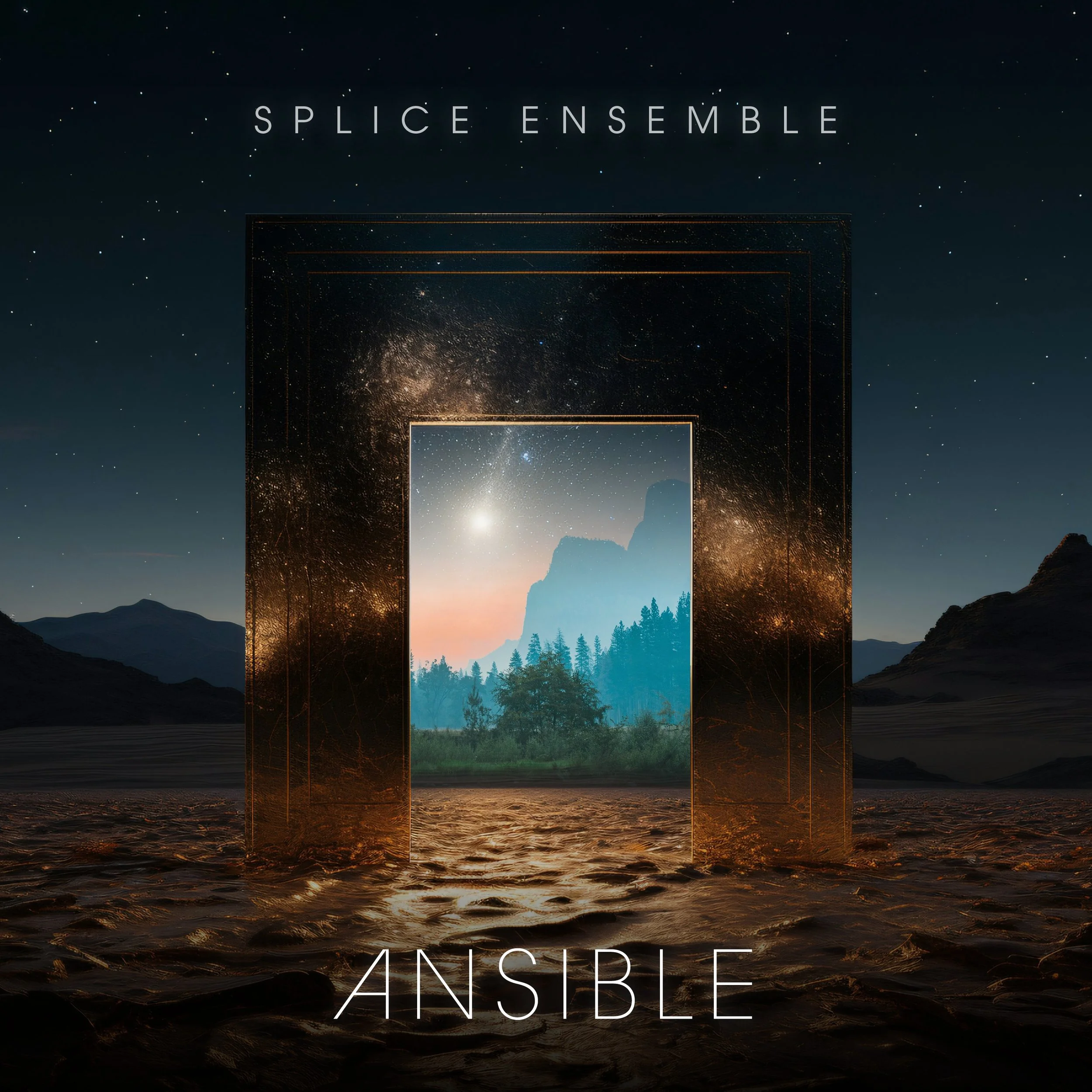
Help us celebrate SPLICE Ensemble's forthcoming release, Ansible on New Focus Recordings
Steven Ricks : Motor Culture (2021)§
I. Hanks Drive Through the Multiverse
II. Blessed Mother of Acceleration
III. Disastrous Experiment
Elainie Lillios : Living Between Seconds (2022)
Caroline Louise Miller : Ansible (2019)‡
I. Antiphony
II. Gethen/Icecaps
III. Urras/Walls
IV. Passacaglia
§Commissioned by the Barlow Endowment for Music Composition at Brigham Young University for SPLICE Ensemble.
‡This commission has been made possible by the Chamber Music America Classical Commissioning Program, with generous funding provided by The Andrew W. Mellon Foundation.
Notes
Steven Ricks : Motor Culture
In 2010 I was invited by my friend Ned McGowan to write a piece for his ensemble Hexnut as part of a project they initiated: WRENCH. It was inspired by the photography of Edward Burtynsky, and each composer involved wrote a piece that coordinated sound with one or more of Burtynsky’s images. At the time I was drawn to two images related to Burtynsky’s concept of “Motor Culture,” that is, all the activities of taking from the earth and production that relate to the automobile, from oil drilling to car manufacturing to freeway systems and beyond. I’ve continued to think about how the automobile influences so many aspects of my life and decided to make this piece a poetic exploration of some of those facets. The first movement, “Hank’s Drive Through the Multiverse,” takes as inspiration a children’s song by Pinto Colvig called “Honkety Hank,” a song I used to listen to from an old vinyl single my Dad had. This playful inspiration is transformed into and/or pit against a more rigorous process of color and talea that provides the underlying structure for the piece. Ultimately, I picture a sort of surreal journey that juxtaposes the playful and idealistic view of going for a ride with the more problematic features and dangers of automobile travel.
The second movement, “Blessed Mother of Acceleration,” steals a line from The Blues Brothers movie (which itself features a lot of driving and an epic car chase) to suggest the ability of cars to accelerate, but also the general “drive” or push to go faster, be better, advance in technology, etc. (cue Daft Punk’s “Harder, Better, Faster, Stronger”). The constant pulse, driving rhythms, and propulsive electronics are pushing things forward in a way that suggests progress, but also perhaps has the spirit of getting out of control and heading for disaster.
The final movement, “Disastrous Experiment,” is a somber reflection on the painful aspects of automobile violence, both intentional and accidental. Motor Culture was commissioned by the Barlow Endowment for Music Composition at Brigham Young University for SPLICE Ensemble and this is its premiere performance.
- Steve Ricks
Elainie Lillios : Living Between Seconds
Living Between Seconds is a work for trumpet in C, drum set with auxiliary percussion, and piano with fixed media and live electronics that explores the phenomenon of temporal expansion through mindfulness and how attending to the present moment can enhance, suspend, and/or expand temporal perception.
The journey to creating Living Between Seconds began by creating a meditative fixed media soundscape composition using environmental recordings captured in remote desert locations across the American southwest.* The foundational soundscape very little processing, allowing the environment’s expansive, temporally suspended nature to remain untouched. The small detailed sounds contained within the environment – birds chirps, owl hoots, coyote howls, train hums, and others – are treated as trigger points for foreground instrumental material, influencing In so acoustic gesture, texture, and timbre. Acoustic events generated from the soundscape in turn produce live, interactive electroacoustic events programmed using Cycling 74’s Max. This real-time processing expands the trio’s acoustic sound, generating “meta instruments” that further delineate the space between sound and silence, creating an immersive environment where the ensemble and electronics articulate the meditative soundscape.
Collaborating and experimenting with the SPLICE Ensemble during the compositional process was a priceless aspect of this project, allowing each member to contribute creative ideas and techniques that make this piece a dynamic, fluid collection of evolving, expanding material. Through guided improvisation, SPLICE Ensemble “lives between the seconds” of the work, articulating gestures and textures, responding to each other, to the fixed media, and to the live electronics, simultaneously creating and living in the evolving sonic landscape.
Living Between Seconds was made possible by a grant from the Fromm Music Foundation. The piece was commissioned by the SPLICE Ensemble, and is dedicated to them with admiration and appreciation.
Caroline Louise Miller : Ansible
Ansible is the result of a year-long, extremely rewarding collaboration with SPLICE Ensemble. A heartfelt thanks to Sam Wells, Keith Kirchoff, and Adam Vidiksis, whose artistry, dedication and honest critique have shaped this work at every stage of our collaboration.
In memoriam: Ursula K. Le Guin
Ursula K. Le Guin coined the term “Ansible” in her 1966 science fiction novel Rocannon’s world. The Ansible is a device that enables instantaneous interstellar communication, alleviating the significant time lag between the transmission and receipt of messages that could previously only travel at the speed of light. In Le Guin’s Hainish Cycle, a loosely connected group of sci-fi novels that take part within the same universe, the Ansible is sometimes present and sometimes absent—for a variety of reasons, economic, political, or because it hasn’t been invented yet. In circumstances where the Ansible is absent, communication between entities is often frustrated or inflected by vast distances of time and space, causing interstellar political troubles as messages received 50 or 100 years later lose their relevance. The Ansible, an open-source, open-science communications device invented by an Anarchist physicist, is conceived by Le Guin as having utopian potentials, enabling a peaceful interstellar coalition called the Ekumen. In spite of its Utopian potentials, its presence produces conflict as well, a rich metaphor for globalization. Struggles are waged for control of the Ansible technology itself, by entities who wish to capitalize on exclusive rights to its use. The rapid exchange of information across galaxies also interacts in unpredictable ways with different societies, in the very worst circumstances causing a technocracy (see The Telling).
The four musical movements of Ansible find resonances with these themes and with my two favorite novels of the Hainish Cycle, The Dispossessed (1974) and The Left Hand of Darkness (1969).
Antiphony is a meditation on pre-ansible communication, as messages from almost a century ago (conveyed by classical music recordings from the 1930’s, 40’s, and 50’s) finally are received in a not-so-distant future. Keith responds by playing extrapolations on these old tunes on a decaying piano. These old recordings, first heard in Antiphony, are carried throughout the other three movements; snippets placed in a variety of contexts—borne on the wind from a distant house maybe, or heard broadcast over the radio. The theme of embedding the same information in a multitude of spatial and temporal contexts carries throughout the rest of the piece.
Gethen / Icecaps is inspired by the ice-covered planet in The Left Hand of Darkness. It is a soundscape of creaking, melting, ice, whistling wind, glaciers, arctic fauna, and eerie voices carried by Sam’s desolate trumpet solo.
Urras / Walls draws on themes from The Dispossessed, where the protagonist constantly runs into walls and barriers of all sorts in his quest to develop the Ansible as an open-science technology. Some of these barriers prevent him from apprehending rampant economic and social inequalities that plague the capitalist society in which he is performing his research, highlighting the idea that walls both keep one side out and the other in. Toward the end of the movement, sounds from a general strike are broadcast over the radio. I used recordings of primarily women chanting, from protests all over the world, as the the oppression of women worldwide is closely linked with various economic and social injustices. During these moments, Adam Vidiksis improvises drum solos drawing on free jazz.
Passacaglia takes the form of a continuously shifting theme and variations, making small ripples and delays through time. The three instruments often work in a loose canon with each other. Delays at the scale of seconds register as near-simultaneity from an interstellar perspective. A broadcast of the general strike is briefly heard again on the radio, this time through the window of a passing car on a remote desert highway.
Bios
SPLICE Ensemble is a trumpet, piano, and percussion trio focused on cultivating a canon of electroacoustic chamber music. Called a “sonic foodfight” by Jazz Weekly, SPLICE Ensemble works with composers and performers on performance practice techniques for collaboration and integrating electronics into a traditional performance space. The resident ensemble of both SPLICE Institute and SPLICE Festival, SPLICE Ensemble has been a featured ensemble at M Woods in Beijing, SEAMUS, the Electroacoustic Barn Dance, SCI National, Electronic Music Midwest, and New Music Detroit’s Strange Beautiful Music 10. They have recorded on both the SEAMUS and Parma Labels.
Described as a “virtuosic tour de force” whose playing is “energetic, precise, (and) sensitive,” pianist and composer Keith Kirchoff has performed throughout North America, Europe, and the Pacific Southwest. A strong advocate for living composers, Kirchoff is committed to fostering new audiences for contemporary music and giving a voice to emerging composers, and to that end has commissioned several dozen compositions and premiered hundreds of new works. He is the co-founder and President of SPLICE Music: one of the United States’ largest programs dedicated to the performance, creation, and development of music for performers and electronics. Kirchoff is active as both a soloist and chamber musician, and is a member of both Hinge Quartet and SPLICE Ensemble. Kirchoff has won awards from the Steinway Society, MetLife Meet the Composer, the Foundation for Contemporary Arts, Chamber Music America, and was named the 2011 Distinguished Scholar by the Seabee Memorial Scholarship Association. He has recorded on the New World, Kairos, New Focus, Tantara, Ravello, Thinking outLOUD, Zerx, and SEAMUS labels.
Acclaimed as one of the “contemporary masters of the medium” by MIT Press’s Computer Music Journal, electroacoustic composer Elainie Lillios creates works that reflect her fascination with listening, sound, space, time, immersion and anecdote. Her compositions include stereo, multi channel, and Ambisonic fixed media works, instrument(s) with live interactive electronics, collaborative experimental audio/visual animations, and installations.
Her work has been recognized internationally and nationally through awards including a 2018 Fromm Foundation Commission, 2016 Barlow Endowment Commission, 2013-14 Fulbright Award, First Prize in the Concours Internationale de Bourges, Areon Flutes International Composition Competition, Electroacoustic Piano International Competition, and Medea Electronique “Saxotronics” Competition, and Second Prize in the Destellos International Electroacoustic Competition. She has also received awards from the Concurso Internacional de Música Electroacústica de São Paulo, Concorso Internazionale Russolo, Pierre Schaeffer Competition, and La Muse en Circuit. She has received grants/commissions from INA/GRM, Rèseaux, International Computer Music Association, La Muse en Circuit, NAISA, ASCAP/SEAMUS, LSU’s Center for Computation and Technology, Sonic Arts Research Centre, Ohio Arts Council, and National Foundation for the Advancement of the Arts. She has been a special guest at the Groupe de Recherche Musicales, Rien à Voir, festival l’espace du son, June in Buffalo, and at other locations in the United States and abroad.
Caroline Louise Miller’s music explores affect, biomusic, labor, tactility, and digital materiality. She works freely across the realms of electroacoustic music, popular-genre crossover, sound art, chamber music, and experimental musical theater, and because of that appears at a diverse array of festivals and venues. Her most recent work is Ansible, a 32-minute meditation on communication, globalization, and open-science technology based around the science-fiction work of Ursula K. Le Guin. Ansible was commissioned by SPLICE Ensemble with a classical commissioning grant from Chamber Music America. In 2018 she won the ISB/David Walter Composition Competition for Hydra Nightingale, created with free jazz bassist Kyle Motl. Other projects include an electronics/trumpet duo with Alexandria Smith. In May 2019, the duo performed at The Stone (NYC), a historic venue curated by John Zorn. An ongoing project is a series of instrumental hip-hop/acousmatic crossover works. The first of these, Subsong, takes us on a journey through a gloomy sonic netherworld. Subsong was voted onto SEAMUS vol. 28 by audience choice. In 2020, C.L.M. will work with Ensemble Adapter (Berlin) on a new biomusic piece, studying the sound cultures of wild dogs, insects, birds, cetaceans, and rainforests.
Alongside individual projects, Caroline is passionate about organizing, curating, and producing concerts. From 2012–2017, she organized and curated annual freeform concerts at the Birch Aquarium at Scripps Institution of Oceanography. Immersion@Birch Aquarium drew over a thousand visitors from the San Diego county community since its inaugural event, and incorporated musics as diverse as experimental chamber, gamelan, American folk, soul, free jazz, drone, and noise; as well as installation, film, and poetry. In 2019 she curated a multimedia science-fiction show called Tales from the Wasteland that brought together works which meditate on alternate realities; pasts, presents, and futures. Since 2014, she has also co-organized and co-curated, with Fernanda Navarro (and many others over the years!) a series of concerts and installations centering the perspectives and experiences of women.
Caroline's music appears across the U.S. and around the world. She holds a Ph.D. in music composition from UC San Diego, where she worked with Katharina Rosenberger, Amy Cimini, Miller Puckette, Anthony Burr, and Ricardo Dominguez.
Steven Ricks (b. 1969) is described in BBC Music Magazine as a composer “unafraid to tackle big themes.” He creates work that is bold, innovative, ambitious, and diverse, and that often includes a strong narrative influence and theatrical flare. His music is performed and recorded by several leading artists and ensembles, including counter)induction (NY), New York New Music Ensemble, Canyonlands New Music Ensemble (SLC), Talujon Percussion (NY), Hexnut (Amsterdam, NE), Links Ensemble (Paris, FR), Manhattan String Quartet, Earplay (SF), NOVA Chamber Music Series (SLC), Empyrean Ensemble (SF), NY Metropolitan Opera soprano Jennifer Welch-Babidge, pianist Keith Kirchoff, guitarist Dan Lippel, flutist Carlton Vickers, and violinist Curtis Macomber.
Ricks has received commissions and awards from the Fromm Music Foundation, the Barlow Endowment, SCI, and Center for Latter-day Saint Arts, among others, and his music has been featured at multiple national and international conferences, festivals, and symposia, including ICMC, SEAMUS, NYCEMF, ISIM, KISS (Kyma International Sound Symposium), Third Practice, Festival of New American Music, and TRANSIT (Leuven, BE). Recordings of his music appear on multiple labels, including New Focus Recordings, Bridge Records, Albany Records, pfMENTUM, Vox Novus, and Comprovise Records. Ricks received degrees in music composition from Brigham Young University (BM), the University of Illinois at Urbana-Champaign (MM), the University of Utah (PhD), and a Certificate in Advanced Musical Studies (CAMS) from King's College London. He is a professor in the BYU School of Music where he teaches music theory and composition and is the Music Composition and Theory Division Coordinator (2016 to the present). He is former Editor of the Newsletter for the Society for Electro-Acoustic Music in the United States (2012-19), and was director of the BYU Electronic Music Studio for 20 years (2001-2021).
Adam Vidiksis is an American drummer, composer, and music technologist whose work explores the entanglement of humanity with the machines we build. Based in Philadelphia & Delaware, he serves as Associate Professor and Director of Music Technology & Composition, as well as the Center for Music Innovation & Creativity, at Temple University. His compositions have received support from organizations such as the National Endowment for the Arts, Chamber Music America, Japan–U.S. Friendship Commission, the American Composers Forum, and the Delaware Division of the Arts. He is President of the Society for Electro-Acoustic Music in the United States (SEAMUS) and Past President and Director of Ensemble Activities for SPLICE. He performs with SPLICE Ensemble, Aeroidio, and the Miller/Vidiksis/Wells trio, and serves as conductor for Network for New Music. A dedicated champion of new work, he has premiered hundreds of compositions by artists from around the world, continually seeking meaning through sound, technology, and human connection.
www.vidiksis.com
Sam Wells is a musician and artist based in Philadelphia, whose work often invokes a heightened sense of the entanglements of space, air, breath, and body. Manifesting as music composition, performance, and improvisation, as well as multimedia performance and installation, his work is experientially substantial. It is rooted in the humanity of breath and highlights our interrelations with the cosmic, terrestrial, social, and internal spaces that surround us.
Sam is a trumpeter and improviser who has performed around the world and is a member of SPLICE Ensemble, Aeroidio, and the Miller/Vidiksis/Wells trio. He has also performed with Contemporaneous, Metropolis Ensemble, Nate Wooley, TILT Brass, the Lucerne Festival Academy Orchestra, and the Colorado MahlerFest Orchestra. Sam has recorded on the Scarp Records, New Amsterdam/Nonesuch, New Focus Records, SEAMUS, and Ravello Recordings labels.
As a composer, Sam creates acoustic, electroacoustic, and electronic works, often incorporating multimedia elements. His works have been performed throughout the United States and internationally. He is a recipient of a 2016 Jerome Fund for New Music award, and his work “stringstrung” is the winner of the 2016 Miami International Guitar Festival Composition Competition. As an avid collaborator, Sam has written for theater and dance productions, as well as for many notable performers of contemporary music such as HOCKET, SPLICE Ensemble, Maya Bennardo, Dana Jessen, Vicki Ray, Lin Faulk, Kenken Gorder, and Will Yager.
Technology is a deep through line of Sam’s practice, and he is active as a music technologist. Sam is a Cycling ’74 Max Certified Trainer and organizes the Max Meetup Philadelphia event series. He runs Scarp Records, a record label dedicated to highlighting the experimental and improvisational practices of performer/composers.
Sam currently serves as the Member At Large for the Society for Electro-Acoustic Music in the United States (SEAMUS), as well as a board member for SPLICE Music, the parent organization of SPLICE Institute, Festival, and Ensemble, dedicated to the performance, creation, and development of music for performers and electronics.
Sam holds degrees in both performance and composition from the University of Missouri-Kansas City, graduate degrees in Trumpet Performance and Computer Music Composition from Indiana University, and a doctoral degree from the California Institute of the Arts. Sam is an Assistant Professor of Music Technology at Temple University.