Jun
27
7:30 PM19:30
Participant Concert 4
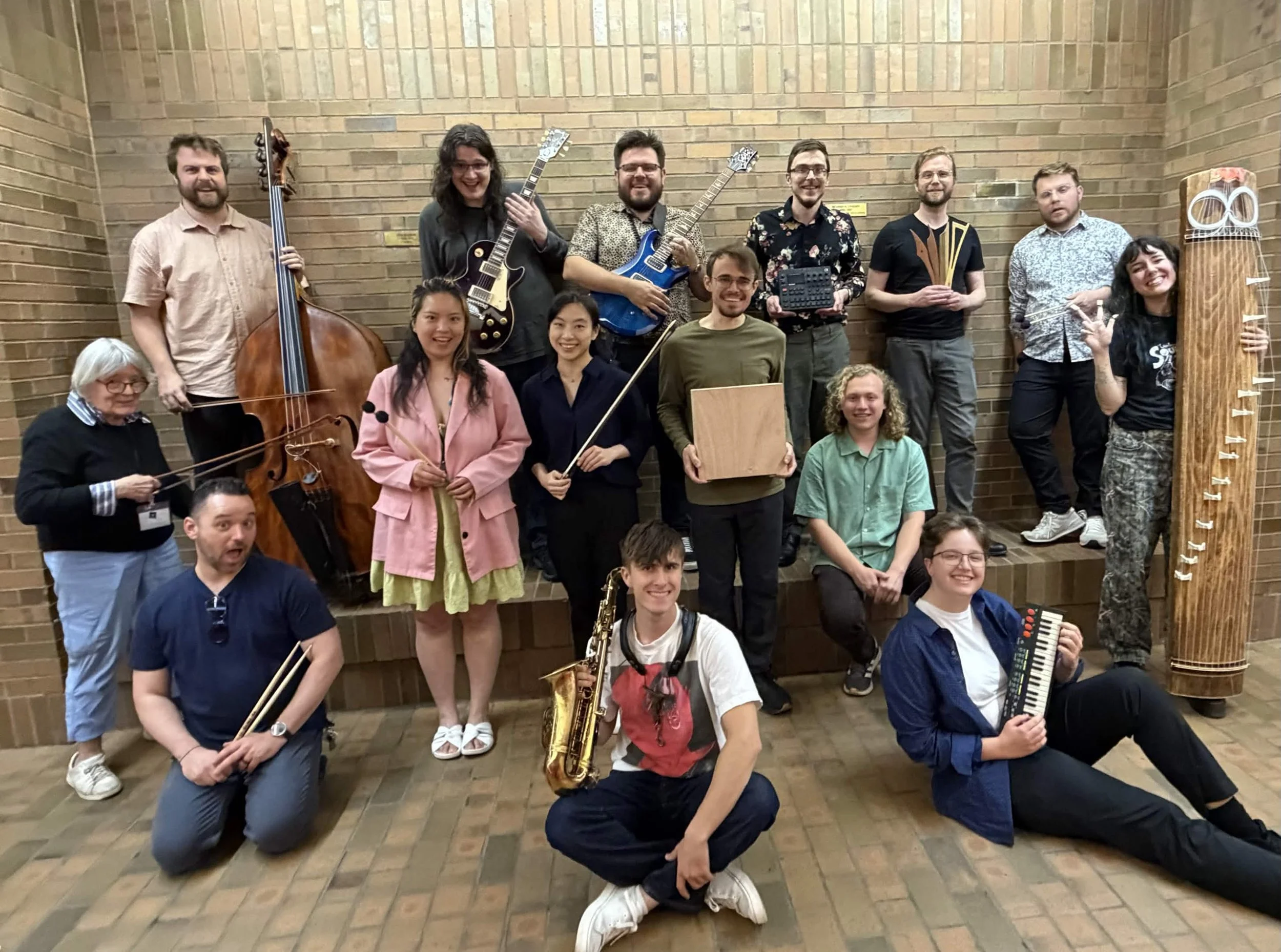
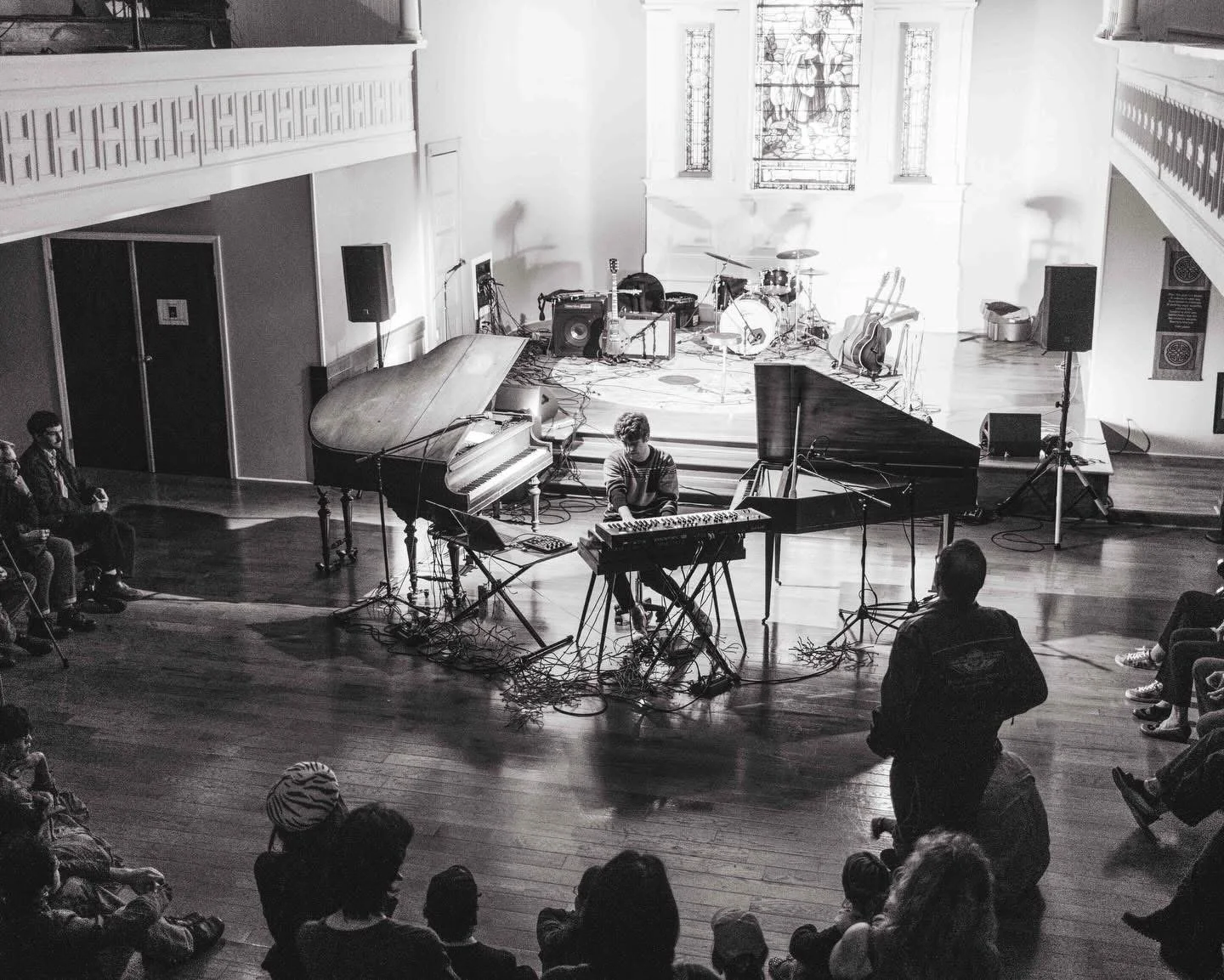
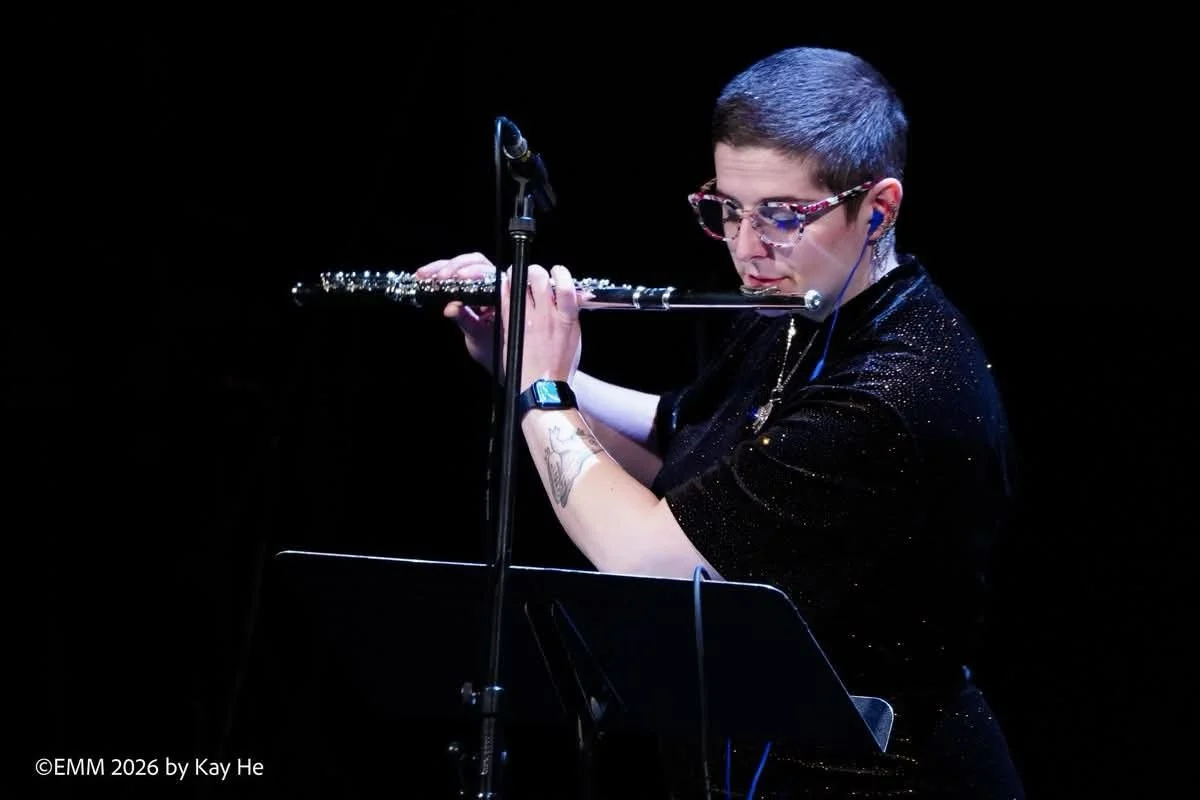
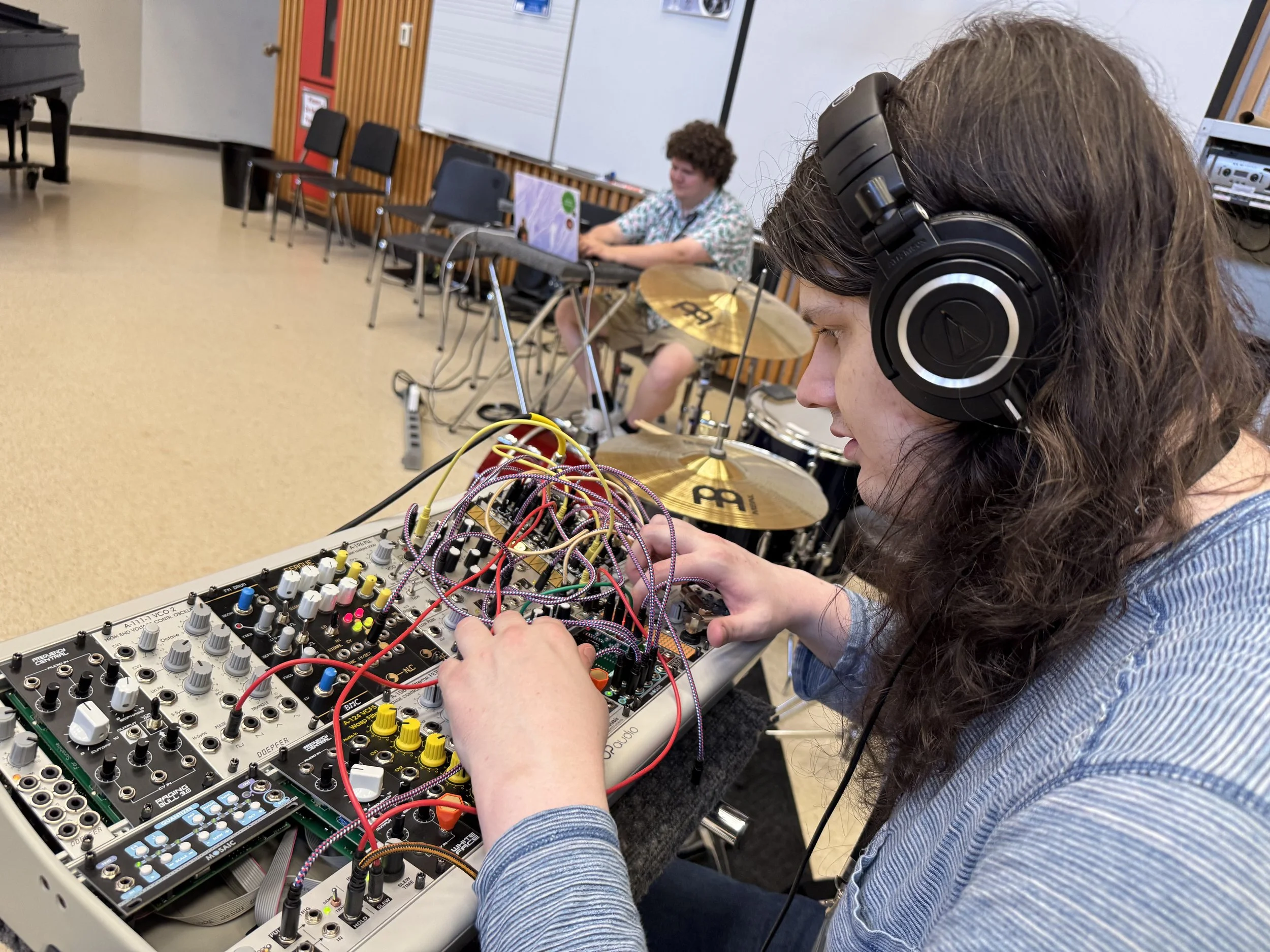
Concert of compositions composed and performed by the SPLICE Institute composer and performer participants.

Concert of compositions composed and performed by the SPLICE Institute composer and performer participants.
Concert of performances by the SPLICE Institute ensemble participants.
Concert of compositions composed and performed by the SPLICE Institute composer and performer participants.
Concert of compositions composed and performed by the SPLICE Institute composer and performer participants.
Concert of compositions composed and performed by the SPLICE Institute composer and performer participants.
Concert of compositions composed and performed by the SPLICE faculty and guests.
Public presentation by SPLICE faculty Per Bloland
Wednesday June 24, 2026
7:30pm EDT
Dalton Recital Hall, Western Michigan University
Livestream simulcast on SPLICE YouTube (unique link)
All compositions by Levy Lorenzo.
See below for Notes.
Modified Attack (2010)
for hacked video game joysticks
… percussion interlude …
Hex Bin (2020)
for inverter chip oscillator and photocells
… percussion interlude …
Where/When (2013)
for FM Koala laptop instrument
… percussion interlude …
Teacups and Light (2009)
for photocells
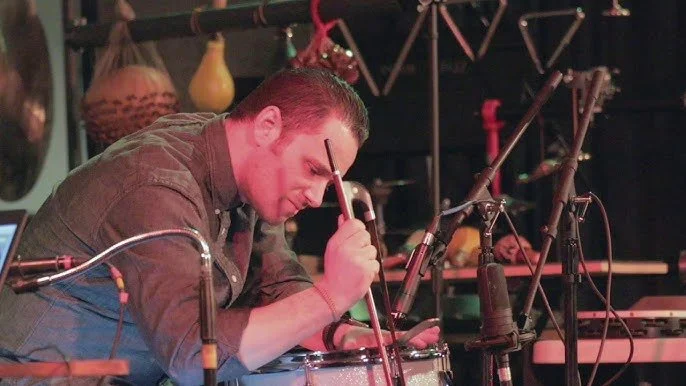
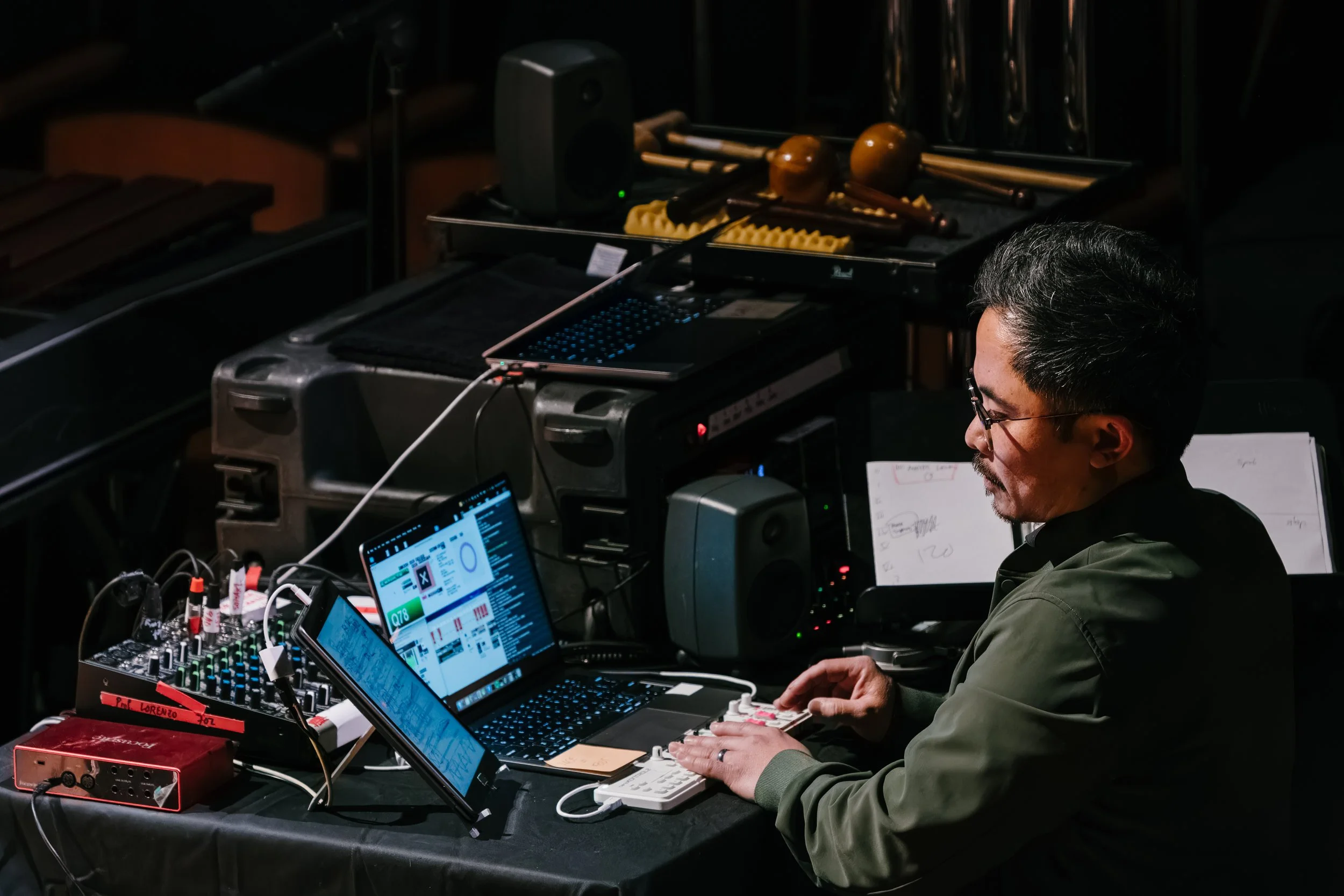
This program features music made from electronic musical instruments that I’ve invented. They use various strategies for mapping gesture to sound, and are realized via various platforms for electronic sound and input parsing. As with the main ideas of my presentation/talk, this concert highlights my core concepts of play, practice and live-performance in electronic music.
Born in Bucharest, Filipino-American Levy Marcel Ingles Lorenzo, Jr. works at the intersection of music, art, and technology. On an international scale, his body of work spans electronics design, sound engineering, instrument building, installation art, improvisation, and percussion performance. With a primary focus on inventing new instruments, he prototypes, composes, and performs new electronic music.
As an art consultant, Levy designs interactive electronics ranging from small sculptures to large-scale public art installations with artists such as Alvin Lucier, Christine Sun Kim, Ligorano/Reese, Autumn Knight, and Leo Villareal. As a musician, he has worked with artists such as Peter Evans, Tyshawn Sorey, Anna Thorvaldsdottir, Ryuichi Sakamoto, George Lewis, Henry Threadgill, and Claire Chase. As a sound engineer, he is in demand as a specialist in the realization of complete electroacoustic concerts with nontraditional configurations.
A core member of the acclaimed International Contemporary Ensemble (ICE), he fulfills multiple roles as percussionist, electronics performer, and sound engineer. His work has been featured at IRCAM, STEIM, REWIRE, MIT Media Lab, Harvestworks, Banff Centre, The Hermitage, Harvard University, G4TV, Grey Group, Bose, Amazon Studios, BBC, The New York Times, and Burning Man. In 2022, he made his debut as an electronic concerto soloist with the New York Philharmonic. More recently, he has had multiple engagements at Carnegie Hall as a soloist, technologist, curator, and composer.
Levy earned a Master's degree in Electrical and Computer Engineering from Cornell University and a Doctor of Musical Arts degree in Percussion Performance from Stony Brook University. He has presented numerous workshops and lectures on electronic musical instrument design and performance practice. Dr. Lorenzo holds a position as Professor of Creative Technologies at The New School College of Performing Arts, where he directs the Nstrument Lab.
Panel Discussion
Tuesday June 23, 2026
7:30pm EDT
Dalton Recital Hall, Western Michigan University
Livestream simulcast on SPLICE YouTube (unique link)
All compositions by Nick Zoulek.
Enter Branch (2025)
tenor saxophone
Torn (2026)
bass saxophone
Reach (2025)
bass saxophone and video
Rushing Past Willow (2016)
alto saxophone and video
video featuring Mauriah Donegan Kraker, additional videography by Cody LaPlant
Amplituhedron (2016)
alto saxophone and video
Video by Simsies
-pause-
Full Vision (2026)
extended bass saxophone
The Life and Death of 9413: a Hollywood Extra (1928)
Original score by the Overture Center’s Duck Soup Cinema, premiered June 2026
A silent experimental film co-written and co-directed by Robert Florey and Slavko Vorkapić.
Hey everyone,
First off, I’m honored to be here at Splice, sharing music and artistry with so many inspiring people. I’m here at Splice focusing on the performer/composer dynamic along with collaboration and multimedia work. I tried writing formal program notes for this performance, but that didn’t quite feel right. Instead, I want to focus on aspects of these pieces that have been on my mind in relation to the performer/composer journey, and I wanted to write it while I’m in a reflective place. So, I’m writing this message while walking along Lake Michigan in my home city of Chicago.
Enter Branch is the lynchpin of the album that I released last year, Enter Branch, on Better Company Records. This was the first piece that came together for the project, but in reality, it wasn’t finished until the very end. When I introduce it live, I usually say that performing it is a journey every time. It came to represent something more: growth, grit, and adversity. I don’t always share this part, but there was a great deal of physical hardship in the performance itself. There was a time when it felt like performing this piece was physically impossible. It sort of backslid, and my body would betray me during the performance. It’s interesting to reflect on that. The harder I tried to avoid it or mask it, the more present those difficulties became. It led me on a journey that included coachings with the Musician’s Wellness Institute, reevaluating my pedagogical background, and completely changing my perspective on what it means to play saxophone. But once I allowed the piece to be what it is, allowed the sounds to exist as they are, and accepted the possibility that I might not be able to perform it, it came together. It’s part of me, and sharing it with you all is a privilege.
For years, Torn was meant to be part of Enter Branch. The album had a dual narrative: one side representing branches extending upward, and another representing the root system creating a foundation. Torn fell into the latter category. By the time I finished recording everything, I had about 130 minutes of music. It was a sprawling project, and I had a great deal of difficulty describing what it was. I realized that the album really became a vernacular: a body of work and a part of me. Torn was crucial to the process, but it was part of something other than Enter Branch. I’m still not sure where this piece will live. In some ways, it feels like part of the process, and maybe that’s enough.
Originally, I thought Reach was part of the same root system as Torn. The piece does what the title says. It reaches both up and down, looks to the future, and reflects on the past. That realization guided me in the video, and I found a home in representing that duality through the visuals.
At this point in the program, I want to reflect and look at where this all came from. Rushing Past Willow was the first thing that felt like a thing, and it was the title track of my first solo album. It began as a vocabulary for improvisation, using sounds and an approach that I started investigating during my undergraduate degree and continued to develop while studying in Paris. The vocabulary lived with me and developed over years of experimentation and collaboration.
Working with Wild Space Dance Company was critical. Based in Milwaukee, Wild Space is a site-specific improvisatory dance company, meaning that they choose specific sites across the city and work specifically within those environments. The sounds that became Rushing Past Willow grew from a sort of ritual across many performances, and eventually solidified into a piece of their own. Many of those performances came together with dancer Mauriah Donegan Kraker. When the piece solidified, we wanted to create a video that could try to embody its site-specific origins. We went to locations deeply associated with the memories I connect to Rushing Past Willow, including Willowood Park, where the titular willow tree still stands. With the help of my friend and longtime skating pal, videographer Cody Laplant, who I first met while making skate videos and who has since become an inspiration through both his production company and incredible videography. We created this dance film as authentically as possible, sometimes with me performing off-screen.
I want to end this first set with Amplituhedron, which is also from the Rushing Past Willow project. So much of that journey involved giving shape to chaotic sounds. The particular pattern used in Amplituhedron is pretty chaotic, and I wanted to give it shape through form and direction. I came across the idea of an amplituhedron, which is a geometric figure that can visually summarize mathematical relationships that would otherwise take pages and pages to express. It is accompanied by a collaborative animation created by Simsies (Josh Simmons).
I’m going to pause for a moment to reset mentally and physically.
I think 2010 was the first time I performed with saxophone mouthpieces on tubing and PVC. I don’t come from a musical family. Rather, the family business was industrial and commercial plumbing and HVAC. I worked for the family business for a while in high school and during my first year of college. I think there was an underlying assumption that I would pursue music school, but eventually I’d come back and work for the business. The thing is... I was a pretty bad plumber. A major contributing factor was that I was really interested in the sounds that all of the tools, pipes, and industrial materials made. Plumbing wasn’t going to be the path for me.
Fast forward to 2010: that was the first time I performed with saxophone mouthpieces on tubing and pipes. At least I kind of came back to the family business, right? It was a performance with my brother Tim Zoulek (who went to school for visual art but returned to the family business), and involved sawing pipes on stage with Sawzalls, drilling vents into them, reassembling them into a massive structure, and then performing on that structure alongside percussionist and longtime collaborator Tim Russell.
Extending and preparing the saxophone became a thing. Shortly after, I started to embrace the idea of the saxophone as a biofeedback mechanism, and altering the horn created all kinds of possibilities in that regard. I developed the sounds and techniques further with Wild Space Dance (one time even including a choir of PVC players scattered in the foliage surrounding a dance performance), and with my experimental saxophone duo with Canadian saxophonist Tommy Davis, Duo d’Entre-Deux.
I continued to develop this vocabulary in the background. Rushing Past Willow and Enter Branch were focal points. I also didn’t have a great deal of time for it during traditional music studies. But it grew over the years, especially after completing my doctorate and during the pandemic. I found that the process and sonic structure of extending and preparing the saxophone continued to be a source of inspiration and growth. The sounds really came into their own while working on the score for Faces of Death, which was recorded in 2023 and released in theaters this summer.
Over the years, this practice became its own thing. I’m certainly not the only one who pursues this, but it’s still quite meaningful to me. While it felt separate from Enter Branch, I realized that the two pursuits worked in tandem and drew inspiration from one another. While I was refining Enter Branch’s track list and message, I realized how much these sounds were part of that story. While many of the root-system pieces and tube pieces felt like a separate project, the piece Vision was important to the overall narrative: both a sonic path forward, a realization in personal growth, and a shift in worldview.
I want to show more of Vision in this performance. I finished tracking a new album earlier this year, and I’m excited to release it.
I’ll conclude with a new original score commissioned by Madison, Wisconsin’s Overture Center and their silent film society, Duck Soup Cinema. It’s pretty fresh—I premiered it two weeks ago.
The Life and Death of 9413: A Hollywood Extra is a 1928 silent experimental film co-written and co-directed by Robert Florey and Slavko Vorkapić, and is considered a milestone in American avant-garde cinema. It follows a character who comes to be labeled 9413 (played by Jules Raucourt), who arrives in Hollywood with dreams of success as an actor, only to become part of the Hollywood machine.
Personally, I find it interesting to see such criticism of Hollywood at this early point in its history. I think the film maintains relevance today, especially as artists are fatigued by algorithms and the current music-release machine. At the same time, I’m inspired by the film’s persistence, resourcefulness, and DIY aesthetic. The film was produced on a budget of $97 (around $1,850 in today’s money), using cardboard, tin cans, and cigar boxes to create its landscapes and establishing shots.
Thank you for reading. Thank you for listening. Thank you for sharing your art. You all rock.
With warmth,
Nick
back to program
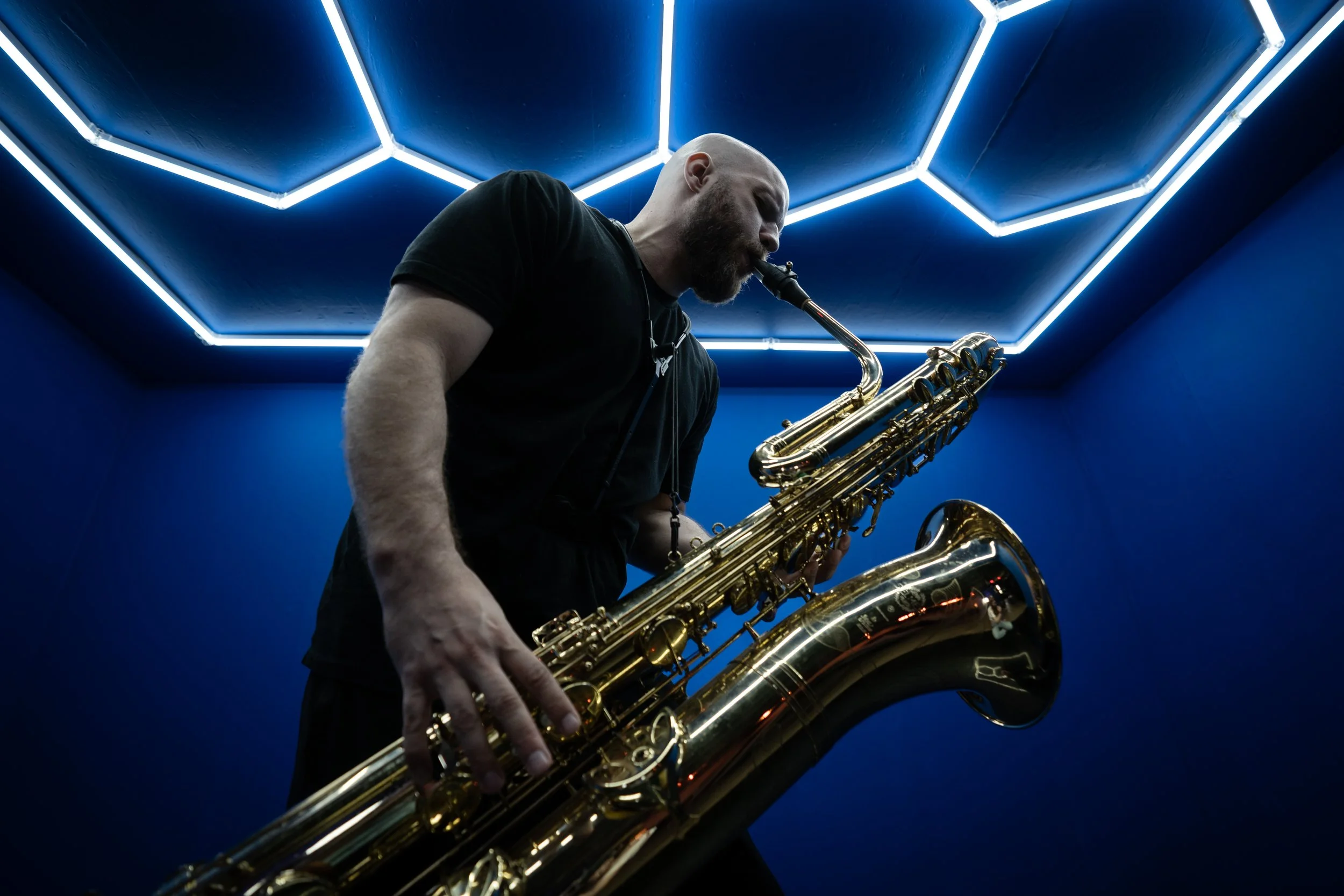
Nick Zoulek builds worlds out of brass, breath, and reeds. Based in Chicago, Zoulek is a saxophonist whose music feels physical, visceral, and urgent. Tender one moment, tectonic the next, his sounds are simultaneously alive and mechanized. Allan Kozinn wrote in The Wall Street Journal, “Zoulek’s performance, on saxophones in every range, is stunningly virtuosic, whatever the genre.” A musician of “pure mindfulness and talent” (PopMatters), his intuitive playing results in a “no-holds barred engine of avant-garde exploration.” (Portland Press Herald)
Zoulek’s new album, Enter Branch, unfolds as a narrative of growth. The album bridges his vivid approach to the saxophone with a cast of collaborators from across the musical spectrum, including Sean Carey (S. Carey, Bon Iver), spoken-word legend J. Ivy, Nathalie Joachim, Nick Photinos, Chris Porterfield (Field Report), ~Nois, and the Tontine Ensemble. These artistic voices merge with Zoulek’s prismatic performance style. His solo saxophone sound is raw, almost impossibly layered. This is not achieved through digital effects like looping or delay, but rather through a tapestry of circular breathing, extended overtones, vocalizations, and unrelenting arpeggios. Every tone of the saxophone is live, recorded in full, uninterrupted takes, and shaped with experimental microphone arrangements. Even the cracks of the saxophone’s sound create a root system of expression, woven with strands of vocals, bowed strings, ambient drones, seismic depth, and unfiltered warmth from his collaborators.
Enter Branch follows Zoulek’s debut album, Rushing Past Willow (Innova, 2016). Of that record, Allan Kozinn wrote, “Circular breathing yields rapidly undulating, swirling figures that seem unstoppable…fascinating chordal figures…evocations of electronic timbres and feedback. None of that would matter much…if he were a less imaginative composer.” Zoulek’s projects have been interdisciplinary from the start, and Rushing Past Willow exemplified this. Collaborators on the project included installation artist Erwin Redl, Wild Space Dance Company, and filmmaker Cody LaPlant. Rushing Past Willow yielded long-form dance works, art installations, and a series of landscape-based performance videos.
Though known for his original music, Zoulek is grounded in classical solo and chamber performance. He has commissioned and premiered over 100 works for the saxophone, including pieces by Martin Bresnick, Shelley Washington, Emma O’Halloran, and Aaron Kernis. His collaborative spirit has led to performances with champions of the contemporary music world, including Eighth Blackbird, Third Coast Percussion, Present Music, and ~Nois, with features by the Shockingly Modern Saxophone Festival, New Music Detroit, the Encore Chamber Music Festival, and the Sensoria series. He is the tenor saxophonist of the Coalescent Quartet and half of the experimental ensemble, Duo d’Entre-Deux. Every now and then, he plays covers of sad pop songs in the tenor saxophone trio, Dial-Up Stepmom.
Zoulek grew up in southeastern Wisconsin. He took up the saxophone in fifth grade, and in middle school, discovered Anthony Braxton’s For Alto at a particularly eclectic local record store. That experience soon expanded, listening to John Zorn, Ned Rothenberg, Joshua Redman, Brian Eno, modernist composers like Stockhausen, Berio, and Takemitsu, along with recordings of saxophone with electronic manipulation. Solo saxophone became a fascination. At the same time, skate videos and their soundtracks left a lasting mark, with everything from DJ Shadow to Slayer blending into his musical identity.
After earning a degree from the University of Wisconsin-Whitewater, Zoulek moved to Paris, studying avant-garde repertoire with Jean-Michel Goury and improvisation with bassist Joëlle Léandre. He later completed a Doctor of Musical Arts in Contemporary Music at Bowling Green State University studying with Dr. John Sampen, one of the foremost innovators of contemporary classical saxophone. Alongside his musical practice, he developed a deep craft in audio engineering, videography, and photography—skills that naturally folded into his interdisciplinary projects.
As a composer, Zoulek’s work lives in a diverse array of settings, writing for Third Coast Percussion, the Madison Ballet, Wild Space Dance Company, Rockstar Games, Legs of Steel ski films, and Found Format films. He is an accomplished video artist, with films screening at festivals and galleries worldwide. His visual work under the rubric NZMEDIA has led to collaborations with the Oregon Shakespeare Festival, the Chicago International Puppet Theater Festival, screenings with the Library of Congress, and numerous projects that translate music to the visual medium. No matter how far his practice branches outward, it remains rooted in the saxophone, built from breath and bones, but wired to become something more.
Public presentation by SPLICE guest Levy Lorenzo
Sam Wells, trumpet
Keith Kirchoff, piano
Adam Vidiksis, percussion
Monday June 22, 2026
7:30pm EDT
Dalton Recital Hall, Western Michigan University
Livestream simulcast on SPLICE YouTube (unique link)
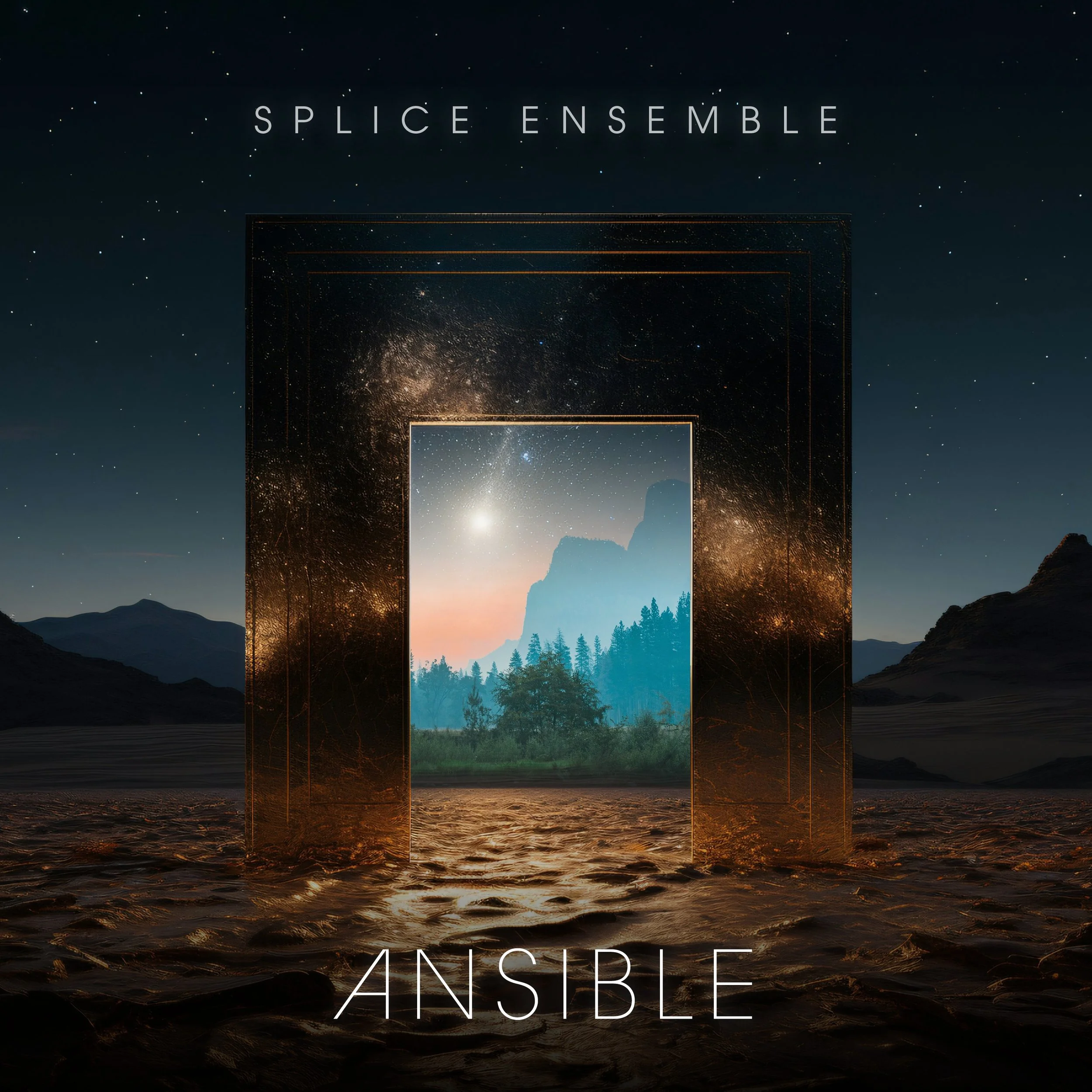
Help us celebrate SPLICE Ensemble's forthcoming release, Ansible on New Focus Recordings
Steven Ricks : Motor Culture (2021)§
I. Hanks Drive Through the Multiverse
II. Blessed Mother of Acceleration
III. Disastrous Experiment
Elainie Lillios : Living Between Seconds (2022)
Caroline Louise Miller : Ansible (2019)‡
I. Antiphony
II. Gethen/Icecaps
III. Urras/Walls
IV. Passacaglia
§Commissioned by the Barlow Endowment for Music Composition at Brigham Young University for SPLICE Ensemble.
‡This commission has been made possible by the Chamber Music America Classical Commissioning Program, with generous funding provided by The Andrew W. Mellon Foundation.
Steven Ricks : Motor Culture
In 2010 I was invited by my friend Ned McGowan to write a piece for his ensemble Hexnut as part of a project they initiated: WRENCH. It was inspired by the photography of Edward Burtynsky, and each composer involved wrote a piece that coordinated sound with one or more of Burtynsky’s images. At the time I was drawn to two images related to Burtynsky’s concept of “Motor Culture,” that is, all the activities of taking from the earth and production that relate to the automobile, from oil drilling to car manufacturing to freeway systems and beyond. I’ve continued to think about how the automobile influences so many aspects of my life and decided to make this piece a poetic exploration of some of those facets. The first movement, “Hank’s Drive Through the Multiverse,” takes as inspiration a children’s song by Pinto Colvig called “Honkety Hank,” a song I used to listen to from an old vinyl single my Dad had. This playful inspiration is transformed into and/or pit against a more rigorous process of color and talea that provides the underlying structure for the piece. Ultimately, I picture a sort of surreal journey that juxtaposes the playful and idealistic view of going for a ride with the more problematic features and dangers of automobile travel.
The second movement, “Blessed Mother of Acceleration,” steals a line from The Blues Brothers movie (which itself features a lot of driving and an epic car chase) to suggest the ability of cars to accelerate, but also the general “drive” or push to go faster, be better, advance in technology, etc. (cue Daft Punk’s “Harder, Better, Faster, Stronger”). The constant pulse, driving rhythms, and propulsive electronics are pushing things forward in a way that suggests progress, but also perhaps has the spirit of getting out of control and heading for disaster.
The final movement, “Disastrous Experiment,” is a somber reflection on the painful aspects of automobile violence, both intentional and accidental. Motor Culture was commissioned by the Barlow Endowment for Music Composition at Brigham Young University for SPLICE Ensemble and this is its premiere performance.
Elainie Lillios : Living Between Seconds
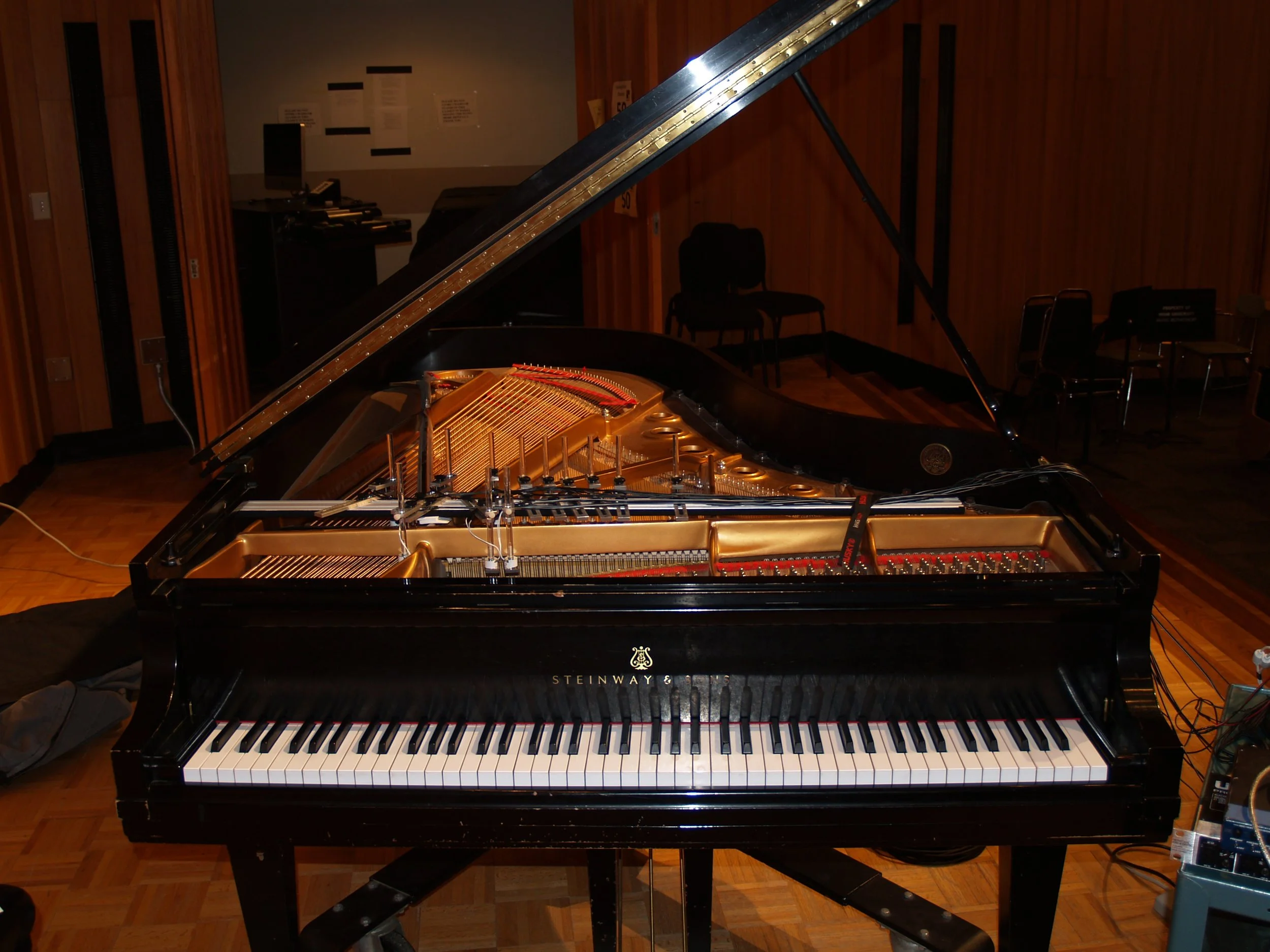
Living Between Seconds is a work for trumpet in C, drum set with auxiliary percussion, and piano with fixed media and live electronics that explores the phenomenon of temporal expansion through mindfulness and how attending to the present moment can enhance, suspend, and/or expand temporal perception.
The journey to creating Living Between Seconds began by creating a meditative fixed media soundscape composition using environmental recordings captured in remote desert locations across the American southwest.* The foundational soundscape very little processing, allowing the environment’s expansive, temporally suspended nature to remain untouched. The small detailed sounds contained within the environment – birds chirps, owl hoots, coyote howls, train hums, and others – are treated as trigger points for foreground instrumental material, influencing In so acoustic gesture, texture, and timbre. Acoustic events generated from the soundscape in turn produce live, interactive electroacoustic events programmed using Cycling 74’s Max. This real-time processing expands the trio’s acoustic sound, generating “meta instruments” that further delineate the space between sound and silence, creating an immersive environment where the ensemble and electronics articulate the meditative soundscape.
Collaborating and experimenting with the SPLICE Ensemble during the compositional process was a priceless aspect of this project, allowing each member to contribute creative ideas and techniques that make this piece a dynamic, fluid collection of evolving, expanding material. Through guided improvisation, SPLICE Ensemble “lives between the seconds” of the work, articulating gestures and textures, responding to each other, to the fixed media, and to the live electronics, simultaneously creating and living in the evolving sonic landscape.
Living Between Seconds was made possible by a grant from the Fromm Music Foundation. The piece was commissioned by the SPLICE Ensemble, and is dedicated to them with admiration and appreciation.
Caroline Louise Miller : Ansible
Ansible is the result of a year-long, extremely rewarding collaboration with SPLICE Ensemble. A heartfelt thanks to Sam Wells, Keith Kirchoff, and Adam Vidiksis, whose artistry, dedication and honest critique have shaped this work at every stage of our collaboration.
In memoriam: Ursula K. Le Guin
Ursula K. Le Guin coined the term “Ansible” in her 1966 science fiction novel Rocannon’s world. The Ansible is a device that enables instantaneous interstellar communication, alleviating the significant time lag between the transmission and receipt of messages that could previously only travel at the speed of light. In Le Guin’s Hainish Cycle, a loosely connected group of sci-fi novels that take part within the same universe, the Ansible is sometimes present and sometimes absent—for a variety of reasons, economic, political, or because it hasn’t been invented yet. In circumstances where the Ansible is absent, communication between entities is often frustrated or inflected by vast distances of time and space, causing interstellar political troubles as messages received 50 or 100 years later lose their relevance. The Ansible, an open-source, open-science communications device invented by an Anarchist physicist, is conceived by Le Guin as having utopian potentials, enabling a peaceful interstellar coalition called the Ekumen. In spite of its Utopian potentials, its presence produces conflict as well, a rich metaphor for globalization. Struggles are waged for control of the Ansible technology itself, by entities who wish to capitalize on exclusive rights to its use. The rapid exchange of information across galaxies also interacts in unpredictable ways with different societies, in the very worst circumstances causing a technocracy (see The Telling).
The four musical movements of Ansible find resonances with these themes and with my two favorite novels of the Hainish Cycle, The Dispossessed (1974) and The Left Hand of Darkness (1969).
Antiphony is a meditation on pre-ansible communication, as messages from almost a century ago (conveyed by classical music recordings from the 1930’s, 40’s, and 50’s) finally are received in a not-so-distant future. Keith responds by playing extrapolations on these old tunes on a decaying piano. These old recordings, first heard in Antiphony, are carried throughout the other three movements; snippets placed in a variety of contexts—borne on the wind from a distant house maybe, or heard broadcast over the radio. The theme of embedding the same information in a multitude of spatial and temporal contexts carries throughout the rest of the piece.
Gethen / Icecaps is inspired by the ice-covered planet in The Left Hand of Darkness. It is a soundscape of creaking, melting, ice, whistling wind, glaciers, arctic fauna, and eerie voices carried by Sam’s desolate trumpet solo.
Urras / Walls draws on themes from The Dispossessed, where the protagonist constantly runs into walls and barriers of all sorts in his quest to develop the Ansible as an open-science technology. Some of these barriers prevent him from apprehending rampant economic and social inequalities that plague the capitalist society in which he is performing his research, highlighting the idea that walls both keep one side out and the other in. Toward the end of the movement, sounds from a general strike are broadcast over the radio. I used recordings of primarily women chanting, from protests all over the world, as the the oppression of women worldwide is closely linked with various economic and social injustices. During these moments, Adam Vidiksis improvises drum solos drawing on free jazz.
Passacaglia takes the form of a continuously shifting theme and variations, making small ripples and delays through time. The three instruments often work in a loose canon with each other. Delays at the scale of seconds register as near-simultaneity from an interstellar perspective. A broadcast of the general strike is briefly heard again on the radio, this time through the window of a passing car on a remote desert highway.
SPLICE Ensemble is a trumpet, piano, and percussion trio focused on cultivating a canon of electroacoustic chamber music. Called a “sonic foodfight” by Jazz Weekly, SPLICE Ensemble works with composers and performers on performance practice techniques for collaboration and integrating electronics into a traditional performance space. The resident ensemble of both SPLICE Institute and SPLICE Festival, SPLICE Ensemble has been a featured ensemble at M Woods in Beijing, SEAMUS, the Electroacoustic Barn Dance, SCI National, Electronic Music Midwest, and New Music Detroit’s Strange Beautiful Music 10. They have recorded on both the SEAMUS and Parma Labels.
Described as a “virtuosic tour de force” whose playing is “energetic, precise, (and) sensitive,” pianist and composer Keith Kirchoff has performed throughout North America, Europe, and the Pacific Southwest. A strong advocate for living composers, Kirchoff is committed to fostering new audiences for contemporary music and giving a voice to emerging composers, and to that end has commissioned several dozen compositions and premiered hundreds of new works. He is the co-founder and President of SPLICE Music: one of the United States’ largest programs dedicated to the performance, creation, and development of music for performers and electronics. Kirchoff is active as both a soloist and chamber musician, and is a member of both Hinge Quartet and SPLICE Ensemble. Kirchoff has won awards from the Steinway Society, MetLife Meet the Composer, the Foundation for Contemporary Arts, Chamber Music America, and was named the 2011 Distinguished Scholar by the Seabee Memorial Scholarship Association. He has recorded on the New World, Kairos, New Focus, Tantara, Ravello, Thinking outLOUD, Zerx, and SEAMUS labels.
Acclaimed as one of the “contemporary masters of the medium” by MIT Press’s Computer Music Journal, electroacoustic composer Elainie Lillios creates works that reflect her fascination with listening, sound, space, time, immersion and anecdote. Her compositions include stereo, multi channel, and Ambisonic fixed media works, instrument(s) with live interactive electronics, collaborative experimental audio/visual animations, and installations.
Her work has been recognized internationally and nationally through awards including a 2018 Fromm Foundation Commission, 2016 Barlow Endowment Commission, 2013-14 Fulbright Award, First Prize in the Concours Internationale de Bourges, Areon Flutes International Composition Competition, Electroacoustic Piano International Competition, and Medea Electronique “Saxotronics” Competition, and Second Prize in the Destellos International Electroacoustic Competition. She has also received awards from the Concurso Internacional de Música Electroacústica de São Paulo, Concorso Internazionale Russolo, Pierre Schaeffer Competition, and La Muse en Circuit. She has received grants/commissions from INA/GRM, Rèseaux, International Computer Music Association, La Muse en Circuit, NAISA, ASCAP/SEAMUS, LSU’s Center for Computation and Technology, Sonic Arts Research Centre, Ohio Arts Council, and National Foundation for the Advancement of the Arts. She has been a special guest at the Groupe de Recherche Musicales, Rien à Voir, festival l’espace du son, June in Buffalo, and at other locations in the United States and abroad.
Caroline Louise Miller’s music explores affect, biomusic, labor, tactility, and digital materiality. She works freely across the realms of electroacoustic music, popular-genre crossover, sound art, chamber music, and experimental musical theater, and because of that appears at a diverse array of festivals and venues. Her most recent work is Ansible, a 32-minute meditation on communication, globalization, and open-science technology based around the science-fiction work of Ursula K. Le Guin. Ansible was commissioned by SPLICE Ensemble with a classical commissioning grant from Chamber Music America. In 2018 she won the ISB/David Walter Composition Competition for Hydra Nightingale, created with free jazz bassist Kyle Motl. Other projects include an electronics/trumpet duo with Alexandria Smith. In May 2019, the duo performed at The Stone (NYC), a historic venue curated by John Zorn. An ongoing project is a series of instrumental hip-hop/acousmatic crossover works. The first of these, Subsong, takes us on a journey through a gloomy sonic netherworld. Subsong was voted onto SEAMUS vol. 28 by audience choice. In 2020, C.L.M. will work with Ensemble Adapter (Berlin) on a new biomusic piece, studying the sound cultures of wild dogs, insects, birds, cetaceans, and rainforests.
Alongside individual projects, Caroline is passionate about organizing, curating, and producing concerts. From 2012–2017, she organized and curated annual freeform concerts at the Birch Aquarium at Scripps Institution of Oceanography. Immersion@Birch Aquarium drew over a thousand visitors from the San Diego county community since its inaugural event, and incorporated musics as diverse as experimental chamber, gamelan, American folk, soul, free jazz, drone, and noise; as well as installation, film, and poetry. In 2019 she curated a multimedia science-fiction show called Tales from the Wasteland that brought together works which meditate on alternate realities; pasts, presents, and futures. Since 2014, she has also co-organized and co-curated, with Fernanda Navarro (and many others over the years!) a series of concerts and installations centering the perspectives and experiences of women.
Caroline's music appears across the U.S. and around the world. She holds a Ph.D. in music composition from UC San Diego, where she worked with Katharina Rosenberger, Amy Cimini, Miller Puckette, Anthony Burr, and Ricardo Dominguez.
Steven Ricks (b. 1969) is described in BBC Music Magazine as a composer “unafraid to tackle big themes.” He creates work that is bold, innovative, ambitious, and diverse, and that often includes a strong narrative influence and theatrical flare. His music is performed and recorded by several leading artists and ensembles, including counter)induction (NY), New York New Music Ensemble, Canyonlands New Music Ensemble (SLC), Talujon Percussion (NY), Hexnut (Amsterdam, NE), Links Ensemble (Paris, FR), Manhattan String Quartet, Earplay (SF), NOVA Chamber Music Series (SLC), Empyrean Ensemble (SF), NY Metropolitan Opera soprano Jennifer Welch-Babidge, pianist Keith Kirchoff, guitarist Dan Lippel, flutist Carlton Vickers, and violinist Curtis Macomber.
Ricks has received commissions and awards from the Fromm Music Foundation, the Barlow Endowment, SCI, and Center for Latter-day Saint Arts, among others, and his music has been featured at multiple national and international conferences, festivals, and symposia, including ICMC, SEAMUS, NYCEMF, ISIM, KISS (Kyma International Sound Symposium), Third Practice, Festival of New American Music, and TRANSIT (Leuven, BE). Recordings of his music appear on multiple labels, including New Focus Recordings, Bridge Records, Albany Records, pfMENTUM, Vox Novus, and Comprovise Records. Ricks received degrees in music composition from Brigham Young University (BM), the University of Illinois at Urbana-Champaign (MM), the University of Utah (PhD), and a Certificate in Advanced Musical Studies (CAMS) from King's College London. He is a professor in the BYU School of Music where he teaches music theory and composition and is the Music Composition and Theory Division Coordinator (2016 to the present). He is former Editor of the Newsletter for the Society for Electro-Acoustic Music in the United States (2012-19), and was director of the BYU Electronic Music Studio for 20 years (2001-2021).
Adam Vidiksis is an American drummer, composer, and music technologist whose work explores the entanglement of humanity with the machines we build. Based in Philadelphia & Delaware, he serves as Associate Professor and Director of Music Technology & Composition, as well as the Center for Music Innovation & Creativity, at Temple University. His compositions have received support from organizations such as the National Endowment for the Arts, Chamber Music America, Japan–U.S. Friendship Commission, the American Composers Forum, and the Delaware Division of the Arts. He is President of the Society for Electro-Acoustic Music in the United States (SEAMUS) and Past President and Director of Ensemble Activities for SPLICE. He performs with SPLICE Ensemble, Aeroidio, and the Miller/Vidiksis/Wells trio, and serves as conductor for Network for New Music. A dedicated champion of new work, he has premiered hundreds of compositions by artists from around the world, continually seeking meaning through sound, technology, and human connection.
www.vidiksis.com
Sam Wells is a musician and artist based in Philadelphia, whose work often invokes a heightened sense of the entanglements of space, air, breath, and body. Manifesting as music composition, performance, and improvisation, as well as multimedia performance and installation, his work is experientially substantial. It is rooted in the humanity of breath and highlights our interrelations with the cosmic, terrestrial, social, and internal spaces that surround us.
Sam is a trumpeter and improviser who has performed around the world and is a member of SPLICE Ensemble, Aeroidio, and the Miller/Vidiksis/Wells trio. He has also performed with Contemporaneous, Metropolis Ensemble, Nate Wooley, TILT Brass, the Lucerne Festival Academy Orchestra, and the Colorado MahlerFest Orchestra. Sam has recorded on the Scarp Records, New Amsterdam/Nonesuch, New Focus Records, SEAMUS, and Ravello Recordings labels.
As a composer, Sam creates acoustic, electroacoustic, and electronic works, often incorporating multimedia elements. His works have been performed throughout the United States and internationally. He is a recipient of a 2016 Jerome Fund for New Music award, and his work “stringstrung” is the winner of the 2016 Miami International Guitar Festival Composition Competition. As an avid collaborator, Sam has written for theater and dance productions, as well as for many notable performers of contemporary music such as HOCKET, SPLICE Ensemble, Maya Bennardo, Dana Jessen, Vicki Ray, Lin Faulk, Kenken Gorder, and Will Yager.
Technology is a deep through line of Sam’s practice, and he is active as a music technologist. Sam is a Cycling ’74 Max Certified Trainer and organizes the Max Meetup Philadelphia event series. He runs Scarp Records, a record label dedicated to highlighting the experimental and improvisational practices of performer/composers.
Sam currently serves as the Member At Large for the Society for Electro-Acoustic Music in the United States (SEAMUS), as well as a board member for SPLICE Music, the parent organization of SPLICE Institute, Festival, and Ensemble, dedicated to the performance, creation, and development of music for performers and electronics.
Sam holds degrees in both performance and composition from the University of Missouri-Kansas City, graduate degrees in Trumpet Performance and Computer Music Composition from Indiana University, and a doctoral degree from the California Institute of the Arts. Sam is an Assistant Professor of Music Technology at Temple University.
Public presentation by SPLICE guest
Saturday March 7, 2026
7:00pm EDT
Performance Hall, Colby College
Produced by Colby College Department of Music with the Department of Performance, Theater, and Dance, Colby Arts Office
All times are Eastern Time.
Andrew Conklin : Vanishing Point
Choreography: Annie Kloppenberg in collaboration with performers
Performance: Isabella Buckman, Elliott Evans, Eva Walden, Anna Winslette, Lydia Wirth,
Camille Alipalo (understudy), Jaden Oulette (understudy)
Set construction: John Ervin
Nick Hwang : Prospect Certainty
Eliott Evans, dance
Scott L. Miller : The Chronicles of Kristi’s Fantastic ICE Machine
Performance: Zoe Anderson, Alexandra Berger, Haiyi Chen, Matthew Cumbie, Katherine Ferrier, Sie Hamilton-Thibert, Jillian Harris, Annie Kloppenberg, Everett Perry-Johnson, Kalyah Sayre, Kate Spence, Holly Taylor, Cho Ying Tsai, Stella Yang, Daniil Zakirzyanov, Xinyi Zhang
Sepehr Pirasteh : IN FLUX I HOLD ON TO YOU
Yingting Liu : P.E.R.F.E.C.T. O.R.D.E.R. O.N.L.Y.
I. F.r.a.c.t.u.r.e.
II. D.i.s.c.i.p.l.i.n.e.
III. C.o.l.l.a.p.s.e.
Xinyi Zhang ('25), choreography
Zoe Anderson ('28), Haiyi Chen, Kate Spence ('25), Stella Yang ('27), dance;
Wex Huang, Digital Designer
Interested in donating to SPLICE? Now you can!
All donations go directly toward scholarships for our summer Institute - and no amount is too small.
Andrew Conklin : Vanishing Point
Writing in the New York Times on Jan. 18, 2026, columnist M. Gessen attempted to take stock of the country a year into the second Trump administration:
“We have become a country where people are disappeared by a paramilitary force that hunts them down in their apartments, on city streets and country roads, and even in the courts. Less than a year ago, videos of ICE arrests would go viral and social media posts about ICE sightings would send chills down our spines. Now even the most high-profile detentions have faded from view: Who has been released? Who has been deported? Who is still missing?”
This quote captures so accurately for me how these individual acts of federal violence coalesce into a slow but unmistakable erosion of political norms, and how impossible it can feel to be adequately attuned to and vigilant against these gradual shifts while attending to the inevitabilities of our everyday lives.
This piece is an expression of my experience living in the United States in 2025. The slowly evolving drone in the electronics part feels to me like an oncoming tidal wave, to which the musicians respond (or don’t respond) by playing different styles of music. They begin with classical music of childlike innocence before proceeding to a more combative form of progressive jazz/fusion, eventually landing in an open soundscape that allows them to engage most directly with the inexorable electronics.
Jessica Ackerley : Svell
Svell, the Old Norse word for “ice,” draws its sound world from field recordings I made last summer in Svalbard, captured over the course of a two-week residency aboard a tall ship. These Arctic sounds form the core of the piece’s atmosphere and texture, drawing on dripping water at the edge of the pack ice at 80 degrees north, melting ice floating in the sea, calving glaciers, and freshwater streams. The stark contrast of the natural landscape, with dark fjords surrounding expanses of white snow and ice, informs the music’s interaction between dynamic spaces of loud and quiet. This composition is part of a larger body of work I have been developing over the past two years, inspired by my Arctic residency and intended to offer audiences a glimpse into this remote part of the planet.
back to program
Nick Hwang : Prospect Certainty
PROSPECT CERTAINTY is an interactive work for the SPLICE Ensemble (and an optional dancer) with elements of gameful performance. While this work was written specifically for the SPLICE Ensemble, I created the framework to expand for ensembles of varying sizes.
back to program
Scott L. Miller : The Chronicles of Kristi’s Fantastic ICE Machine
I am working some things out with this piece. Musically, I’ve been concerned with one aspect of what Monty Adkins labels a “post-acousmatic practice” for a few years now—merging the aesthetic and production values of the acousmatic tradition with the agency and musical coherence of certain improvised music traditions. Several challenges present themselves repeatedly. Critical are performer experience and preparation with different improvisational styles; is there overlap with my own experiences or expectations? What do the performers uniquely bring to the final musical outcome? This is a fundamentally collaborative endeavor, but how do I balance the responsibilities and effectively communicate my desires? This last question leads to the challenge of notation. In the absence of an aural performance practice guiding improvisational choices, which traditions should I go to and which ones lend themselves to being easily integrated into my chosen graphic approach? So far I have several compositions that serve as possible answers, but there is a long way to go yet.
back to program
Sepehr Pirasteh : IN FLUX I HOLD ON TO YOU
Like distorted images, distorted memories, wrapped tape, this piece comes from my own journey as an immigrant and artist in exile. It’s about how moving between places and being held by borders can warp your sense of the past. I wanted to capture that feeling of memories stretching and pulling like an old tape caught in a machine, where the melodies and images of home feel familiar, yet also completely different. The music takes that messy feeling of a life in flux and turns it into a landscape where everything you remember is slightly out of focus and always changing.
back to program
Yingting Liu : P.E.R.F.E.C.T. O.R.D.E.R. O.N.L.Y.
Perfect. Order. Only. is a sonic fable about how women learn to move, breathe, speak, and fit themselves into the shapes that society draws for them. In many East Asian contexts today, perfection often wears the mask of order. It appears polite and graceful on the surface, yet underneath it quietly molds the body and softens the voice. Women are encouraged to be gentle and quiet, slim and pale, and to smile in precisely the right way, until they become bodies that are watched, consumed, managed, and adjusted.
This work asks political questions about sound.
Whose voice is allowed to be heard?
Who is told to speak softly?
Who is shaped into a standard?
Whose breathing becomes almost invisible?
The music weaves together many types of training sounds. It carries traces of the collective singing and broadcast recitation that followed the Cultural Revolution, the rhythmic pulse of 1980s aerobics culture, the energetic tone of Korean fitness media, and the slightly glitchy texture found in today’s viral electronic aesthetics. There are also subtle tones and sound images that echo the listening traditions of India and Japan, like faint memories emerging through the surface of the music. These are not direct quotations but sonic images, small cultural ghosts that reveal how sound and the body have been shaped across different times and Regions.
These seemingly unrelated sounds come together naturally in my music. This continues the listening environment I grew up with, which felt like a cultural melting pot. I did not hear a single, linear cultural sound while growing up. Instead, I heard a mixture of media, histories, and aesthetics. Propaganda voices, workout rhythms, television sound cues, noisy human chatter, popular music, and fragments of online sound culture appeared together in daily life. For me, this mixture is not a deliberate collage but a natural way of hearing the world. It has shaped the way I understand rhythm, energy, and structure.
Although the sounds come from different sources, the messages they carry are strikingly similar. Stay consistent. Follow the rules. Do not cross the line.
back to program
SPLICE Ensemble is a trumpet, piano, and percussion trio focused on cultivating a canon of electroacoustic chamber music. Called a “sonic foodfight” by Jazz Weekly, SPLICE Ensemble works with composers and performers on performance practice techniques for collaboration and integrating electronics into a traditional performance space. The resident ensemble of both SPLICE Institute and SPLICE Festival, SPLICE Ensemble has been a featured ensemble at M Woods in Beijing, SEAMUS, the Electroacoustic Barn Dance, SCI National, Electronic Music Midwest, and New Music Detroit’s Strange Beautiful Music 10. They have recorded on both the SEAMUS and Parma Labels.
back to program
PORTLAND BALLET
Now in its 45th season, Portland Ballet is the region’s professional ballet company, which presents classical, neoclassical, and contemporary works and offers a wide range of educational experiences. It uses ballet performance and education to strengthen communities, helping to make Maine even more vibrant, healthy, inclusive, and cooperative.
back to program
Zoe Anderson (Colby ‘28) is from Newton, Massachusetts. She is majoring in Psychology and minoring in Chinese and Dance. Zoe started dancing her senior year of high school, and before that, she was a competitive rhythmic gymnast. She loved how dance was incorporated into the sport. Her favorite styles of dance are ballet, contemporary, and jazz. When she’s not dancing, you can find her getting coffee, crocheting, or spending time with friends. She is so excited to get to work with Xin Yi and her peers on such a special piece! back to program
Isabella Buckman was raised in Eureka, California where she began her classical ballet training at North Coast Dance. She spent summers training with Boston Ballet, American Ballet Theater, The Rock School, and State Street Ballet. In 2024, Buckman graduated cum laude from Butler University with a BFA in Dance Performance. In her time at Butler, she had the opportunity to perform in classical works including The Nutcracker, Giselle, Swan Lake, and Cinderella, as well as original contemporary works by Derek Reid, Susan McGuire, Cynthia Pratt, and David Ingram. In addition, she also had the opportunity to work with Deborah Wingert of the George Balanchine Trust in Serenade. After graduation, she moved to Maine to join Portland Ballet. Her performance credits with Portland Ballet include Russian Caviar in A Victorian Nutcracker and Fairy of the Golden Vine in The Sleeping Beauty.
back to program
Haiyi Chen is a graduate student in the Dance MFA Embodied Interdisciplinary Practice at Duke University. She holds a B.A. degree in Performance(ballet) at Beijing Dance Academy. Haiyi began her professional career dancing with San Francisco Ballet, Ballet West and National Ballet of China. In 2020, she worked as a ballet teacher and choreographer at Bali Dance Company. As a choreographer, Haiyi focuses on exploring the social and cultural implications behind dance. Her recent creative projects have centered on giving voice to marginalized groups (including people with disabilities) through body language, with a key focus on investigating the role and value of dance as a medium in promoting inclusion, constructing identity, and advancing social equity.
back to program
Andrew Conklin (b. 1984) is Associate Professor of Composition and Theory at University of the Pacific, where he directs the Composition program. Andrew's music has garnered recognition from diverse voices spanning the worlds of popular and classical music, and he has appeared as a composer and performer throughout the United States and Europe. His music has received support from organizations including the Trust for Mutual Understanding, the Howard Gilman Foundation, the Mid Atlantic Arts Foundation, the New York Foundation for the Arts, and Millay Arts. His albums are released on New Focus Recordings and Bot Cave Records. A versatile musical collaborator, Conklin earned a Grammy nomination for Best Bluegrass Recording for his contributions to The Hazel and Alice Sessions (Spruce and Maple Music). His guitar and bass playing can be heard on record labels such as Six Degrees, Spruce and Maple, Plug Research, City Slang, BAG Productions or Arhoolie, and he has toured extensively in the United States and Europe as a guitarist and bassist with indie rock bands, bluegrass groups and improvising combos.
back to program
Guitarist, composer and visual artist, Jessica Ackerley expands the lines between avant-garde jazz, contemporary classical, and ambient music, Ackerley has distinguished their musical voice across 25 releases as a bandleader with acclaim from publications like Pitchfork, BBC Radio, Wire Magazine, GRAMMY News, WholeNote, Musicworks and BandCamp, among others, making multiple critics’ year end lists.
Ackerley has toured extensively throughout North America and Europe, performing at noteworthy venues like The Metropolitan Museum of Art: Met Breuer, Vortex (U.K.), Bang on a Can LOUD Weekend (Mass MoCA), The Stone, Roulette Intermedium, Earshot Jazz Festival, Something Else! Festival, Ironworks Fest and Coastal Jazz Festival. Ackerley has composed music for Unheard-Of Ensemble, HYPERCUBE, and Clara Kim.
They have been commissioned by Bang on a Can, NYSFA, Continuum (Toronto), Adult Swim, Mutual Mentorship, and New Music USA; awarded funding from Canada Council for the Arts and Foundation for Contemporary Arts; nominated for the prestigious Academy of Arts and Letters Music Composition Award; and attended residencies at Banff Center for the Arts, Atlantic Center for the Arts, and Arctic Circle Residency.
back to program
Elliott Evans was born in Phnom Penh, Cambodia, and has studied ballet since the age of nine with American Ballet Theatre Jacqueline Kennedy Onassis School (under Franco De Vita). He also trained privately with Fabrice Herrault in New York City, and with The National Ballet School of Canada in Toronto (under Sergiu Stefanschi and Raymond Smith). He then continued as a trainee with the Washington School of Ballet under the direction of Xiomara Reyes, Rinat Imaev, and Mimmo Miccolis, and danced with Washington Ballet under Artistic Director Julie Kent. He has attended several summer intensives at American Ballet Theatre and Fabrice Herrault in New York City, English National Ballet in London, Canada’s National Ballet School in Toronto, Sarasota Ballet, Arts Umbrella in Vancouver, and with Orsolina28 in Moncalvo, Italy. His work with Arts Umbrella and Orsolina28 included repertoire by Crystal Pite, Ohad Naharin, Jiři Kylián, Lukáš Timulak, Tom Weinberger, and Peter Chu.
back to program
Annie Kloppenberg, (Professor, Department of Performance, Theater, and Dance and Inaugural Director, Lyons Arts Lab, Colby College) Called “a choreographer of nuances” by the Boston Globe, Annie has worked as a teacher, performer, and choreographer nationally and internationally. Her creative and scholarly research are braided practices that focus on pedagogy, athletics, collaboration, and improvisation. For example, her essay, Imperfect Unity and Productive Frictions: Ethics and Aesthetics of Play in Dance Improvisation, published in The Aesthetics of Imperfection in Music and the Arts (Bloomsbury, 2020), proposes a relationship between ethical and aesthetic dimensions of group improvisational practice. Choreographic commissions and residencies include The Portland Ballet, The Bates Dance Festival, The Boston Dance Alliance Fellowship at Mass MoCA, Summer Stages Dance & ICA Boston, The Boston Center for the Arts, Dance Theater Workshop’s Outer/Space, Dublin Arts Council with OhioDance and The Ohio State University, and the Taft School. Kloppenberg has served on Boards of Directors for Green Street Studios, Now Next Dance Mentoring Project, American College Dance Association, and as an elected faculty representative for Colby Museum of Art and Colby Board of Trustees.
back to program
Nick Hwang is a composer, sound artist, and software/game developer who holds a Ph.D. in Music Composition, Experimental Music, and Digital Media from Louisiana State University. His creative works- ranging from music compositions and interactive installations to electronic music and networked performances- have been showcased globally, including at the Edinburgh Fringe, Federal Hall in New York, Ars Electronica Festival, International Society for Electronic Art, and the International Computer Music Conference. His music has been described as “evocative” and “emotional yet cerebral.” Nick’s research focuses on computer music, networked performance, instrument creation, and audience engagement in interactive art. Nick co-founded several ventures, including Lyrai, which utilizes AI to create digital acoustic twins of architectural spaces, and Collab-Hub.io, a platform that connects creative software across the Internet. His practice encompasses interactivity, acoustic and electroacoustic composition, sound design, audio programming, networked music performance, game design, and development. Nick has led workshops on his software through organizations such as Harvestworks, Music Hackspace, WebAudioConference, and NowNetArts. For more information, visit NickHwang.com.
back to program
Scott L. Miller
I have dabbled with electroacoustic music composition for 4 decades. My music is known by some, ignored by many, revered by a few. After studying with an eclectic mix of recovering post-serialist composers, some of them the right mentor at the right time (looking at you, Lloyd Ultan), I was rewarded with a tenure track position at St. Cloud State University in 1993. This tenure will conclude in 2027, after which the future is open. I am Past-President of SEAMUS and currently serve as Director of SEAMUS Records, a role I regard as important to our community and discipline and that I hope to continue in for years to come. www.scottlmiller.net
back to program
Sepehr Pirasteh is a composer, conductor, and interdisciplinary artist born and raised in Shiraz, Iran. His compositions draw on Persian classical and folk traditions, as well as contemporary classical music vocabularies, to express his deep concerns about the political and social realities of the world. Through his art, Sepehr reflects on his personal journey as an immigrant and his commitment to activism. He has been commissioned and performed by American Composers Orchestra, Illinois Philharmonic Orchestra, San Francisco Contemporary Music Players, Ensemble MISE-EN, Network for New Music, Arcana New Music Ensemble, ENA Chamber Opera Company, Pacific Chamber Orchestra, Argus String Quartet, PRISM Saxophone Quartet, PushBack Ensemble, and Unheard-of Ensemble. Sepehr has also received fellowships from Harvard University's Fromm Foundation (Composers Conference) and the Presser Foundation.
Sepehr pursued his Ph.D. in Music Composition at Temple University. His research interests focus on political music in Iran and the Iranian diaspora, the dynamics of hegemony in performance arts, the intersection of art and activism, and the role of music under totalitarian regimes.
Sepehr is based in Philadelphia and plays Persian Kamancheh and Tanbour. He is the co-founder and artistic director of the Shiraz Ensemble, a contemporary Iranian music ensemble.
www.sepehrpirasteh.com
back to program
Yingting Liu is a composer whose work explores sound as a cultural melting pot, weaving together Chinese traditional culture, contemporary composition, electronics, popular culture fragments, and multimedia practices. Her music often integrates acoustic instruments, fixed media, and visual elements to create narrative-driven sonic experiences, in which sound functions not only as music but as storytelling, memory, and embodied gesture. Drawing inspiration from Taoism, folk traditions, and everyday sonic environments, Liu is particularly interested in the relationships between sound, body, space, and social structures, and in reimagining concert formats as immersive, installation-based experiences.
Liu earned her bachelor’s degree from the China Conservatory of Music and her master’s degree from the Central Conservatory of Music. She is currently pursuing a Doctor of Musical Arts (DMA) in Composition at the University of Missouri–Kansas City.
Her works have been recognized by the ASCAP Foundation Morton Gould Young Composer Awards, the 2026 MMTA Composer Commission, the 2026 Hear & Now Composition Competition at Westminster University, the International Digital Music Innovation Competition (IDMIC), the HANGZHOU 2025 Electroacoustic Music Composition Competition, the RIVERS AWARDS, the SUN RIVER PRIZE (ISCM), “New Music Generation,” “Ise-Shima,” and the Luciano Berio International Composition Competition.
She has participated in major international festivals and workshops including the Mizzou International Composers Festival, RED NOTE New Music Festival, Albany Symphony Composer Workshop, Taproot New Music Festival, Splice Festival VII, Barcelona Modern International Composition Course, Darmstadt Summer Course, Time of Music (Finland), ICIT Thailand, KlexosLab, Avanti! Summer Sounds Festival, and the Asian Classical Music Initiative.
back to program
Kate Spence is a dancer and choreographer based in Minneapolis. She is an Apprentice at Collide Theatrical Dance Company (Little Women, Holiday Spectacular, Wonderland), an Academic Success Fellow at Breakthrough Twin Cities, and a Digital Assistant at the University of Minnesota Kerlan Collection. Selected performance credits include Chanhassen Dinner Theatres (The Music Man), Children’s Theatre Company (Matilda, Cinderella), Contempo Physical Dance (Maharu), Portland Ballet (Keepers of the Light), and Berkshire Pulse (Of This Place: of monuments). Kate holds a B.A. in English Literature and Creative Writing with minors in Chinese and Performance, Theater, and Dance from Colby College. She is grateful to be back at a place that has so deeply shaped her artistry and creative practice.
back to program
Stella Yang is a dancer from China, currently in her sophomore year at Colby College, where she majors in Performance, Theater, and Dance and Psychology, with a minor in Women’s, Gender, and Sexuality Studies. Trained in jazz, hip-hop, and contemporary dance for over ten years, her work investigates how sound, cultural ideology, and systems of discipline shape bodies, particularly female and East Asian bodies, and how movement can gesture toward resistance and liberation.
back to program
Eva Walden began her formal ballet training under Natalya Getman at Bossov Ballet Theatre in Pittsfield, Maine. In 2019, she joined Charlotte Ballet as a trainee, where she had the honor of training under Patricia McBride, Laszlo Berdo, and Kati Hanlon Mayo. After three seasons at Charlotte Ballet, she relocated back to Maine and joined Portland Ballet in the 2022/2023 Season. Since joining Portland Ballet, she has performed roles including the Sugar Plum Fairy in A Victorian Nutcracker, Mina in Nell Shipman’s Dracula, and Princess Florine in Nell Shipman’s The Sleeping Beauty. In addition, Walden is a faculty member with the Portland School of Ballet, and teaches in its Young Dancer, Junior, and Community Divisions.
back to program
Anna Winslette received her early training under Portland Ballet company alumna, Deborah Grammatic. Her education also includes ABT Curriculum training, jazz, and modern at Sole City Dance under Deborah Grammatic, Jacqui Young, and Moriah Bureau. She has performed in multiple full-length ballets including The Nutcracker, as Clara, Dew Drop Fairy and Sugar Plum Fairy, Assaf Benchetrit’s Cinderella, as the Fairy Godmother and Deborah Grammatic’s Treasure Island. She has also attended programs such as Walnut Hill Summer Intensive, Complexions Contemporary Winter Program, and Little House Creation Lab. During Winslette’s time with the Portland Ballet, she has performed roles such as Chinese Tea and A
back to program
Lydia Wirth began dancing at age five in Pittsburgh, PA, then continued at West Point Ballet with Cynthia Castillo and Damien M. Coro. She went on to graduate magna cum laude from Butler University with a BFA in Dance-Performance, and with a minor in Strategic Communication. After graduating, she spent a season performing with Columbia Classical Ballet, before moving to Maine to join Portland Ballet for its 2022/2023 Season. Her performance credits with Portland Ballet include Russian and Spanish in A Victorian Nutcracker and Berenice in “Sickness” in Nell Shipman’s Tales By Poe. Wirth is also a faculty member with the Portland School of Ballet.
back to program
Xinyi Zhang is a graduate student in the Dance MFA Embodied Interdisciplinary Practice at Duke University. She holds a B.A. degree with a double major in Performance Theater and Dance, and Education with a minor in Mathematics from Colby College. She is a choreographer, performer, and math teacher. Because of her own experiences of living between China and the US, her work explores relationships, community, and diaspora. She is interested in how the more-than-human world forms connections and builds ecological networks. Her movement research embodies plants and reimagines relationships from an ecological perspective.
back to program
Wex Huang Exploring body, technology, and cultural systems through generative and interactive media.
Saturday March 7, 2026
4:00-5:30pm EDT
Arts Incubator - Room 120, Colby College
This workshop introduces composers and sound artists to bellplay~, a scripting-based environment for offline audio generation, analysis, and processing. Rather than working within the constraints of real-time performance, bellplay~ opens up possibilities for multi-pass processing, look-ahead analysis, and computationally intensive transformations that would be difficult or impossible to achieve otherwise. The environment is built around the bell programming language and integrates symbolic music operations with audio processing, creating a unified space for composing across acoustic, electronic, and mixed media.
The workshop takes a practical approach: participants will build a granular processing script from the ground up, learning bellplay~'s features through direct application. We'll start by launching the environment and writing a simple script that generates sound, places it on a timeline, and renders it to disk. From there, we'll move into the core project—importing a sample into a buffer and generating grains by defining their onset positions, durations, gains, and stereo placements through code. By looping and layering these grains, participants will create dense textures and learn how to iterate by rendering, adjusting parameters, and re-rendering as needed.
If time allows, we'll explore how to run basic analysis such as onset detection or spectral centroid extraction, then use those results to influence grain behavior. We'll also cover exporting rendered audio or buffer data for further work in other environments. By the end of the session, participants will have a working granulation script and a clear sense of how bellplay~ handles algorithmic audio processing. Example scripts and documentation will be provided to support continued exploration beyond the workshop.
The audio reel submitted with this proposal demonstrates what's possible in bellplay~—every excerpt was produced entirely within the environment. Additional examples are available at https://drive.google.com/drive/folders/1oCLNEL8UdWrYb21DRIRcnh7h7szt5Jl0?usp=sharing, and more information about the environment can be found at https://bellplay.net.
Participants will bring personal laptops (Mac or Windows), or use the lab's computers, and setup instructions will be provided in advance to make efficient use of session time. A 90–120 minute format works best, allowing adequate time to cover bell programming fundamentals while building toward a complete, functional project. This workshop is designed for those who want direct, fine-grained control over sound through code and are curious about what becomes possible when working outside the boundaries of real-time interaction.
Felipe Tovar-Henao is a US-based multimedia artist, developer, and researcher whose work explores computer algorithms as expressive tools for human and post-human creativity, cognition, and pedagogy. This has led him to work on a wide variety of projects involving digital instrument design, software development, immersive art installations, generative audiovisual algorithms, machine learning, music information retrieval, human-computer interaction, and more. His music is often motivated by and rooted in transformative experiences with technology, philosophy, and cinema, and it frequently focuses on exploring human perception, memory, and recognition.
As a composer, he has been featured at a variety of international festivals and conferences, including TIME:SPANS, the International Computer Music Conference, the Mizzou International Composers Festival, the Ravinia Festival, the New York City Electroacoustic Music Festival, WOCMAT (Taiwan), CAMPGround, the Electroacoustic Barn Dance, CLICK Fest, the SCI National Conference, the SEAMUS National Conference, the Seoul International Computer Music Festival, CEMICircles, IRCAM's CIEE Summer Contemporary Music Creation + Critique Program and ManiFeste Academy, Electronic Music Midwest, and the Midwest Composer Symposium. He has also been the recipient of artistic awards and distinctions, including the SCI/ASCAP Student Commission Award and the ASCAP Foundation Morton Gould Young Composer Award.
His music has been performed by international artists and ensembles such as Alarm Will Sound, the Grossman Ensemble, Quatuor Diotima, the Contemporary Art Music Project, the New Downbeat Collective, NEXUS Chamber Music, Sound Icon, the IU New Music Ensemble, AURA Contemporary Ensemble, Hear no Evil, Sociedad de Música de Cámara de Bogotá, Ensamble Periscopio, Andrés Orozco-Estrada, and the Orquesta Sinfónica EAFIT, among many others.
He has held research and teaching positions at various institutions, including the 2023/25 Charles H. Turner Postdoctoral Fellowship in Music Composition at the University of Cincinnati College-Conservatory of Music, the 2021/22 CCCC Postdoctoral Researcher at the University of Chicago, Lecturer in Music Theory and Composition at Universidad EAFIT, as well as Associate Instructor and Coordinator of the IU JSoM Composition Department. He was recently appointed as Assistant Professor of AI and Composition at the University of Florida.
Saturday March 7, 2026
2:00pm EDT
Bright Theater, Colby College
Produced by Colby College Department of Music with the Department of Performance, Theater, and Dance, Colby Arts Office
All times are Eastern Time and various events will be streamed live.
Tristan Kanitz : Passing Through Dreams and Realities (for Trombone and Live Electronics)
Tristan Kanitz, trombone
Jaehoon Choi : Brushing Improvisation – N°2
Jaehoon Choi, tablet
Holly Taylor, dance
Julian Hoff, sound
Katherine Ferrier, dance
Addison Hill, sound
Leslie Elkins, dance
Brad Robin, sound
Everett Perry-Johnson, dance
Lauren Sarah Hayes, sound
Elliot Emadian, dance
Paul Leary, sound
Interested in donating to SPLICE? Now you can!
All donations go directly toward scholarships for our summer Institute - and no amount is too small.
Tristan Kanitz : Passing Through Dreams and Realities (for Trombone and Live Electronics)
This piece was inspired by liminal spaces and how we pass through them every day. By its literal definition, a space that is between destinations can be considered liminal. Freeways, subway stations, long hallways, and aircraft cabins are liminal spaces. Dreams can also be liminal “spaces,” occurring between our waking hours. I explore these concepts with Ableton Live’s built in Max for Live program, a magnetometer, and a trombone. The magnetometer tracks the orientation of the trombone in 3D space. Depending on the performer’s movements while playing the trombone, the Max program alters the trombone’s sound and acts as a second performer.
back to program
Jaehoon Choi : *Brushing Improvisation – N°2
Brushing Improvisation – N°2 is a semi-composed improvisation that translates the brush’s material subtleties into sound and explores its cultural perception as a foundation for musical form. The piece utilizes the Brushing Interface, a self-made musical instrument that captures the sound and movements of brushing gestures in real-time. The formulation of the piece came from my deep inter-relation with the instrument as a maker and performer, which my body acts as a central role in this creative process.
This piece emphasizes the translation of the brush’s material subtleties and gestures into sonic expression through specific mediated technologies. Also, it explores the cultural perception of the brush, employing it as a structural element for musical improvisation. This dual focus fosters a seamless integration of theatricality, gestural performance, and the interplay between composition and improvisation. This piece was commissioned by and premiered at La Biennale di Venezia 2023 - 67th International Festival of Contemporary Music.
back to program
Jaehoon Choi is a New York City based sound artist, computer musician, and a scholar. His practice centers on creating novel musical instruments using DIY software, hardware, and diverse materials. This process entails creating the instrument from scratch while exploring its functionality, operation, and the unique artistic affordance and/or musicality it embodies—blurring the line between the luthiery and the artistic creation. In this context, the instrument transcends its role as a mere functional device, becoming a complex assemblage of epistemological and cultural dynamics expressed through materiality.
He has been selected for various residencies and awards including Djerassi Resident Artists Program, NEW INC, Squeaky Wheel Workspace Residency, Biennale College Musica, Zer01ne and etc. His works were presented at La Biennale di Venezia 2023 - 67th International Festival of Contemporary Music, NEW INC DEMODAY, Fabrica, MATA Festival, SEAMUS, San Francisco Tape Music Festival, Routledge, NIME, ICMC, ECHO Journal, ZER01NE Day, and etc.
back to program
Dr. Leslie Elkins, Associate Professor in the Rowan University Department of Theatre and Dance, teaches theory and technique specializing in improvisational dance composition and performance. Body-Presence: Lived Experience of Choreography and Performance, her phenomenological-hermeneutic study involving work with noted artist Deborah Hay and two Philadelphia-based dance artists, is published by Lambert Academic Publishing. She's a founding member of foursome performance, a collaborative arts ensemble in Philadelphia creating and performing together since 2007. Her most recent collaboration is with Agustin Muriago, Professor of Keyboard Skills at The Peabody Institute. Leslie’s ongoing research continues her over twenty-year fascination with creating and adapting improvisational scores in performance and examining the timing of compositional choices. Leslie serves on the editorial review board for the Journal of Dance Education. Dr. Elkins received her Ph.D. in Dance from Temple University.
back to program
Elliot Reza Emadian is an interdisciplinary artist, teacher, and scholar. Their work occurs in the intersection of dance and choreography, video art and editing, sound and music, light and photography, and popular culture.
back to program
Lauren Sarah Hayes is a Scottish improviser, sound artist, and scholar who is recognised for her embodied approach to computer music. Her music is a mix of experimental pop/live electronics/techno/noise/free improvisation and has been described as "voracious" and "exhilarating". Her performances stretch, transform, and sculpt sound by manipulating, remixing, and bending voice, drum machines, analogue synths and self-built software live and physically. Her shows are highly gestural, exploring the ephemeral and fragile relationships between sounds, spaces, and audiences. Over nearly two decades, she has developed and honed her live electronics improvisation system, an instrument that allows her to playfully navigate between the realms of responsiveness and unpredictability in both her solo performances and numerous collaborations.
She has been commissioned by major festivals including the London Jazz Festival, the Huddersfield Contemporary Music Festival with a live BBC Radio 3 broadcast as part of its 2017 International Showcase, and Sonica, for which she gave four sold-out performances inside Hamilton Mausoleum, Scotland, famous for once holding the longest echo of any man-made structure. She has performed extensively across Europe and the US, including at Moogfest, World New Music Days (USA selection 2024), and as part of her tenure with the New BBC Radiophonic Workshop at Kings Place, London. The Wire described her 2016 album MANIPULATION (pan y rosas discos) as “skittering melodies and clip-clopping rhythms suggesting a mischievous intelligence emerging from this web of wires”. Reviews of her acclaimed 2021 release Embrace (Superpang) called it "sensual and frenetic", "a kind of religious joy", and "profound talent breaking new grounds". Her music has been released on Superpang, Hard Return, Pan Y Rosas Discos, LOL Editions, Werra Foxma, Sunwarped, and Harmonic Ooze Records. She is currently Associate Professor of Sound Studies at Arizona State University and serves on the editorial board of the Journal of Music, Technology & Education.
back to program
Addison Hill is an artist, composer, multi-instrumentalist, and educator from Phoenix, Arizona. Her work collages together different mediums, stories, and sonic possibilities to create experiences that strive for emotional liberation and connection. When composing, Addison steps into the role of a director to holistically consider the relationship between sound and space, allowing for a more visceral experience inspired by the imaginary worlds Addison lives in.
She received her Bachelors of Music in Music Composition from Arizona State University and is currently pursuing a Masters in Music Composition with music technology at the University of Colorado Boulder, where she teaches Intro to Music Technology.
Addison’s works have been performed at the Gammage Auditorium, PRISMS festival, Wildflower Composer’s Festival, Arizona Women’s Collaboration Concert, soundSCAPE, Sō Summer Institute, Superbloom Drone Festival, CLICKfest, and National Sawdust. Addison spends her free time yapping, napping, yearning and learning, while providing love and support to her needy cat (which is definitely a full time job).
back to program
Jullian Hoff is an awarded composer recognized by the Canadian Electroacoustic Society, Beijing Musicacoustica, and Luigi Russolo prize. His work has been performed internationally at venues such as the Seoul International Computer Music Festival, New York City Electroacoustic Music Festival, Burning Man, San Francisco Tape Music Festival and the Melbourne International Animation Festival.
back to program
Paul Leary begins a new job Fall 2024 as Associate Professor of Music in the School of Performing Arts at the Rochester Institute of Technology in Rochester, NY.
After earning degrees in music composition at the University of Michigan and the Cleveland Institute of Music, Dr. Leary completed a PhD in composition from Duke University in 2012. His recent video project with CCP Games’ EVE Online has been viewed 350,000 times on youtube. His choral music has been performed widely and his electronic music has been featured at over forty concerts and festivals over the last few years including SEAMUS, The Florida State New Music Festival, the New York City Electro Acoustic Music Festival, The Electro Acoustic Barn Dance Festival, and Electronic Music Midwest. His musical interests connect several creative areas; musical composition, video production/animation, instrument design and construction, software design, and performance. His recent EDM EP ‘Artificially Intelligent’ is available on all streaming platforms.
In addition to composing and teaching, Paul was a professional orchestrator and arranger and was principle orchestrator of the ASCAP award-winning Contemporary Youth Orchestra for ten years, orchestrating over a hundred works of jazz, hip-hop, popular, Broadway, and classical music. He has orchestrated and arranged for various pop artists including Pat Benatar, Graham Nash, and Jon Anderson, as well as music by percussionist Valerie Naranjo and pianist Michael Garson. Some of these orchestrations have been featured on VH1, PBS, and HDNet internationally as well as released on CD and DVD. His works are published by Bachovich Music Publications.
Paul’s works often include hand built instruments that bring kinetic motion his electronic works through sensors. Recent works have included a 9 foot wooden pendulum and a bike wheel rig that utilize magnetometers and accelerometers.
Paul’s other interests include cycling, woodworking, and arts and crafts. Paul builds midi controllers in his wood shop and plays the Shakuhachi flute.
back to program
Everett Perry-Johnson holds an MFA in Dance and Choreography from NYU Tisch Dance and a BA in Dance Performance from Winthrop University. He is an Instructional Assistant Professor at Texas A&M University and a multi-hyphenate artist whose Contemporary Fusion workshops have been featured nationally and internationally. His choreography has appeared at The Ailey CitiGroup Theater, Manhattan Movement Arts Center, and Charlotte Dance Festival. As a narrative based choreographer, Mr. Perry-Johnson’s work centers on LGBTQIA+ and POC identities, faith intersections, and HIV/AIDS activism in Black and Latinx communities.
back to program
Composer, pianist, programmer, improviser, sound and media artist Brad Robin creates and performs integrating numerous genres including classical, jazz, electroacoustic, experimental, and popular mediums, as well as traditional and experimental intermedia theatre. Often while merging media into the world of theater, dance, and video, his music produces visceral experiences integrating musical and naturally occurring sounds and images. The music swirls, bites, and caresses, creating an immersive experience for performers and audience. His music has been performed at national and international festivals including ICMC, SEAMUS, and NYCEMF. His recent piano works Gleam, Shimmer and Spread, won 1st place consecutively and 2nd place respectively in the 2025, 2023, and 2022 Golden Key Piano Composition Competitions in Vienna, and have been performed internationally. His live piano improvisations album, Release, is available through Naxos on the Centaur label, and Universal Edition distributes his scores. Robin's principal composition teachers were Joel Hoffman, Joseph Klein, and Christopher Trebue Moore for instrumental music, and Jon Nelson and Chris Mercer for electronic music. He has done workshops at Juilliard with Dalit Warshaw and Evan Fein. His piano instructors include Winston Choi, Steven Harlos, Vladimir Leyetchkiss, Natalie Matovanovic, Michael Coonrod, and Frank Caruso. He currently teaches at DePaul and Northwestern Universities in Chicago.
back to program
Holly Taylor (they/she) is a Portland, ME-based movement educator, choreographer, and arts administrator. Recent exploits include: improvisational performance with interactive Chroma2Four sculptures; musical theater choreography at the Children’s Museum and Theatre of Maine; a duet tangled in pairs of long socks; and site specific workshops with Portland Youth Dance and TEMPOart. Holly received her B.A. in American Studies from Yale University and M.A. in Performance Studies from NYU Tisch, and has a movement background in modern, ballet, gaga, postmodern and site-specific composition, and contemporary forms. They serve as the Program Associate at the Onion Foundation (Auburn, ME). Holly also teaches youth dance classes at Casco Bay Movers Dance Studio (Portland, ME) and is becoming certified in the Danceability teaching method with Michaela Knox of Spark Inclusive Arts.
back to program
Tristan Kanitz, originally from Southern California, is a student in his senior year at Colby College in Waterville, Maine. He is majoring in Music Computation, an interdisciplinary degree combining music and computer science. His experience in music-making includes writing pieces for trombone, percussion, and synthesizer, playing the trombone in the Colby wind ensemble and orchestra, and producing electronic music with his twin brother. Tristan performed with the 21-time world champion Blue Devils Drum and Bugle Corps in 2023. He received the John Philip Sousa Award in 2022 for outstanding achievement in high school band.
back to program
Saturday March 7, 2026
10:00-11:30pm EDT
Studio 1, Colby College
An embodied movement workshop focusing on physical movement interacting with electronic sound, led collaboratively by Alexandra Berger and Allen Fogelsanger. Participants, both dancers and musicians, will create movement that visualizes, converses with, opposes, and ignores electronic noise provided by Fogelsanger, while also exploring making movement collaboratively within compositional structures. While some very limited access to the noise-making instruments may be provided, this workshop is primarily about movement. Dialogue will be facilitated as a means of processing the experience, gaining a better understanding and comfort level in collaborative partnerships.
Working as A-B/F Movement/Sound Collective since August, 2024, Berger (movement) & Fogelsanger (sound) practice collaborative real-time movement/sound composition. They work as a duo, as well as with invited additional collaborators. They have composed work at GreenSpace in Queens, New York University in Manhattan, and most recently at the inaugural Global Performance & Sound Lab gathering hosted by Rutgers University at Newark & New York University.
Alexandra Berger has danced professionally in NYC since completing her BFA at The New School in 2003. Throughout her career as a freelancer she has danced for and with many artists and choreographers, including Merce Cunningham (RUG 2007) and Douglas Dunn. Seeking a world beyond dance, Alexandra earned her MSW from Fordham GSS in 2023 and is licensed in New York State. With a broad spectrum of interests, she is most drawn to our shared human experience. Together, Dance and Social Work provide her with overlapping frameworks with which to understand the world. She continues to investigate how the arts can intersect with other fields to improve our systems for a healthier and more inclusive society.
Allen Fogelsanger makes music for dances, videos and installations; teaches courses on dance and music; and accompanies dance classes. His work, alone and as part of multimedia performances and projects, has been presented in the Americas, Europe and Australia, including at the Bourges Festival of Electroacoustic Music and Festival Synthèse, the Phoenix Experimental Arts Festival, the Cloud Dance Festival (London), the Boston Cyberarts Festival, il Corpo nel Suono (Rome), the global telematic festival Earth Day Art Model, and the New York City Electronic Music Festival. He teaches in the NYU Tisch Dance Department.
Friday March 6, 2026
7:00pm EDT
Studio 3 (Bright Studio), Colby College
Produced by Colby College Department of Music with the Department of Performance, Theater, and Dance, Colby Arts Office
All times are Eastern Time and various events will be streamed live.
Butch Rovan : of the survival of images
Butch Rovan, instrument design, video and sound
Ami Shulman, movement
Molly W. Schenck : Embodied Disbelief
Molly W. Schenck, dance
BEEP : SHIFT
Daniil Zakirzyanov, dancer
Nora Gibson, visualist
Jillian Harris and Daniil Zakirzyanov, Movement Design
BEEP (Vincent Fulvio, Gabi Love, and Grace Ricci)
under the direction of Adam Vidiksis, Original Sound Design
Robin Oxley-Luyster : Little Things That Happen
April Levy, Esme Erdos, Lulu Damon Dong, Halle Puchalski, dance
Sangeeth Kumaski : ALL BORN THE TIDE
Hannah Kumaski, dance
Summer Dregs : What You Want
Ariel Rivka Dance:
Ariel Grossman, choreographer
Asia Bonilla, Casie Marie O'Kane, Hana Ginsburg Tirosh,
Sienna Hamilton-Thibert, Kristin Licata, Gabrielle Marino, Kalyan Sayre, dance
Interested in donating to SPLICE? Now you can!
All donations go directly toward scholarships for our summer Institute - and no amount is too small.
BEEP : SHIFT
SHIFT consists of layered projections of human-programmed visuals to accompany live movement and sound. This process involves volumetric motion capture of the dancer. A point cloud representing every x,y,z coordinate of the surface of the dancer’s body in space is rendered through custom programming. AI-generated visuals are integrated to complete the contextual world for the dancer and his point cloud likeness, representing the shift from real, to representation, to abstraction.
This project was funded by a Vice Provost for the Arts Grant and Dean’s grant from the Center for Performing and Cinematic Arts, Temple University, Philadelphia, PA, USA.
back to program
Molly W. Schenck : Embodied Disbelief
Embodied Disbelief is a solo performance investigating the body’s struggle to reconcile what it knows with what it feels. The work traces the moments when reality becomes too much or too good, when the body refuses to believe its own sensations.
Through movement and live sound interaction using a Makey Makey system, each step activates fragments of sound that echo, distort, or fall silent, reflecting the body’s uncertain grasp on the present. The piece unfolds as a negotiation between numbness and awe, stillness and surrender.
Embodied Disbelief invites audiences into the fragile space between knowing and feeling, a space where integration becomes both an act of courage and an act of grace.
back to program
Butch Rovan : of the survival of images
for custom GLOBE controller, video and sound
We shall never reach the past unless we place ourselves within it. Essentially virtual, it cannot be known as something past unless we follow and adopt the movement by which it expands into a present image, thus emerging from obscurity into the light of day.
–Henri Bergson, Matter and Memory.
of the survival of images belongs to a larger ongoing work for music, video, and the moving body, called Studies in Movement. It draws inspiration from Henri Bergson, whose meditations on time, matter, and memory offer a philosophical framework for the multimedia experience. The piece features the GLOBE, my custom wireless music controller, an instrument I designed to capture performance gestures in order to control real-time synthesis and video. The video footage presents the image of my longtime collaborator, the South African dancer Ami Shulman. Together, my performance onstage and her performance onscreen form a visual counterpoint that draws out, in sensory form, the ideas contained in Bergson’s text.
back to program
Robin Oxley-Luyster : Little Things That Happen
This piece is about finding community through the hardships of life. It centers specifically around the choreographers' more recent lived experiences, which the performers embody. There is a wide range of events that the piece covers, but within it are allusions to a car accident, a concussion, friendship, and spilled tea. Though the work is about adversity, there is an emphasis on connection between the performers. Through physically leaning on and sharing weight with each other, they are demonstrating the importance of having a community to turn to for support. The process was highly collaborative, with much of the movement generated by the performers, creating an open environment that fostered the development of true connection.
back to program
Sangeeth Kumaski : ALL BORN THE TIDE
Choreography and Performance by Hannah Kumaski. Original Music by Sangeeth Kumaski.
back to program
Summer Dregs : What You Want
When we are left alone with our truth, what is it that we want? What is stopping us from going after those goals? Emerging from isolation, we have started to uncover the layered identities and imposed vs. chosen selves that have been informing our lives.
back to program
BEEP, the Boyer College Electroacoustic Ensemble Project at Temple University, was founded in 2013 by Dr. Adam Vidiksis. As a trailblazing group specializing in electroacoustic music creation, BEEP thrives in a collaborative environment, embracing diverse musical aesthetics from electronic dance music to abstract classical compositions. The ensemble exhibits versatility—functioning as a laptop orchestra, merging computers with traditional instruments, and performing as an electronic music band. BEEP's primary mission is to forge new paths in music and technology, bringing together individuals with diverse talents to explore novel sound creation possibilities. Featured at prestigious venues like the International Computer Music Conference in Daegu, South Korea, the Society for Electro-Acoustic Music in the United States National Conferences in Georgia and Boston, and the New York Electronic Arts Festival, the Electroacoustic Barn Dance in Virginia, and headlining at the Andy Warhol exhibition in Beijing's M WOODS contemporary art gallery, BEEP has established itself as a notable force in the international music scene. Their collaborations with esteemed artists such as DM Hotep, Tara Middleton, Toshimaru Nakamura, Nicholas Isherwood, Dan Blacksberg, Julius Masri, and Susan Alcorn, alongside regular performances in Philadelphia, underscore their commitment to evolving and expanding the landscape of electroacoustic music.
back to program
Asia Bonilla graduated Magna Cum Laude from the Ailey/Fordham BFA program with a major in Dance and a minor in Mathematics. She has performed internationally at the Sydney Opera House in Australia and the Rudolfinum Concert Hall in the Czech Republic and danced with Awaken Dance Theater, VISIONS Contemporary Ballet, BHdos (the second company of Ballet Hispánico), and Alison Cook-Beatty Dance. She has performed works by choreographers Alvin Ailey, Robert Battle, Michelle Manzanales, Annabelle Lopez Ochoa, and Jacqulyn Buglisi among others. Asia is also a personal trainer and dance teacher for ARD at institutions such as West Village Nursery School, Barrow Street Nursery School, and The Dalton School.
back to program
Lulu Damon Dong
Lulu is a first year at Colby College, and is a dancer and performer.
back to program
Summer Dregs is an Emmy-nominated, Image-Award Winning engineer, composer and producer. From scoring films and ballets, to producing and mixing pop artists, Summer Dregs works with collaborators to make art only they together could make.
Little kid Summer Dregs fell in love with music playing organ in jazz and gospel bands. But soon his drive to blend beats, classical, and experimental pop could no longer be contained. So he started producing and writing songs with artists all over the map. His penchant for reckless ecstasy, neon synths and collaboration has led him to work with many musicians, choreographers, and film makers across the country. These include Nick Lutsko, Ariel Rivka Dance, Ben Crump (How to Sue The Klan), Mon Rovia, and Sunny War. SummerDregs.com
back to program
Esme Erdos
Esme is a first year at Colby College, and is a performer, dancer, and choreographer.
back to program
Nora Gibson is a dance technologist with a research focus on consciousness, embodiment, and artificial intelligence. Her materials are the body and its physiological data, merging scientific and philosophical inquiry with poetic use of technology. Her choreography has been presented by institutions including Joyce SOHO, Dance Place, Performance Garage, and Kaatsbaan, while her interactive and installation works have appeared at international venues such as MUTEK, Ars Electronica, The Istanbul Digital Art Festival, Jacob’s Pillow, and The Society for Arts and Technology (SAT). Gibson holds a BFA in Dance from NYU’s Tisch School of the Arts and an MFA in Intermedia from Concordia University. Her work has further been supported through an internship with the BIAPT neuroscience lab at McGill University. Gibson teaches ballet, composition, research-creation practices, and dance & technology.
back to program
An Associate Professor of Dance at Temple University, Jillian Harris researches new models and platforms for dance-based collaborations. Recently, she became a co-recipient of an Asian Cultural Council Individual Fellowship for a cross-cultural exchange project with Xiang Xu. Other projects include Mud: Bodies of History, an interactive web dance experience (www.mudbodies.com), and the award-winning short dance film Red Earth Calling. She has had a distinguished performance career, working with the Metropolitan Opera and collaborating with notable artists like composer Ola Gjeilo. Jillian continues to explore what animates and connects us across time and space—real, imagined, and digital.
back to program
Hana Ginsburg Tirosh holds a BA in Education Policy from Princeton University and an MFA in Dance Performance and Teaching from Purchase College, SUNY. Currently a member of Ariel Rivka Dance, Matthew Westerby Company and Kaleidoscope Dance Theatre, she has also performed with Mark Dendy Dancetheater, Kazuko Hirabayashi Dance Theater, Valerie Green/Dance Entropy, Riedel Dance Theater, Yuka Kawazu/Danse En L’air, Tamara Saari Dance, Lane & Co, KDNY and Amy Marshall among others. She was a founding member of 360° Dance Company, serving as a dancer, General Manager, Board Member and Rehearsal Director from 2006-2014. Hana is the New York City Director for the New York Institute of Dance and Education, and her most perfect creations are her three sons, Orin, Arlin and Zahavi.
back to program
Ariel Rebecca (Rivka) Grossman is a native New Yorker, who trained at LaGuardia High School of Music & Art and the Performing Arts and Joffrey Ballet School under Gerald Arpino. She earned a B.S. in Dance, with honors, and a Minor in Women’s Studies from Skidmore College, and a masters in Early Childhood Education from Bank Street College. In 2008, she founded an all-female contemporary company, Ariel Rivka Dance. Ariel Grossman received a 2023 Fellowship from the New Jersey State Council on the Arts.Ariel's work has been presented worldwide, including BAM Fisher, NJPAC, The Place, London, England, Bryant Park, NYLA, Baruch Performing Arts Center, Martha Graham Studio Theater, NYU Tisch, Rutgers University, Roxbury Performing Arts Center, and in Philadelphia, Baltimore, Houston, Cleveland, Florida, Oklahoma, Detroit, Memphis, Istanbul, TR, Paris, FR, Perigord, FR and Bari, IT, Portugal, France, Rwanda and the UK. Dance Lab NY, Konverjdans, Breathing Art Company, Ballet Vero Beach, and Skidmore College have commissioned choreography by Ariel in addition to Heritage and Harmony, which featured NYCB Principal Dancer Chun Wai Chan. She has collaborated with Rioult Dance NY, Taylor 2, Heidi Latsky, Carolyn Dorfman Dance Company, and Sean Curran. Ariel is a past recipient of the New Jersey Performing Arts Center (New) Moves Fellowship, DanceNYC, Dance New Jersey, and Jersey City Dance Artist Relief Fund by Nimbus, with support from the New Jersey Arts and Culture Recovery Fund. ARD is an awardee of Lower Manhattan Cultural Council, the Nathan Cummings Foundation, The Charles & Joan Gross Family Foundation, Jersey City Council of the Arts, and New Jersey State Council on the Arts and more.
back to program
Sie Hamilton-Thibert is a freelance dancer based in New York City. They have honed their craft in prestigious conservatories, including the Alonzo King LINES Ballet Training Program from 2021 to 2023, and the University of North Carolina School of the Arts from 2015 to 2019. Sienna has worked with esteemed faculty and choreographers such as Mike Tyus, Kyle Abraham, James Vu Anh Pham, Lea Ved, Brett Conway, Gregory Dawson, Laura O’Malley, Jay Carlon, Brenda Daniels, and many more. They have gained valuable experience through roles as a videographer, social media coordinator, and intern for organizations such as SFDanceWorks and American Dance Competition. Since graduating from LINES, Sienna has danced for LUMU Movement and Body Artifacts, and they are eager to start their journey with Ariel Rivka Dance.
back to program
Sangeeth Kumaski (he/him) is a multimedia artist, sound designer, optical engineer, and a third-culture immigrant based in South Portland, Maine.
His work focuses on generative algorithm-driven imagery based on the principles of signal processing to build textural, synthesized soundscape behaviors from audio field recordings.
His educational background includes Interactive Media at New York University and Mechanical & Manufacturing Engineering at Rochester Institute of Technology. Sangeeth's sound and multimedia design work in collaboration with dancers Amy and Hannah Wasielewski (Kumaski) has been seen at the Joe Goode Annex (SF CA), the GUSH Virtual Festival (SF CA), Dance Hack (SF CA), Subcircle (ME), and University of Southern Maine. In 2025 he participated in a residency at SPACE Studios as a part of SPACE’s Rent-Free Studio Program (Portland, ME).
Hannah Kumaski (fka Wasielewski) is a dancer, mother, teacher, and healer based in South Portland, Maine. She has been engaged in choreographic practice as a soloist and in collaboration since 2012. Her practice today is centered around contact improvisation, experimental contemporary dance forms, and healing through radical performance.
Formally, based in San Francisco, her work with Amy Wasielewski has been produced by several dance organizations and she has collaborated with a wide-range of choreographers as a performing artist, most notably Sara Shelton Mann (CA/Europe), FAKE Company/Kathleen Hermesdorf (CA/Europe), and Kinetech Arts (CA).
Living in her home state of Maine since 2020, her solo works and collaborative epics with Kristen Stake as dance duo “imaginary island” have been presented by NEFA’s Regional Dance Initiative at the ICA in Boston, TEMPOarts in collaboration with visual artist Pamela Moulton, Hewnoaks Artist Residency, Meeting House Arts, SPACE Gallery, University of Southern Maine, and Subcircle.
April Levy
April is a current junior majoring in Government and Performance, Theater, and Dance, with a minor in Classical Civilizations. She creates works of performance art inspired by the world around her, often centered on feminism and female experiences in our male-centric society. This is her first piece of work in which she is not a performer.
back to program
Kristin Licata is from the Ailey/Fordham BFA program. She performed classics by Alvin Ailey and Joyce Trisler and worked with Robert Battle, Sean Curran, William Forsyth, and Elisa Monte. After graduation, she danced with Dayton Contemporary Dance Company II, Felice Lesser Dance Theater, Regina Nejman and Company, Tamara Saari, Dance, Yuka Kawazu/Danse En L'air, Vabang!and Vox Luminere. Recently, she worked in the creative process with Chanel DaSilva, Maria Naidu and Michael Spencer Phillips. Touring internationally in Brazil, Greece, and Poland, Kristin currently dances with Covenant Ballet Theater, Matthew Westerby Company, and Valerie Green Dance Entropy, as well as being an ABT® certified teacher, teaching ballet and modern throughout NYC.
back to program
Gabrielle Marino grew up in Lafayette, Louisiana. She graduated with a BFA in Dance in 2025 from Northwestern State University in Natchitoches, Louisiana. She has received additional training from various intensives and workshops such as Perry-Mansfield with Limón Dance Company, Hubbard Street Dance Chicago, Doug Varone and Dancers, New Dialect, Basin Arts, and more. She has been awarded the 2025 Outstanding Senior in Dance, the Colleen Lancaster Scholarship, and the Jean-Breaux Award. She is currently working to receive her Pilates certification. She is excited to begin her journey with Ariel Rivka Dance.
back to program
Casie Marie O'Kane originally from Northern Virginia, attended the Alonzo King LINES Ballet Training Program in San Francisco, California from 2010-2012. While in the training program, Casie worked closely with Alonzo King, David Harvey, Maurya Kerr, Christian Burns, and Karah Abiog. Since moving to New York in 2012 she has worked with Sidra Bell, Erin Carlisle Norton, Maruya Kerr, Jennifer Archibald, Yoshito Sakuraba and Karol Armitage. She has a B.S. in Public Affairs from Baruch College and completed her 200 Hour Yoga Teacher Training in 2018. Casie joined Ariel Rivka Dance in 2014.
back to program
Robin Oxley-Luyster
Robin is a junior at Colby College, and composed an original score for this piece.
back to program
Halle Puchalski
Halle is a senior at Colby College, and is a performer, dancer, and choreographer. Some of her works include "Lustidia", performed at the American College Dance Association 2024, and "Arrhythmia" in the fall of 2024.
back to program
Ariel Rivka Dance (ARD) is an all-female contemporary dance company based in New Jersey led by Artistic Director Ariel Grossman that creates a space for open-hearted movement collaborations rooted in women’s experiences. With live performances, global touring, and workshops for all ages, the company transcends the stage by exploring individual stories that connect to the broader community. Through movement, ARD creates a community of vulnerability and acceptance, providing opportunities for hope and connection.
back to program
Butch Rovan is a composer, media artist, and performer on the faculty of the Music and Multimedia Composition (MMC) program at Brown University. From 2016-19 he was the inaugural faculty director of the Brown Arts Initiative.
Prior to Brown, Rovan was a compositeur en recherche with the Real-Time Systems Team at IRCAM in Paris, and a faculty member at Florida State University and the University of North Texas. Rovan worked at Opcode Systems before leaving for Paris, serving as Product Manager for Max.
Rovan has received prizes from the Bourges International Electroacoustic Music Competition, first prize in the Berlin Transmediale International Media Arts Festival, and has contributed writing to numerous books and journals. His music appears on Wergo, EMF, Circumvention, SEAMUS, and New Focus labels. Rovan has received patents for his instrument and interface design. Recent projects include an accessible interface that allows non-sighted composers to program interactive computer music.
back to program
Kalyan Sayre is a North Carolina native and New York transplant. She studied dance at George Mason University, where she was also a member of the Honors college. Kalyan has performed for companies and choreographers such as The Yard, Stefanie Nelson Dancegroup, Go.Co, The Moving Architects, Abby Bender, Shannon Yu/Sha Creative Outlet, Rachael Lieblein-Jurbala, and Madeline Hoak. She currently dances with Brian Sanders’ JUNK and is thrilled to be joining ARD. In addition to dance, Kalyan is a circus artist, has spent time farming/gardening, and is a volunteer sexual assault and domestic violence crisis advocate while in school pursuing psychology.
back to program
Molly W. Schenck (MFA, MEd) is a multi-disciplinary artist and somatic practitioner fascinated by human movement and what interrupts its full expression. Her performance work moves fluidly between dance, theater, film, and visual art. Her performance work has been featured in venues such as the Tuscon Fringe Festival, Boulder Fringe Festival, and multiple events and venues within the Phoenix Metropolitan Area. Additionally, her film and photography work has been on exhibition in New Zealand and the Netherlands. She also specializes in the intersection of creativity and trauma. She is the author of Trauma-Informed Teaching Practices for Dance Educators and has presented workshops and trainings for individuals, organizations, and arts leaders locally, nationally, and internationally - including San Francisco Opera, Actors Equity Association, and the Association of Theatre Movement Educators. In 2016, she founded Grey Box Collective, an arts organization that makes weird art about tough stuff, where she currently serves as Director and Creative Producer. Schenck holds a BA in Theater and an M. Ed. in Higher Education from the University of Maine and an MFA in Dance from Arizona State University. For more information, visit mollywschenck.com.
back to program
Movement artist, Ami Shulman has choreographed for the National Theatre of London, UK and the Shakespeare Theatre Company, Washington DC where she received a Helen Hayes Award for choreography. She co-created work with the Cirque Du Soleil, has assisted creations with the National Ballet of Canada and Ballet BC and has been a rehearsal director at the Göteborgoperans Danskompani in Sweden. Ami has taught throughout Europe, Canada, and the USA, including for the Netherlands Dans Theater; the Venice Biennale and the Juilliard School amongst others and she is an Artistic Associate of the Springboard project. Ami has worked as a performer and movement director on several film and installations projects, including with Mouvement Perpetuel and Butch Rovan. She is also a certified Intimacy Coordinator. Ami co-authored for the anthology Back to the Dance Itself. She is a certified Feldenkrais practitioner and has presented her work at conferences internationally.
back to program
Adam Vidiksis is an American drummer, composer, and technologist whose work explores social structures, science, and the entanglement of humankind with the machines we build. Based in Philadelphia and Delaware, he serves as Associate Professor and Director of Music Technology & Composition and the Center for Music Innovation & Creativity at Temple University. His music examines technology as an artifact of culture, revealing the friction, growth, and decay that arise where natural and constructed worlds meet. Critics have described his work as “mesmerizing,” “dramatic,” and “striking” (Philadelphia Weekly), “magical” (Local Arts Live), and have noted that he provides “an electronically produced frame giving each sound such a deep-colored radiance you could miss the piece’s shape for being caught up in each moment” (Philadelphia Inquirer). His compositions have been performed around the world at major festivals and conferences, supported by the National Endowment for the Arts, Chamber Music America, the Japan–U.S. Friendship Commission, and the American Composers Forum. The 2025 Established Artist Fellow in Music Composition for the Delaware Division of the Arts, Vidiksis engages deeply with real-time audio processing, gestural controllers, AI-driven music, and multimedia installation. His projects have been presented internationally at the Tokyo Tokyo Festival, Centre d’Art Santa Mònica in Barcelona, Pontificio Collegio Gallio in Como, the Andy Warhol Exhibition in Beijing, and the Accademia Filarmonica Romana in Rome. A founding director of SPLICE Music, he performs with SPLICE Ensemble, Aeroidio, and the Miller–Vidiksis–Wells trio, and serves as conductor for Philadelphia’s Network for New Music. A dedicated champion of new work, he has premiered hundreds of compositions by artists from around the world, continually seeking meaning through sound, technology, and human connection. www.vidiksis.com
back to program
Daniil Zakirzyanov is a multi-disciplinary artist creating at the nexus of the corporeal and the computational. Born in Philadelphia to Kazakh heritage, his path—from the disciplined world of international ballroom competition to the experimental studios of contemporary art and dance—informs a unique inquiry into the moving body and its relationship to others.
His creative practice is a deep meditation on the posthuman condition, pondering the body as a data-rich landscape and contemplating the liminal space where the organic merges with the digital ether. Zakirzyanov views glitch not as an error but an aesthetic; technology not as a tool but a collaborator in shaping new realms of being.
These ideas materialize as lucid, sensory landscapes. Through the use of motion capture, Touchdesigner, and expansive audio design, he orchestrates pansensory experiments—kaleidoscopic arenas where the boundaries of body, identity, and perception are dissolved and reimagined.
back to program
Friday March 6, 2026
4:00-5:30pm EDT
Room G10 (Film Screening Room), Colby College
Smee Wong
From Score to Stage: Music as Choreographic Partner
This presentation explores the collaborative process between composer and choreographer in the creation of The Secret of a Dream, a string quartet written in dialogue with contemporary dance. I will discuss how movement and music influenced one another throughout the project, highlighting the roles of mood, narrative, and embodiment in developing a shared artistic language. The talk offers insight into how interdisciplinary collaboration can generate new expressive possibilities beyond either medium alone.
Holly Stanley
Hear Me: Musical adaptability through background noise
Pupillometry and eye-tracking technology measure pupil dilation and gaze movement through speech and music perception. In the Speech Perception and Cognition (SPAC) Lab at Temple University, we use eye-tracking technology to measure the difference in speech perception between musicians and nonmusicians. Musicians have demonstrated increased multisensory neuroplasticity which influences their listening effort during speech-in-noise and speech-in-speech, to the benefit of those who use music as a rehabilitative practice.
Lauren Hayes
Beyond Skill Acquisition: Improvisation, Interdisciplinarity, and Enactive Music Cognition
What can it mean to say that musical activity is embodied? Much has been written over the last decade and beyond on the subject of embodiment within musical scholarship. In this talk, I discuss how a combined enactive-ecological approach to music cognition provides a useful framework for understanding musical activity as fundamentally embodied, as well as imagining the creative possibilities that can be facilitated through technological mediation. I also examine whether practice-based research related to music, technology, and embodiment has fully grasped the social and political implications of such a turn to the body, as has been seen in other fields such as science and technology studies, and sociology.
Héloïse Garry
AI in Audiovisual Performance: From Creative Practice to Critical Inquiry
This talk explores emerging approaches to creative expression through the use of artificial intelligence in music and performance. Drawing on recent advances in AI technologies and generative models, it examines how artists can engage these tools not merely for automation but as collaborators in the creative process. The presentation situates AI within a broader critical inquiry: questioning authorship, agency, and the evolving relationship between human and machine expression.
Smee Wong is a Doctoral Lecturer at Lehman College. He is a 2024–2025 CUNY Career Success Fellow and serves as a senator on the CUNY University Faculty Senate.
A multifaceted musician and scholar, Smee received training at the Shanghai Conservatory of Music, where he developed a distinctive voice that led to his invitation as a guest composer at the prestigious Beijing Modern Music Festival. His compositions—spanning chamber, orchestral, and jazz idioms—have been performed across China, Europe, Canada, and the United States and synthesize Eastern and Western musical traditions.
As a vocalist and improviser, Smee is noted for his lyrical phrasing, emotional depth, and adventurous timbral palette. He holds a Master’s degree in Vocal Jazz Performance from the University of Denver and a Ph.D. in Composition from the University of Hawai‘i at Mānoa.
His scholarly work includes publications in Art Review and the Journal of Xinghai Conservatory of Music, as well as an award-winning presentation at the China Music Review Society. His Chinese translation of Norman Lebrecht’s Who Killed Classical Music? underscores his commitment to global musical dialogue. His works are published by TUX People’s Music and Dulcamara Press.
Before joining Lehman, Smee taught at the University of Hawai‘i at Mānoa and Umpqua Community College in Oregon. He is currently working on two book projects slated for release in 2026 and 2027.
back to program
Holly Stanley is a undergraduate student at Temple University studying Music Technology and Music Perception. Her current research primarily focuses on how music influences speech perception and development. She creates biofeedback pieces, original recorded music, and classical vocal music performances.
back to program
Lauren Sarah Hayes is a Scottish improviser, sound artist, and scholar who is recognised for her embodied approach to computer music. Her music is a mix of experimental pop/live electronics/techno/noise/free improvisation and has been described as "voracious" and "exhilarating". Her performances stretch, transform, and sculpt sound by manipulating, remixing, and bending voice, drum machines, analogue synths and self-built software live and physically. Her shows are highly gestural, exploring the ephemeral and fragile relationships between sounds, spaces, and audiences. Over nearly two decades, she has developed and honed her live electronics improvisation system, an instrument that allows her to playfully navigate between the realms of responsiveness and unpredictability in both her solo performances and numerous collaborations.
She has been commissioned by major festivals including the London Jazz Festival, the Huddersfield Contemporary Music Festival with a live BBC Radio 3 broadcast as part of its 2017 International Showcase, and Sonica, for which she gave four sold-out performances inside Hamilton Mausoleum, Scotland, famous for once holding the longest echo of any man-made structure. She has performed extensively across Europe and the US, including at Moogfest, World New Music Days (USA selection 2024), and as part of her tenure with the New BBC Radiophonic Workshop at Kings Place, London. The Wire described her 2016 album MANIPULATION (pan y rosas discos) as “skittering melodies and clip-clopping rhythms suggesting a mischievous intelligence emerging from this web of wires”. Reviews of her acclaimed 2021 release Embrace (Superpang) called it "sensual and frenetic", "a kind of religious joy", and "profound talent breaking new grounds". Her music has been released on Superpang, Hard Return, Pan Y Rosas Discos, LOL Editions, Werra Foxma, Sunwarped, and Harmonic Ooze Records. She is currently Associate Professor of Sound Studies at Arizona State University and serves on the editorial board of the Journal of Music, Technology & Education.
back to program
Héloïse Garry is an artist working at the intersection of filmmaking, theater, and performance, exploring the aesthetics of totality across art forms. Her compositions reflect a deep interest in cross-cultural and linguistic experimentation, and sonic storytelling. Her work has been presented at ICMC, NIME, NYCEMF, ICAD, Audio Mostly, the Audio Engineering Society, and the Internet Archive. As a Yenching Scholar at Peking University, she researched the politics of independent Chinese cinema and the role of music in the films of Jia Zhangke. An artist-in-residence at Gray Area and the Mozilla Foundation in San Francisco, she has collaborated with IRCAM and the Columbia Computer Music Center, and explored the sonification of the universe under the mentorship of physicist Brian Greene. In September 2024, she joined Stanford’s Center for Computer Research in Music and Acoustics (CCRMA), where she studies with Mark Applebaum, Paul DeMarinis, and Ge Wang. Héloïse holds bachelor’s degrees in Filmmaking, Economics, and Philosophy from Columbia University, Sciences Po, and Sorbonne University.
back to program
Friday March 6, 2026
2:00pm EDT
Studio 2 (Black Box Theater), Colby College
Produced by Colby College Department of Music with the Department of Performance, Theater, and Dance, Colby Arts Office
All times are Eastern Time and various events will be streamed live.
Adam Wilson : The Fourth Man
Adam Wilson, fretless electric guitar
Miguel Chuaqui : Arioso
Lisa Chaufty, recorder
Michael Mills : These Days
Marie Herrington, soprano
Robert Karpay, cello
Antoine Jackson : In the Time Between
Antoine Jackson, trumpet
Cecilia Suhr : Self-Censorship
Cecilia Suhr, violin
Robert Karpay : Chasm of Vines
Robert Karpay, cello
Felipe Tovar-Henao : «salsa al vapor»
Jacob Mason, piano
Jonas Regnier : Plastic Cinders
Duo Riso:
Zaira Castillo, piano
Evan Kopca, clarinets
Interested in donating to SPLICE? Now you can!
All donations go directly toward scholarships for our summer Institute - and no amount is too small.
Adam Wilson : The Fourth Man
The Fourth Man is a musical work for fretless electric guitar and real-time electronics that builds off The Third Man, for the same instrumentation, conceived in 2024. The Fourth Man augments technology used in The Third Man with a novel analysis involving bitstream correlation of repeated motives based on contour. Recognized motives will be exploited for real-time accompaniment. The Fourth Man presents, rhythmically and timbrally, as a jazz fusion quartet (drums, bass, harmony and lead guitar). However, aside from being mostly algorithmically generated and orchestrated with virtual instruments, it deviates from the fusion tradition through (1) use of harmonies built on a sixteen-tone scale, and (2) subtle deployment of passages that human instrumentalists would find close to impossible. Drums are pre-generated from a short kernel of composed music, providing a scaffolding for formal structure, while harmonies are generated in real time and develop according to a few rule-based systems and a simple probability model applied to a factor oracle representation of music produced by the improvising guitarist. Pitches and note durations from the live guitar are tracked in real time and quantized to a pitch-duration cross-alphabet before being fed to the factor oracle. The pitch of the live guitar is used to adjust the reference frequency of the scale from which harmonies are derived.
back to program
Miguel Chuaqui : Arioso
Arioso is a style of singing between the recitative and aria that arose in the 16th century. The form is usually free, and it tends to include frequent tempo changes. The piece is inspired by a print from a picture of a captive unicorn from “The Hunt of the Unicorn,” a tapestry from the early 16th century. The soloist represents the unicorn, and its captivity is represented by the harmonies that surround it, especially in the recurring slow sections of the piece. These alternate with more lyrical yearning types of gestures and with fast music in which the unicorn attempts to escape from the harmonies, sometimes more successfully than others. At the end the only possible release is a disembodied sort of dream-like escape. The work uses live electronics created by a Max patch that receives the audio from the soloist and tracks the pitches played by the soloist. It transposes these pitches to create successions of harmonies and other transformations of the soloist's musical material. These transformations are intended to blur the distinction between harmony and timbre, further emphasizing the imprisonment in which the recorder finds itself.
back to program
Michael Mills : These Days
These Days for soprano, cello, and electronics blends Appalachian folk traditions, art song, and church hymns into a piece that searches for hope and beauty amongst what can otherwise feel like an overwhelming torrent of anxiety and fear.
back to program
Antoine Jackson : In the Time Between
In the Time Between explores the fragile space where change occurs — the moment when something has ceased to be what it was, yet has not fully become what follows. The work reflects the tension between resistance and acceptance, the unease of transformation, and the quiet beauty that emerges through uncertainty.
The trumpet exists not as a dominant voice but as one color within a shifting texture. An array of effects merges acoustic and electronic soundscapes, while the interplay of tonality and atonality evokes the state of being “in between.” The piece contemplates how we, as humans, navigate transition — discovering meaning not through resolution, but through the continuous act of becoming.
back to program
Cecilia Suhr : Self-Censorship
Self-censorship is a multimedia audio-visual performance representing disenfranchised and oppressed voices. It combines a loosely improvised violin performance with live processing and fixed media featuring a bamboo flute. The live violin music interacts with the visual elements in real-time, creating a dynamic auditory and visual landscape. This piece not only depicts the push to silence minorities, women, and other marginalized groups but also reflects on the broader intersections of sound, music, and artistic expression. Within Self-censorship, the boundaries between sound and music, artistic intent, didactic purpose, and immersive storytelling are blurred. This interweaving of sonic and visual elements mirrors the tension between the impulse to speak up and the fear of suppression, evoking both the chaos of a Tower of Babel and the potential for new, unexpected connections. By expanding our perception of sound and its role in expression, this work transforms self-censorship from an act of oppression into a space for reimagining voices that refuse to be silenced.
back to program
Robert Karpay : Chasm of Vines
Chasm of Vines is a work for cello and fixed electronics consisting of two movements. All of the electronic elements are made from cello samples. The cello part is improvised in reaction to the tape part and is intended to be different with every performance.
back to program
Felipe Tovar-Henao : «salsa al vapor»
«salsa al vapor» is an homage to and celebration of the late Méxican composer Javier Álvarez (1956-2023), whose eclectic and idiosyncratic music had a transformative impact on my own.
Largely inspired by his 1990’s electroacoustic miniature « Mambo à la Braque », where Álvarez uses samples from Pérez Prado’s mambo, «Caballo negro» to create a cubist-like sound collage, «salsa al vapor» takes the recording of Colombian salsa hit song, «El Preso» by Fruko y sus Tesos, to generate highly rhythmic passages for both the electronic and instrumental parts. This is interwoven with more meditative and sparse material that takes inspiration from the album Mirror Guide (2021) by vaporwave artist Giant Claw. The coexistence between these two highly contrasting soundworlds is meant to allude to the vast and diverse range of influences that Álvarez had throughout his life.
back to program
Ethan Helm : The Lotus Peak
The Lotus Peak is inspired by the majesty and mystery of Mt. Fuji. Although this monument is so large that it dominates the horizon, it is often entirely hidden by clouds. This piece recreates the spiritual experience of witnessing the mountain—its ancient power, geometry, and its fickle nature.
back to program
Jonas Regnier : Plastic Cinders
Plastic Cinders is a multidisciplinary composition that intertwines music, theater and lights to create an immersive experience that addresses the pressing issues of plastic pollution and the concepts daily plastic consumption, waste and microplastics.
By blending synthesized sounds, field recordings, and studio-recorded sounds from the duo, the electronics (stereo fixed media) expand and contract the auditory space, amplifying further the tension between the instruments.
Plastic Cinders not only transforms passive listening into a multi-sensory experience through its use of lights, electronics and theatrical elements, but also engages the audience in a thought-provoking exploration of the consequences of plastic consumption and the resilience of our planet.
back to program
Lisa Chaufty
In addition to her work as Director of the University of Utah McKay Music Library, Lisa is an active early music performer and concert curator. She began her musical studies as a flutist in Rhode Island and discovered early music and the recorder while an undergraduate at Wellesley College. Her training in Medieval/Renaissance Studies and Musicology inform her work as a performer and teacher of early music. Lisa's early music mentors include Dutch recorderist Saskia Coolen and Baroque flutist Suzanne Stumpf. Lisa has directed the University of Utah Early Music Ensemble since 2014 and seeks out collaborations from members of the local and national early music community to provide exciting musical opportunities for her students. A recent ensemble collaboration, featuring the villancico "Xicochi conetzintle" by Gaspar Fernandes (c. 1565-1629), is a wonderful example of collaboration at work.
As a performer, Lisa has been praised for her "remarkably vibrant" playing, performing frequently as a soloist and chamber player with local early music groups and with musicians in the School of Music. Lisa plays primarily early music; however, she has traveled into the realm of new music, premiering Miguel Chuaqui's Arioso for Recorder and Live Electronics at several festivals; and most notably in June 2014 at the New York City Electroacoustic Music Festival. In the past few years, Lisa has returned to her first instrument (in its ancestral form), and performs on the traverso as well as the recorder. She has taught traverso to undergraduate and graduate flute students through the Early Music Ensemble. Lisa is also the co-founder and co-director of heArt Music, an early music group that performs music several concerts a season for underserved populations.
back to program
Chilean-American composer Miguel Chuaqui studied piano at the Escuela Moderna de Música and the Pontificia Universidad Católica de Chile and completed his undergraduate studies at the University of California at Berkeley, where he studied electroacoustic music at the Center for New Music and Audio Technologies (CNMAT). He completed his Ph.D. in Composition at UC Berkeley with composer Andrew Imbrie. Chuaqui’s music, which includes orchestral, chamber, vocal, and electroacoustic works, has been performed in many venues in the U.S. and abroad, by ensembles and music presenters such as NOVA, Speculum Musicae, Parnassus, San Francisco Contemporary Music Players (SFCMP), Earplay, Left Coast Ensemble, Empyrean Ensemble, Octagon, Riverside Symphony (New York), New York Virtuoso Singers, Colorado Chamber Players, Canyonlands Ensemble, Abramyan String Quartet, Ulysses Quartet, Ensemble Bartok Chile, Teatro del Lago (Frutillar, Chile), SEAMUS (Society for Electro-Acoustic Music in the U.S.), New York City Electroacoustic Music Festival (NYCEMF), and Festival Ai-Maako (Chile). He has received commissions from the Fromm Foundation at Harvard University, the Koussevitzky Foundation at the Library of Congress, the Utah Arts Council (NEA), Meet the Composer, and from many U.S. and international performers and ensembles. Honors include an Award in Music from the American Academy of Arts and Letters, an Aaron Copland Recording Grant, the Eisner Prize, a Nicola de Lorenzo Award, an award from the Society for Universal Sacred Music, and induction into the National Association of Composers of Chile. His works are released on Parma Recordings, Centaur Records, New World Records, and Albany Records, and they are available on all streaming platforms. Dr. Chuaqui is Professor of Music in the School of Music at the University of Utah, where he has served as Director and head of the Composition Area.
back to program
Ethan Helm
plays the saxophone,
writes music,
leads Cowboys & Frenchmen,
drinks a responsible amount of coffee,
works with dancers,
wakes up early,
releases albums,
improvises,
wanders through old neighborhoods,
collaborates,
plays the flute,
listens,
authors books,
teaches at NYU and Hofstra University,
has a PhD,
came from Southern California,
attended Eastman School of Music,
lives in New York City,
and daydreams often.
back to program
Duo Riso—co-founded by clarinetist Evan Kopca and pianist Zaira Castillo—reimagines the concert experience as a playful, boundary-blurring exploration of sound, space, and connection. Riso, meaning “laughter” in Latin, reflects the duo’s joyful approach to music-making, where camaraderie and curiosity fuel creative expression. Dedicated to expanding the sonic possibilities of piano and clarinet, Duo Riso performs in both traditional and unconventional spaces. Their repertoire spans classical, contemporary classical, improvisation, and electroacoustic works, with a growing emphasis on pieces that incorporate electronics and live processing. The duo is deeply committed to interdisciplinary collaboration, working with artists from diverse fields to create immersive and unexpected experiences. Recent projects have involved recycled plastics, sculpture, interactive lighting, and theatrical elements. Duo Riso is equally invested in education and community engagement. They have led workshops for students at Northwestern University and strive to make experimental music accessible and engaging for a wide range of audiences. Performance venues include Roosevelt University, Northwestern University, Experimental Sound Studio, the Toledo Club (Ohio), Clara Chicago, and the Constellation Frequency Series. Duo Riso seeks to cultivate spaces where music becomes a shared act of discovery and connection—open, joyful, and transformative.
back to program
Marie Herrington
Marie’s active love of writing and performing vocal music is a staple of her artistic career and bleeds into her collaborations. She actively works on projects with New Orleans-based videographer and photographer Luca Hoffmann, who sets eerie electronic vocal music of hers to footage of nature in the greater New Orleans area that has been affected by climate change. The two have been members of the NOLA contemporary music collective, Alluvium Ensemble. Both began working together for an art installation at the New Orleans Contemporary Arts Center in 2023 titled “Water,” with music primarily composed by Alluvium’s lead composer, Ben Zervigon. Marie was also a featured musician on Alluvium Ensemble’s 2021 album “Hipster Genocide” which featured all improvised instruments. Marie and Luca most recently had a work “What is Hell? Let me awake from this paralysis” which was premiered for La Hora Ausmática’s first virtual concert of the fall 2025 season.
back to program
Antoine Jackson is a musician and composer whose work dissolves boundaries between the classical tradition, electronic experimentation, and multimedia art. His creative practice centers on electroacoustic performance and chamber collaborations, with a growing body of work that explores the intersections of acoustic and digital sound.
Through projects that merge real-time processing, fixed media, and immersive environments, Antoine seeks to reimagine the relationships between performer, instrument, and technology. His most recent work, "Come What May…" was premiered at the 2025 New York City Electroacoustic Music Festival.
He has performed at Carnegie Hall, the Kimmel Center, and other major venues, appearing with leading conductors and ensembles. Antoine earned degrees in Trumpet Performance from Youngstown State University (B.M.), Penn State University (M.M.), and the Peabody Conservatory (GPD). He is currently pursuing a DMA at Temple University.
Robert Karpay is a Baltimore-based composer, improviser, cellist, pianist, and recording artist. His concert works span from chamber and orchestral pieces to maniacal and intimate electronic productions, with notable projects including the award-winning score for “Vivid Dreams” and his original soundtrack “This World Falls”.
A Manhattan School of Music graduate (BM, MM), Karpay studied under Richard Danielpour, Nils Vigeland, and Reiko Füting, while studying piano with Marjean Olson. His collaborative spirit has led to partnerships with a wide range of performers, most recently joining forces with Stephen Tamas and Olivia Katz in Moon Unit. His recording expertise extends to working with diverse artists and creating sound design for major brands (Toshiba, Bose, Google).
back to program
American pianist Jacob Mason leapt onto the classical music scene in 2013, when he performed Prokofiev’s Piano Concerto no. 1 with the New World Symphony alongside conductor Joshua Gersen. Since then, he has played with numerous orchestras, and in some of the world’s premiere halls. He has been invited to perform at the Miami International Piano Festival Academy, Piano Lab in Martina Franca, Kaleidoscope MusArt, Tzlil Meudcan in Tel Aviv, and the Birmingham New Music Festival. He is the winner of the second prize at the 9th annual John Cage Award in Halberstadt, Germany.
Critics have praised his “daunting technique and expertise.” He has been called “clearly a talented player with a penchant for offbeat and demanding repertoire,” and has been lauded for his “rock-solid technique and attention to detail.” George Grella wrote of his Carnegie Hall debut, “Mason’s playing was exceptional, with dazzling fingerwork and an ear for phrasing.”
The son of two composers, he has been an active member of the global new music community. He has performed in various theatrical productions, including “Senza Ora” at Gare du Nord and “Abteilung Leben,” a production of Christoph Marthaler at Theater Basel. He has founded many chamber groups, including the Escape Ensemble in Seaside, FL, and has performed with SOYUZ and Ensemble Lemniscate in Switzerland. In 2020 he founded Ex-Sentia, along with percussionist Miguel Fernández and percussionist Santiago Villar. In the past few years, Ex-Sentia has commissioned and premiered new works by various important composers throughout Europe and the US. In 2023 they were asked to play the closing concert of the Impuls Festival Graz.
Born in Birmingham, Alabama in 1998, Jacob currently holds a Master of Arts degree from the Hochschule für Musik Basel, where he studied with Claudio Martinez Mehner. He earned his Bachelor of Music degree from the Frost School of Music where he studied with Kevin Kenner. He previously spent two years studying at the New England Conservatory in Boston. In addition to the piano, he has studied harpsichord and continuo at the Schola Cantorum Basiliensis, organ with Joanne Schulte, and digital processing and synthesis at the Elektronisches Studio Basel.
back to program
Described as having a “…highly individual sound world…” that is “… both beautiful and piercingly astringent at once,” (Richard Sisson) Michael Mills composes music addressing topics of the human condition through an extremely personal lens. Utilizing a unique compositional voice that blends contemporary and traditional practices as well as Appalachian folk influences, Michael explores and embraces the paradox of universality amongst otherwise highly individualistic lives. His work is defined by visceral gestures, expansive timbres, and the juxtaposition “natural” and “unnatural” sounds. Michael’s work has garnered performances throughout America, on public radio, and across Europe and Asia working with groups such as Tacet(i), Quartetto Indaco, Dal Niente, and Popebama.
Michael is currently pursuing a Ph.D. at the University of Pittsburgh. He holds an M.M. in Composition from The Peabody Institute and a B.A. in Music: Composition and Technology with a minor in Psychology from Virginia Tech.
back to program
Jonas Regnier (b.1995) is a French composer and researcher currently based in Montreal. Their research and artistic interests focus on music cognition and psychology, and more specifically the ways to direct listeners’ attention with timbre, space and musical discourse. They are exploring instrumental, electroacoustic, and mixed music composition with equal interest. Their music has been performed in France, Belgium, Canada, Thailand, South Korea and the US and is published by BabelScores in digital and printed formats.
They integrated the Centre for Interdisciplinary Research in Music Media and Technology and the ACTOR Project (Analysis, Creation and Teaching of Orchestration) research labs in 2019, which allowed them to work on numerous interdisciplinary research-creation projects with performers, music technologists and neuroscientists.
Jonas Regnier obtained an organ performance diploma, an instrumental and electroacoustic composition diploma at the Conservatoire of Music of Toulouse (France) in 2018. At the same time, they obtained their Bachelor of Arts degree in Musicology at the Sorbonne University (Paris). In 2021, they received a Master of Music in Composition at McGill University. They are now pursuing a PhD in Composition at McGill University under the supervision of Philippe Leroux, Robert Hasegawa and Stephen McAdams.
back to program
Cecilia Suhr is an award-winning intermedia artist, multimedia composer, and researcher whose work bridges music, visual art, performance, and technology. A multi-instrumentalist (violin, cello, voice, piano, and bamboo flute) and painter, she creates immersive performances that merge acoustic improvisation, live electronics, and visual expression into cohesive, interdisciplinary experiences. Her creative practice and research explore the intersections of sound, image, and embodiment—often engaging themes that examine tensions, paradoxes, and boundaries between opposing forces and concepts. She has received honors spanning music, art, research, and interactive media, including recognition from the International Alliance for Women in Music (Pauline Oliveros Award), the MacArthur Foundation (DML Grant), The American Prize, the Global Music Awards, and the Broadcast Education Association (BEA), among others. Her music and intermedia works have been featured internationally at major festivals and conferences such as ICMC, SEAMUS, NYCEMF, Mise-En Music Festival, New Music on the Bayou, Performing Media Art Festival, Splice, Mantis, TENOR, ACMC, EMM, SCI, BEAST Feast, MoXsonic, and many more. She is the author of Social Media and Music (Peter Lang, 2012) and Evaluation and Credentialing in Digital Music Communities (MIT Press, 2014) and serves as a full professor in the Department of Humanities and Creative Arts at Miami University Regionals.
back to program
Felipe Tovar-Henao is a US-based multimedia artist, developer, and researcher whose work explores computer algorithms as expressive tools for human and post-human creativity, cognition, and pedagogy. This has led him to work on a wide variety of projects involving digital instrument design, software development, immersive art installations, generative audiovisual algorithms, machine learning, music information retrieval, human-computer interaction, and more. His music is often motivated by and rooted in transformative experiences with technology, philosophy, and cinema, and it frequently focuses on exploring human perception, memory, and recognition.
As a composer, he has been featured at a variety of international festivals and conferences, including TIME:SPANS, the International Computer Music Conference, the Mizzou International Composers Festival, the Ravinia Festival, the New York City Electroacoustic Music Festival, WOCMAT (Taiwan), CAMPGround, the Electroacoustic Barn Dance, CLICK Fest, the SCI National Conference, the SEAMUS National Conference, the Seoul International Computer Music Festival, CEMICircles, IRCAM's CIEE Summer Contemporary Music Creation + Critique Program and ManiFeste Academy, Electronic Music Midwest, and the Midwest Composer Symposium. He has also been the recipient of artistic awards and distinctions, including the SCI/ASCAP Student Commission Award and the ASCAP Foundation Morton Gould Young Composer Award.
His music has been performed by international artists and ensembles such as Alarm Will Sound, the Grossman Ensemble, Quatuor Diotima, the Contemporary Art Music Project, the New Downbeat Collective, NEXUS Chamber Music, Sound Icon, the IU New Music Ensemble, AURA Contemporary Ensemble, Hear no Evil, Sociedad de Música de Cámara de Bogotá, Ensamble Periscopio, Andrés Orozco-Estrada, and the Orquesta Sinfónica EAFIT, among many others.
He has held research and teaching positions at various institutions, including the 2023/25 Charles H. Turner Postdoctoral Fellowship in Music Composition at the University of Cincinnati College-Conservatory of Music, the 2021/22 CCCC Postdoctoral Researcher at the University of Chicago, Lecturer in Music Theory and Composition at Universidad EAFIT, as well as Associate Instructor and Coordinator of the IU JSoM Composition Department. He was recently appointed as Assistant Professor of AI and Composition at the University of Florida.
back to program
Adam James Wilson is a composer, guitarist, and software developer who programs computers to improvise with human musicians. His music incorporates algorithmic music composition and real-time generative techniques. Wilson performs with his software experiments on the fretless electric guitar, an instrument that caters to his penchant for microtonality. He has performed/presented his work in Tokyo, New York, Paris, Montreal, San Diego, Washington D.C., Boston, Brussels, Baltimore, Atlanta, Belfast, Baton Rouge, Palo Alto, and elsewhere. Wilson co-founded and serves as director of the New York City Electroacoustic Improvisation Summit, an annual concert series featuring music by artists focused on the integration of music improvisation and real-time interactive computer systems. He is currently Associate Professor and Director of Emerging Media Technology, specializing in Computer Music, at New York City College of Technology (CUNY City Tech).
back to program
Friday March 6, 2026
10:00-11:30pm EDT
Room G10 (Film Screening Room), Colby College
Molly W. Schenck
Expanding the Circle: Technology as a spark for artists, audiences, and communities
This lecture explores a creative practice built on using technology to widen opportunities for connection. Whether it is between artists across disciplines, between creatives and audiences, or within communities of all ages and abilities, technology can be the bridge. This talk will focus on how technology can serve a common goal of creating more entry points for people to connect with ephemeral performances, with each other, and with their own embodied experience as creators, witnesses or participants.
Nora Gibson
Integrating Dance and Technology
In this lecture, I’ll walk through the creation and performance of the volumetric capture projection component of SHIFT.
Everett Perry-Johnson
10's Across the Board!: Movement Creations Using the Art of Vogue
This engaging session introduces the foundational movements of Vogue while highlighting its roots in Black and Latinx LGBTQ+ Ballroom Culture. Participants will learn core elements, collaborate on short choreographic sequences, and experience how Vogue functions as a powerful form of expression, identity, and community celebration.
Molly W. Schenck (MFA, MEd) is a multi-disciplinary artist and somatic practitioner fascinated by human movement and what interrupts its full expression. Her performance work moves fluidly between dance, theater, film, and visual art. Her performance work has been featured in venues such as the Tuscon Fringe Festival, Boulder Fringe Festival, and multiple events and venues within the Phoenix Metropolitan Area. Additionally, her film and photography work has been on exhibition in New Zealand and the Netherlands. She also specializes in the intersection of creativity and trauma. She is the author of Trauma-Informed Teaching Practices for Dance Educators and has presented workshops and trainings for individuals, organizations, and arts leaders locally, nationally, and internationally - including San Francisco Opera, Actors Equity Association, and the Association of Theatre Movement Educators. In 2016, she founded Grey Box Collective, an arts organization that makes weird art about tough stuff, where she currently serves as Director and Creative Producer. Schenck holds a BA in Theater and an M. Ed. in Higher Education from the University of Maine and an MFA in Dance from Arizona State University. For more information, visit mollywschenck.com.
back to program
Nora Gibson is a dance technologist with a research focus on consciousness, embodiment, and artificial intelligence. Her materials are the body and its physiological data, merging scientific and philosophical inquiry with poetic use of technology. Her choreography has been presented by institutions including Joyce SOHO, Dance Place, Performance Garage, and Kaatsbaan, while her interactive and installation works have appeared at international venues such as MUTEK, Ars Electronica, The Istanbul Digital Art Festival, Jacob’s Pillow, and The Society for Arts and Technology (SAT). Gibson holds a BFA in Dance from NYU’s Tisch School of the Arts and an MFA in Intermedia from Concordia University. Her work has further been supported through an internship with the BIAPT neuroscience lab at McGill University. Gibson teaches ballet, composition, research-creation practices, and dance & technology.
back to program
Everett Perry-Johnson holds an MFA in Dance and Choreography from NYU Tisch Dance and a BA in Dance Performance from Winthrop University. He is an Instructional Assistant Professor at Texas A&M University and a multi-hyphenate artist whose Contemporary Fusion workshops have been featured nationally and internationally. His choreography has appeared at The Ailey CitiGroup Theater, Manhattan Movement Arts Center, and Charlotte Dance Festival. As a narrative based choreographer, Mr. Perry-Johnson’s work centers on LGBTQIA+ and POC identities, faith intersections, and HIV/AIDS activism in Black and Latinx communities.
back to program
Thursday March 5, 2026
7:00pm EDT
Studio 2 (Black Box Theater), Colby College
Produced by Colby College Department of Music with the Department of Performance, Theater, and Dance, Colby Arts Office
All times are Eastern Time and various events will be streamed live.
Beth Weiman : Eroded Lions
Vive Ensemble: Spencer Brand, trumpet; Katrina Clements, clarinet
Jintae Park : Machine Dreams
Jintae Park, electronics (hand gestures)
Richie Arndorfer : Tinker
Richie Arndorfer, oboe
Joao Pedro Olivera : Singularity for amplified cello and electronics
Stephen Marotto, cello
Tristan Kanitz : Passing Through Dreams and Realities (for Trombone and Live Electronics)
Tristan Kanitz, trombone
Indigo Knecht : if you care to listen
Matt Sharrock, marimba
José Martinez : 8x8x8
Tristan Kanitz, William Mueller, August Kim, electronics
Alex Temple : This Changes Everything!
Amy Advocat, clarinet
June Cummings : Voice Training
June Cummings, percussion
Rob McClure : prowl
Robin Meiksins, flute
Interested in donating to SPLICE? Now you can!
All donations go directly toward scholarships for our summer Institute - and no amount is too small.
Beth Weiman : Eroded Lions
This work, commissioned by the Vive Ensemble, features a poem by Joan Wickersham from her book No Ship Sets Out To Be A Shipwreck. The visuals include documentation photos from the Vasa Museum in Stockholm, against which the live performers perform.
back to program
Jintae Park : Machine Dreams
Machine Dreams explores how movement and gestures can be used as a means of musical expression. This composition contains a loose structural framework, allowing the performer to improvise throughout the piece. Built in Max/MSP, it utilizes Google’s Mediapipe for real-time hand tracking to translate the performer’s movement and gestures into sound, which creates an ambient and ethereal soundscape. Specific gestures and movements trigger distinct instruments built within Max, connecting human motion and digital sound synthesis.
back to program
Richie Arndorfer : Tinker
Tinker is inspired by the book Pilgrim at Tinker Creek by Annie Dillard: in particular, the sentence that ends “it will shear, loose, launch, winnow, grind.” Each of these words—shear, loose, launch, winnow, and grind—is represented by a different kind of music and corresponds with its own formal section. The electronic sounds in the piece are produced entirely from nature samples that were altered to sound synthesized, mechanical, and unrecognizable, and from audio samples taken from various public domain films and speeches (yes Orson Welles narrated a public domain nature documentary!). The music was also written so that it could be played precisely and more-or-less agreeably alongside the song “I Want to Be Well” by Sufjan Stevens.
back to program
Joao Pedro Olivera : Singularity for amplified cello and electronics
A singularity is a phenomenon that relates to several areas of knowledge. In cosmology, the singularity lies at the center of a black hole (resulting from a collapsing star), where matter compresses into an unimaginably small region whose density becomes infinite. Everything that passes within a certain proximity of a singularity will be inexorably attracted and can never escape this attraction. This piece operates with very heavy densities in the electronics part in opposition to the instrument. The instrument tries continually (and without success) to escape the weight and force transmitted by the electronics.
back to program
Tristan Kanitz : Passing Through Dreams and Realities (for Trombone and Live Electronics)
This piece was inspired by liminal spaces and how we pass through them every day. By its literal definition, a space that is between destinations can be considered liminal. Freeways, subway stations, long hallways, and aircraft cabins are liminal spaces. Dreams can also be liminal “spaces,” occurring between our waking hours. I explore these concepts with Ableton Live’s built in Max for Live program, a magnetometer, and a trombone. The magnetometer tracks the orientation of the trombone in 3D space. Depending on the performer’s movements while playing the trombone, the Max program alters the trombone’s sound and acts as a second performer.
back to program
Indigo Knecht : if you care to listen
Written for Matt Sharrock.
if you care to listen explores my thoughts about living as a non-binary person in today’s world. Featuring my own voice, the piece navigates the various emotions about my identity while I still fight to fit in with my peers. It is both a cry to be heard and a cry for change.
back to program
José Martinez : 8x8x8
This piece is based on the joy of playing games - of any kind. In this case, performers use a video game controller to play with their sounds, and they are invited to transform, enhance, and destroy them. The controls follow the paradigm for a standard configuration of a 3D video game that uses joysticks to move the character and camera and buttons and triggers for specific actions. To make the experience more personalized, each performer has previously curated their own sounds making the piece completely different every time it is performed.
back to program
Alex Temple : This Changes Everything!
I was working on a cello duo, and I just couldn’t get excited about it. At the time I was listening almost exclusively to Oingo Boingo, and it suddenly occurred to me: why am I trying to write chamber music when all I want to hear is spiky, nervy New Wave? So I sat down with some synth software — and it changed everything! The result was a genre-bendy piece that takes 80s synths, industrial drums, a Wendy Carlos fugue, a post-minimalist ending, and a big yellow buzzing ugly microtonal slow section, and squeezes them all into something resembling sonata form.
A year later, I created a new version of the piece, with a soprano sax replacing certain melodic lines and occasionally adding new layers to the texture. In 2014, I reworked it for John Seaton, who premiered the new version at the US Navy Band International Saxophone Symposium in Winchester, VA. — Alex Temple
https://alextemplemusic.com/
back to program
June Cummings : Voice Training
Voice Training is a ritual which utilizes feedback between two contact microphones attached to the performer’s teeth and a small hand held cymbal and a transducer mounted to a bass drum used as a resonating chamber. Through a combination of the physical manipulation of the instruments, their own bodily sounds, and the electronic processing of the feedback, the performer evokes a hybrid sonic being - its presence emerging from the volatile relationship between itself and the medium which makes it audible.
back to program
Rob McClure : prowl
Don’t. Turn around.
back to program
Sought out for her “dazzling” (Boston Globe) performances with “extreme control and beauty” (The Clarinet Journal), Amy Advocat, clarinetist, is an avid performer of new music having performed with Boston Modern Orchestra Project, Alarm Will Sound, Sound Icon, Guerilla Opera, Firebird Ensemble, Callithumpian Consort, Collage New Music, and Dinosaur Annex. Recent appearances include performances at Beethovenfest Bonn, Vienna Summer Music Festival, Monadnock Music, New Hampshire Music Festival, and the White Mountain Music Festival.
Amy is a founding member of the bass clarinet and marimba duo, Transient Canvas, with whom she has commissioned and premiered hundreds of new works and released three albums to critical acclaim. Transient Canvas regularly tours across the United States and Europe, including featured performances at New Music Gathering (San Francisco/Boston), SoundNOW Festival (Atlanta), Alba Music Festival (Italy), Music on the Edge (Pittsburgh), Outpost Concert Series (Los Angeles), and more. Their debut album, Sift, was released in August 2017 on New Focus Recordings to rave reviews. KLANG New Music called it "one of the more refreshing things I've heard in recent years." Their second album, Wired, was named a top local album of 2018 by The Boston Globe with I Care If You Listen raving “Transient Canvas is a tour de force and this record is a must-add to any new music lover’s library.”
Amy Advocat is a proud endorsing artist with Conn-Selmer and Henri Selmer Paris Clarinets.
back to program
Richie Arndorfer is a composer pursuing a DMA in Composition at the University of Georgia. He has a background as a concert oboist, jazz saxophonist, and singer-songwriter and this diversity of experience is reflected in his music which incorporates different styles and often blends text, technology, and theater.
back to program
Dr. Spencer Brand serves as Artist/Assistant Professor of Trumpet at McNeese State University, where he teaches applied trumpet, chamber music, and Music History. Brand has performed with the Lake Charles Symphony Orchestra, Rapides Symphony Orchestra, Phoenix Brass Collective, the MusicaNova Orchestra (Phoenix, AZ), Symphony of the Southwest (Mesa, AZ), and other ensembles. As an active proponent of new music, Brand is a founding member of the ‘Vive Ensemble (a trumpet/clarinet duo) that commissions and performs new works for trumpet and clarinet. The ensemble has appeared at the International Duo Symposium, International ClarinetFest, and at the Regional College Music Society conference in Bellingham, Washington. Brand earned his DMA from Arizona State University and his research centers on Czech trumpet playing and repertoire. Brand’s investigation of Czech musical style encompasses interviews and consultation with famous Czech trumpet players, culminating in a catalogue of over 200 Czech solo works for trumpet, providing a resource for performers and educators seeking to explore underrepresented European trumpet repertoire. He has presented this research at the International Trumpet Guild Conference, Historic Brass Society Symposium, and trumpet studios across the country. Brand is a Van Laar performing artist, and his teachers include David Hickman, David Baldwin, Robert Dorer, Ladislav Kozderka, and Albert Moore.
back to program
Dr. Katrina Clements is Assistant Professor of Music at McNeese State University in Lake Charles, Louisiana where she teaches applied clarinet and saxophone, chamber music, and woodwind methods. Clements plays clarinet/bass clarinet with the Fargo-Moorhead Symphony Orchestra and has recently joined the Lake Charles Symphony Orchestra as principal clarinet. During the summers, she teaches at the Minnesota Clarinet Academy and the International Music Camp. Previously, she was the Assistant Professor of Woodwinds at Valley City State University in North Dakota.
As a proponent of creative collaborations across art disciplines, her current work focuses on commissioning and performing new pieces for clarinet and multimedia that include visuals to create deeper sensory experiences for audiences. She also performs as a founding member of the ‘Vive Ensemble, clarinet and trumpet duo. Recent performances, premieres, and lectures include the International ClarinetFest® in Dublin, the Low Clarinet Festival in Arizona, the International Duo Symposium, the College Music Society Regional Conferences, Oh My Ears New Music Festival, and presentations for studios across the US.
Originally from Albuquerque, New Mexico, Clements received the Doctor of Musical Arts Degree from Arizona State University and is a Henri SELMER Paris/Conn-Selmer performing Artist.
back to program
Energetic and sincere, June Cummings is an interdisciplinary percussionist, improviser and educator based in Long Island, NY. As a performer, she brings the immediacy and materiality of her percussive sound both to her repertoire of contemporary works and to her premieres of new electroacoustic works. June’s current work utilizes custom instruments and feedback systems enmeshed with her own bodily sounds, exploring her identity mediated through technology and motion. She is currently a doctoral student at Stony Brook University and holds a masters degree from Stony Brook University and a bachelor degree from James Madison University.
back to program
Tristan Kanitz, originally from Southern California, is a student in his senior year at Colby College in Waterville, Maine. He is majoring in Music Computation, an interdisciplinary degree combining music and computer science. His experience in music-making includes writing pieces for trombone, percussion, and synthesizer, playing the trombone in the Colby wind ensemble and orchestra, and producing electronic music with his twin brother. Tristan performed with the 21-time world champion Blue Devils Drum and Bugle Corps in 2023. He received the John Philip Sousa Award in 2022 for outstanding achievement in high school band.
back to program
August Kim
August is currently a freshman studying government at Colby College. He plays percussion in the Colby Symphony Orchestra, along with the Midcoast Symphony Orchestra in Topsham, Maine. August is originally from Wellesley, Massachusetts, and previously played in the Senior Massachusetts Youth Wind Ensemble along with the NEC Prep Youth Philharmonic Orchestra.
back to program
Indigo Knecht is a composer, tubist, and educator fascinated with the challenges people face as they navigate this world. Through a synthesis of contemporary classical music and rock & roll, Indigo explores themes such as environmentalism, mental illness, and self-realization.
Indigo has a BM in Composition from Bowling Green State University and a MM in Composition from University of Michigan. They are currently in their fourth year at University of Miami pursuing a DMA in Composition under the guidance of Dr. Juan Chattah. Their multimedia installation, “The Chanting of Coral Reefs: Bringing Awareness to the Endangerment of Coral Reefs Through the Sonification of Settling Larvae,” received the 2024 Presser Foundation Graduate Award. After graduation, Indigo intends on teaching music theory and composition at the university level while continuing to develop expansive compositions that bring awareness to issues in our world with groundbreaking technology.
back to program
Stephen Marotto
A native of Norwalk, Connecticut, Stephen has received a Bachelors degree with honors from the University of Connecticut, and Masters and Doctor of Musical Arts degrees from Boston University. Stephen’s formative teachers include Michael Reynolds, Kangho Lee, Marc Johnson, and Rhonda Rider. A passionate advocate for contemporary music, Stephen plays regularly with groups such as Sound Icon, Callithumpian Consort, the Boston Modern Orchestra Project, and also performs on various new music concert series in the Boston area and beyond. Stephen has attended music festivals at the Banff Centre, Cortona Sessions for New Music and SoundSCAPE festival in Italy, and the and the Summer Course for New Music in Darmstadt, Germany. Stephen has a wide range of musical interest that include contemporary chamber music, improvisatory music, and electroacoustic music. As a soloist, Stephen has commissioned several new works for the instrument, and is concerned with expanding and augmenting the tonal pallet of his instrument both with and without technology. Stephen can be heard as a featured artist on Mode Records. In his spare time, Stephen is an avid hiker and outdoorsman.
back to program
José Martínez is a composer, percussionist, and educator interested in the intersection of contemporary composition, Afro-Latin music, audio sampling, and interactive systems. His portfolio ranges from solo electronics and electroacoustic pieces to chamber ensemble music, large-scale orchestral works, and interdisciplinary collaborations. His music has been performed by leading ensembles, including Alarm Will Sound, Wild Up, and the Grammy Award-winning Third Coast Percussion. An alumnus of the National University of Colombia, he earned advanced degrees in composition from the University of Missouri and UT Austin. He is currently an Assistant Professor of Music at Colby College.
back to program
Robert McClure is an Ohio-based composer who focuses on the interaction between acoustic and electronic sounds, conceptual and practical ideas, nature and technology, and the spheres of beauty, intensity, and drama. His work has been featured at festivals including NYCEMF, Beijing Modern Music Festival, ISCM, TIES, SEAMUS, and ICMC.
His works may be found through ADJ·ective New Music, Bachovich Music Publications, Resolute Music Publications, and Tapspace Publications as well as on ABLAZE, Albany, Cero, Neuma, Parma, and SEAMUS Record labels. He is the recipient of multiple Ohio Arts Council Individual Excellence Awards and was recently named the 2023 Music Teachers National Association Distinguished Composer of the Year.
Robert received his doctorate from Rice University’s Shepherd School of Music. Robert has previously held positions at the Shanghai Conservatory of Music and Soochow University in Suzhou, China. He serves as Associate Professor of Composition/Theory at Ohio University.
back to program
Robin Meiksins is a flutist and improviser focused on collaboration with living composers and music performance through the internet. Chicago-based, she uses online media to support and create collaboration, as well as more traditional means of performance. Robin’s biggest creative platform is YouTube. On her channel she is most known for her long term collaborative projects, the first being 365 Days of Flute in 2016-2017. Robin has since completed 5 more long term Youtube projects. Most recently, Robin completed two projects highlighting improvisation and Chicago beer and breweries. Robin has performed over 300 works written by living composers, including numerous world premieres. She has presented as a featured performer at the SEAMUS national conference, EMM, SPLICE Institute and Festival, and Oh My Ears festival, among others. Robin is also a frequent collaborator with Chicago based based theater company Manual Cinema.
Robin holds a masters degree from Indiana University’s Jacobs School of Music where she studied with Kate Lukas and Thomas Robertello. Robin received a Bachelors of Music with Distinction from University of Toronto, having studied with Leslie Newman.
back to program
Portuguese-born composer Professor João Pedro Oliveira holds multiple degrees in various areas, in architecture (BS, Lisbon School of Fine Arts, 1981), organ performance (Superior Degree, Gregorian Institute, Lisbon, 1985), music theory (MA, SUNY/Stony Brook, 1988), and composition (MA, 1987 and PhD, 1990, SUNY/Stony Brook). From 1985 to 1990, he was a Fulbright Scholar in the US, and simultaneously held a fellowship from the Gulbenkian Foundation, a Portuguese foundation that supports the arts, sciences, and education. He has held several academic appointments: Full Professor, Aveiro University (2002-2011); Full Professor, Federal University of Minas Gerais, Brazil (2011-2019). Additionally, he has held several visiting appointments (Portugal, Slovakia, Spain, New Zealand, and the US).
Oliveira’s music explores multiple facets of the interaction between acoustic instruments and electronic sounds and, further, relationships between sound and images. His works include over 150 compositions published in various countries (opera, orchestral and choral, chamber music, solo instrumental pieces, tape/electroacoustic works, video, music for public spaces, orchestrations and arrangements). His discography includes 12 solo/monographic CDs, as well as other pieces recorded on over 60 CDs. Oliveira’s music is performed all over the world. In competitions, Oliveira has been highly successful, garnering over 70 prizes and awards. Among others, a Guggenheim Fellowship, The American Prize in Composition, the Bourges Magisterium Prize, Giga-Hertz Award, Musica Nova Prize, and Metamorphosis Competition.
Most recently, Oliveira was a recipient of the Fromm Foundation Commission (2025) awarded by Harvard University, and will compose a new work to be premiered in 2027 at the University of California, Santa Barbara, by Tempo Ensemble from California State University, Northridge.
In addition to the artistic work and accomplishments as a composer, Oliveira has also been active for many years as an author and co-author, having published a large-scale analysis book and 25 articles and chapters on a variety of topics. www.jpoliveira.com
back to program
Jintae Park
Hi! I'm a Music/Computer Science double major at Bowdoin College. I'm interested in the crossovers between music and technology, and I enjoy creating interactive Max patches.
back to program
Hailed as one of “Boston’s best percussionists” by I Care if You Listen, Matt Sharrock (they/she) is a versatile marimbist, percussionist, and conductor who tirelessly champions the music of living composers. As half of the bass clarinet/marimba duo Transient Canvas and director of operations for the Hinge Quartet, they have commissioned and premiered over 100 works while performing in the United States and abroad. In demand as a chamber musician, Matt is the resident percussionist with the Chameleon Arts Ensemble of Boston and have performed with the Lydian String Quartet, Boston Musica Viva, Lorelei, and Dinosaur Annex, among others. As an orchestral percussionist, Matt can be heard regularly with the Lexington Symphony Orchestra, the Vista Philharmonic, and the Grammy-winning Boston Modern Orchestra Project. They are an assistant professor of core studies and composition at the Boston Conservatory at Berklee. Matt proudly endorses Marimba One and Encore Mallets.
back to program
A sound can evoke a time, a place, a cultural moment, or a worldview. Alex Temple (b. 1983) writes music that distorts and combines iconic sounds to create new meanings, often in service of surreal, cryptic, or fantastical narratives. She’s particularly interested in reclaiming socially disapproved-of (“cheesy”) sounds, playing with the boundary between funny and frightening, investigating lost memories and secret histories, and telling queer and trans stories.
In addition to performing her own works for voice and electronics, she has collaborated with performers and ensembles such as Mellissa Hughes, Julia Holter, Isabel Leonard, wild Up, Spektral Quartet, the American Composers Orchestra, and the Detroit Symphony Orchestra. She has also played keyboards with the chamber-rock group The Sissy-Eared Mollycoddles, and made sounds using her voice, synthesizers and household objects with a·pe·ri·od·ic.
Alex got her BA from Yale in 2005, and her MA from the University of Michigan in 2007. After leaving Ann Arbor, she spent two years working for the New York Youth Symphony’s Making Score program for young composers. In 2017 she completed a DMA at Northwestern, and she is now an Assistant Professor of Composition at Arizona State University.
back to program
The Vive Ensemble is a clarinet/trumpet duo committed to promoting chamber music for their distinctive instrumentation through performance and education. Comprised of Dr. Katrina Clements (clarinet) and Dr. Spencer Brand (trumpet) – faculty members at McNeese State University – this duo seeks to expand the repertoire for clarinet and trumpet through performances of existing works, creative transcriptions, and new commissions. Recent performance highlights include appearances at the College Music Society Northwest Regional Conference in Bellingham, WA, the 2024 International ClarinetFest in Dublin, Ireland, and the International Duo Symposium in Natchitoches, LA in 2024. The duo gave a Louisiana tour in the fall of 2025 and the program consisted of all new works written explicitly for their duo. Dr. Clements is a Henri Selmer/Conn-Selmer Performing Artist, and Dr. Brand is a Van Laar Artist.
back to program
Beth Wiemann was raised in Burlington, VT, studied composition and clarinet at Oberlin College and received her PhD in composition from Princeton University. Her works have been performed nationally and internationally by the ensembles Continuum, Transient Canvas, Earplay, Guerilla Opera, and others. Her compositions have won awards from the Orvis Foundation, Copland House, the Colorado New Music Festival, New York Treble Singers, and regional arts councils. She teaches clarinet, composition and music theory at the University of Maine.
Recordings of Wiemann's music include Why Performers Wear Black, on Albany Records in 2004, and works on the New Focus Recordings, Navona, Ravello, Capstone, innova and Americus record labels. A recording of her chamber opera I Give You My Home for Guerilla Opera was released on Parma in 2023, and also made into a film released by Guerilla. Her compositions are available from American Composers Edition in New York.
back to program